


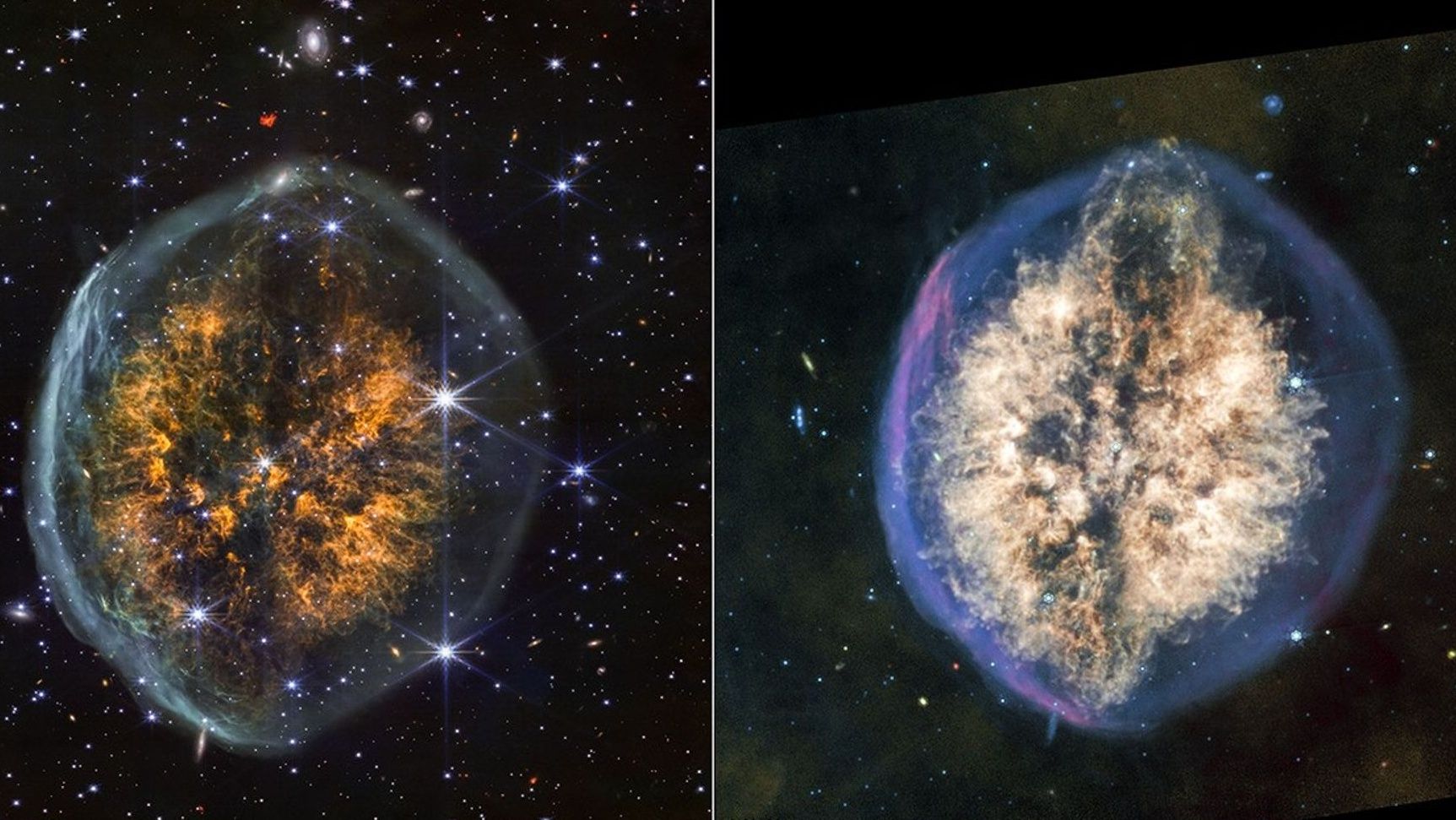
The James Webb Space Telescope’s latest imagery is its most “cerebral” yet, capturing a dying star’s nebula that looks uncannily like a brain inside a transparent skull.
Located about 5,000 light-years away in the constellation of Vela, the Sails, the nebula is officially called PMR 1. It is named after the astronomers who discovered it — Parker, Morgan and Russell — while conducting a survey with the 1.2-meter U.K. Schmidt Telescope at the Australian Astronomical Observatory in the late 1990s. When the Spitzer Space Telescope observed PMR 1 in infrared light in 2013, the nebula’s appearance led to its unofficial nickname of the “Exposed Cranium Nebula.”

That outer shell is thought to have been expelled from the star at the center of the nebula first, and that shell has cooled down considerably compared to the complex mix of various ionized gases within the interior that were emitted later.
A curious split down the middle of the nebula looks like it is dividing the brain into left and right lobes. This split could have been blown by polar jets from the dying star. This hypothesis is supported in the MIRI image where the ionized gas can be seen spewing out through the hydrogen envelope at the top of the picture. If the split was produced by a jet, it gives some indication as to the orientation of the star relative to the nebula.
The big question though is the nature of the central, dying star. When it was discovered in the 1990s, the nebula’s emission features looked like they belonged to a Wolf–Rayet star, which is one of the more extreme breeds of massive star. Wolf–Rayet stars are so unstable that they shed mass at a tremendous rate, blown away by a wind of radiation many times more powerful than the sun‘s solar wind. This expelled matter then forms a Wolf–Rayet nebula before the star itself eventually explodes as a supernova.
However, the presence of a Wolf–Rayet star inside PMR 1, or indeed inside its cousin PMR 2 that was discovered at the same time, has yet to be confirmed.
This leaves the door ajar for the possibility that the Exposed Cranium is actually just an ordinary planetary nebula produced by a less massive sun-like star that has expanded into its red giant phase and is now casting adrift its outer envelope to eventually leave behind its inert core in the form of a white dwarf.