
Jack Vettriano never made any bones about what it was that inspired him as an artist.
‘I want to paint attractive women, I don’t give a damn about the men,’ he once told me. ‘I will spend half an hour putting a seam on to a stocking and two minutes on a man’s face.
‘I want to paint the things that touch me, that move me, because they are me. I know my priorities.’
Vettriano, whose death at the age of 73 was announced yesterday, first became fascinated by the female form as a teenager. The numerous liaisons that followed would inform his life’s work.
These included relationships with a number of his models and muses, as well as an admission that he had, in the past, frequented brothels and downmarket bars to ‘research’ his art.
The details of those assignations resonated through his paintings – the big beehive hair, the red lipstick, the cigarettes, the stockings and suspenders and sense of sexual tension.
Ironically, it is a picture of a very different nature for which Vettriano will forever be remembered, one which turned this Scottish miner’s son into Britain’s most popular artist.
Called The Singing Butler it depicts an elegant couple dancing on a storm-swept beach accompanied by their maid and umbrella-wielding butler.

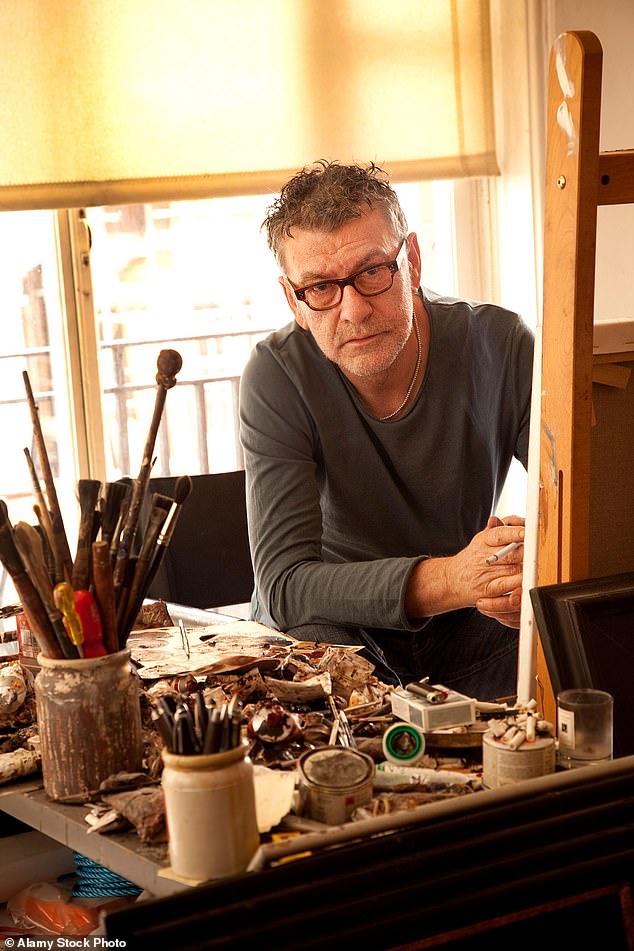
Jack Vettriano in his London studio in 2010

Vettriano at a Clarence House reception hosted by Queen Camilla, then Duchess of Cornwall

Vettriano at Bonhams auction house in Edinburgh with his painting An Unexpected Guest
It was painted in 1992 in the very early days of his professional career, only for it to be rejected by the Scottish Arts Council and by the Royal Academy for its summer exhibition.
Little more than a decade later, it was auctioned by Sotheby’s in Edinburgh. After fierce bidding, it finally sold for a staggering £744,800, the highest price ever paid at auction for a Scottish painting.
The sale and the image’s use on everything from biscuit tins to birthday cards would ignite the debate surrounding Vettriano’s worth as an artist. On one side were large sections of the art establishment, disdainful of his craft and the ‘sleazy’ subject matter of many of his paintings.
As Richard Calvocoressi, the former head of the Scottish National Gallery of Modern Art, once wrote: ‘We think Vettriano an indifferent painter and he is very low on our priorities.’
On the other were the collectors, who include the likes of Jack Nicholson and Sir Alex Ferguson, and the general public who so love Vettriano’s work that his prints outsell those by Van Gogh, Dali and Monet.
More fuel was added to the fire when a newspaper announced it had discovered an art manual from which Vettriano had ‘copied’ a number of figures in his most famous work.
It was then, in 2005, that I first met the painter. Determined to defend his reputation from the art world’s criticisms, he invited me to his Art Deco apartment in the South of France to interview him for the Daily Mail.
There he defended the work, saying: ‘What I do is not cutting edge, it is not pushing back any boundaries. It pleases me and fortunately it also pleases other people. I do not apologise for The Singing Butler, far from it. I think to have been able to do that, to have been able to create an iconic image from a £17 manual, deserves a wee bit more than scorn.’

Vettriano’s The Singing Butler became a bestselling image in Britain

Vettriano’s The Billy Boys, one of his most famous paintings

Vettriano’s exhibition A Retrospective in Glasgow
But it was clear from that meeting and from interviews I conducted with him for a subsequent book how much the controversy and criticisms had stung him.
Because while his popularity brought him financial success – at his peak he was earning royalties of £500,000 a year – I sensed it never entirely made up for the lack of critical acclaim.
Naturally tending to melancholia, he also battled cocaine and alcohol abuse for many years. ‘If a critic writes I am someone who just “colours in” and that I shouldn’t be an artist, well, then, you would have to be sub-human not to be affected by that,’ he admitted.
‘I know I am supposed to be Britain’s most popular artist but that is with the public. I am Britain’s most unpopular artist with the critics. And maybe you can never have it both ways.’
Born in 1951, Vettriano was the second of four children born to Bill and Catherine Hoggan in a mid-terrace Coal Board house in Methilhill on Scotland’s east coast.
Life was short on creature comforts – ‘another cup of water in the soup’, was his father’s cry whenever he learned his wife was pregnant again – and there was never any expectation that Jack would do anything other than find a trade. Aged ten, his family moved to nearby Leven, a popular holiday destination that would shape his view of women.
‘In those days women all wore stockings and you could be guaranteed if you went out you would get a glimpse of a stocking top,’ he said. ‘That did for me… I spent the age of ten to about 13 on my knees, desperate to catch a glimpse. Then there were the working girls who used to hang around the Innerleven Hotel.
Me and a friend would wait around, looking at them all dressed up in that very cheap way. I believe that the things that move you when you go into puberty never quite leave you.’
Vettriano left school at 15, and an apprenticeship as a mining engineer and a number of short-lived jobs followed.
Then, aged 22, he dated a schoolteacher who encouraged him to study at college and also gave him a set of poster paints.
For the next two decades Vettriano practised copying other artists, starting with the Impressionists, moving on to the likes of Picasso and Dali.
During that time he moved between a number of white-collar jobs and married Gail Cormack, a local girl from Kirkcaldy.
But as the years passed Vettriano became disillusioned with his middle-class lifestyle and started to devote all his spare time to painting work of his own.
He adopted a variation of his mother’s maiden name and in 1988 submitted two small paintings to the Royal Scottish Academy’s summer exhibition in Edinburgh. One was of a man moodily leaning against a pillar in a ballroom, the other of a woman in a white slip. Both sold within minutes.
‘I remember going back home on the train that evening and thinking: “If you like that kind of work, I’ve got plenty more where that came from,”’ he said.
Vettriano started painting for 16 hours a day, stopped socialising and his marriage collapsed. In 1990 he moved to Edinburgh. It was a particularly hedonistic time, with regular visits to sauna parlours and prostitutes.
Solo exhibitions followed, as did representation by a leading London gallery. Vettriano started to spend more and more time in the English capital, buying an apartment close to Harrods. He also later bought a property in Nice.
In large part his success was fuelled by his decision in 1995 to allow his works to be reproduced. He thought the move might bring in a couple of thousand pounds a year but the prints, posters, cards and coffee mugs proved hugely popular and saw him dubbed ‘The People’s Painter’.
Then came the sale of The Singing Butler and the controversy that surrounded it. As he told me at the time, all he did was what artists have always done, ‘foraging’ for material from which to work from.
One such source was The Illustrator’s Figure Reference Manual, bought from a bookshop in Edinburgh. He turned to it for inspiration when he came up with the idea for The Singing Butler.
‘I wish I could say that there is some terribly romantic tale behind the painting but there isn’t,’ he said. ‘At the time I was having an exhibition in Perthshire and this old lady who had seen a painting I had done of this guy digging for bait on a beach said: “You know, son, you’re very good at doing beaches.” ’
Recognition would follow, if not from the art world, in the shape of an OBE for services to visual arts.
Vettriano struggled with ill-health later in life but he continued to paint. At the age of 70 he revealed that he had not one but two new female muses, Eastern Europeans aged 38 and 42.
According to his publicist, Vettriano’s body was found at his apartment in Nice on Saturday. There are said to be no suspicious circumstances.
Paying tribute to him, Scottish First Minister John Swinney said: ‘I am very sorry to hear that one of Scotland’s best-known artists, Jack Vettriano, has died, and I want to express my deepest condolences to his family.
‘Jack made a unique and evocative contribution to artistic life in Scotland.’
How history views his work, only time will tell. But as Vettriano himself observed, if you can’t please everyone, pleasing lots of people isn’t a bad start.