


The Iran war spiraled on Tuesday as the US and Israel launched a fresh bombing raid on the capital Tehran.
Israel warned civilians in Persian to evacuate the Hakimiya Industrial Zone and the area around Payam Airport in Karaj, where they were striking military targets.
The announcement followed an overnight barrage the Israelis said had destroyed key government and security compounds in Tehran.
Multiple US embassies across the region were on high alert after attacks on consulates in Saudi Arabia and Kuwait.
The State Department ordered the evacuation of non-emergency personnel and family in Kuwait, Bahrain, Iraq, Qatar, Jordan and the UAE.
The US urged citizens to leave more than a dozen Middle Eastern countries, but with much of the airspace closed many remained stranded. A government source said more than a million Americans are believed to be in the region.
Donald Trump warned ‘the big one is coming’ and that ‘the big wave hasn’t even happened.’
The US Embassy in Saudi Arabia sent out a security alert shortly after 8am EST warning of ‘imminent’ missile and drone attacks over the city of Dhahran, a major center for the oil industry and the headquarters of Aramco.
‘Do not come to the US Consulate. Take cover immediately in your residence on the lowest available floor and away from windows. Do not go outside,’ the warning said.

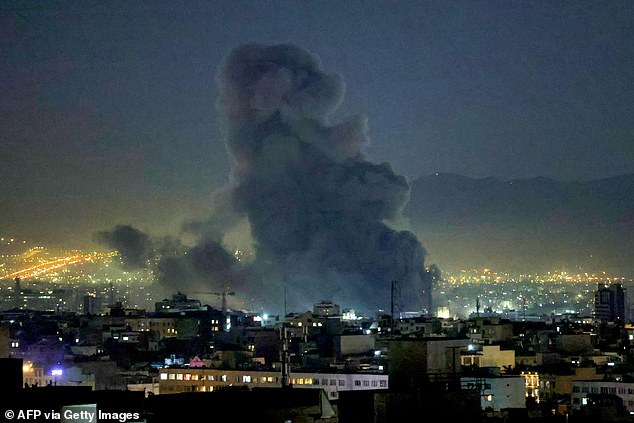
Smoke plumes rise following missile strikes in Tehran on March 1

This image provided by U.S. Central Command shows a F/A-18E Super Hornet launching from the USS Abraham Lincoln (CVN 72) in support of Operation Epic Fury on Monday

Smoke rises from an area in the direction of Al Udeid Air Base, which houses the Qatar Emiri Air Force and foreign forces including the US

This US Navy handout photo released by US Central Command public affairs shows an F-35C Lightning II, attached to Marine Fighter Attack Squadron (VMFA) 314, being staged for flight operations on the flight deck of Nimitz-class aircraft carrier USS Abraham Lincoln (CVN 72) in support of Operation Epic Fury on March 2

This US Navy handout photo released by US Central Command public affairs shows the Arleigh Burke-class guided-missile destroyer USS Thomas Hudner (DDG 116) firing a Tomahawk land attack missile in support of Operation Epic Fury on March 1

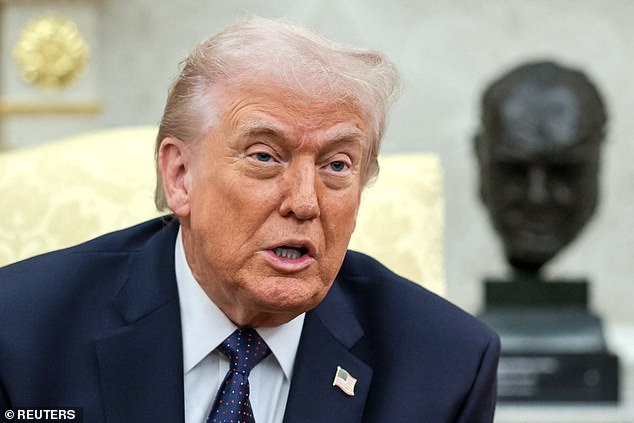
Donald Trump speaks during a Medal of Honor ceremony in the East Room of the White House in Washington on Monday
Iran has also launched drone attacks on America’s largest Middle East base and warned ‘the gates of hell will open.’
The Islamic regime’s army said Tuesday its forces were launching attacks on Al Udeid Air Base in Qatar, which hosts up to 10,000 troops and serves as the main forward headquarters for US Central Command. There were no immediate reports of any casualties or damage to the base.
The war has rapidly engulfed the region, with Iran launching hundreds of drones at Israel, US bases, and Arab allies Saudi Arabia, Bahrain and the UAE.
Trump hit out at reports the US is running low on anti-drone missiles, insisting America has ‘unlimited mid to upper tier weaponry.’ The President declared Iran’s military and leadership ‘is gone’ and that Tehran was requesting talks. ‘Too late,’ he wrote on Truth Social.
But the Iranians are vowing to continue the fight. Ali Mohammad Naini, of the Islamic Revolutionary Guard Corps, told Iranian state TV: ‘The gates of hell will open more and more, moment by moment, upon the United States and Israel .’
The warning came after the Riyadh embassy was closed following an overnight two-drone attack that sparked a ‘limited fire,’ Saudi Arabia’s Defense Ministry said, with Americans urged to avoid the compound.
It followed an attack on the US Embassy in Kuwait, which announced it had been closed until further notice.
US-Israeli strikes have killed at least 787 people, the Iranian Red Crescent Society said. Iranian missiles struck several locations inside Israel, killing 11. Hezbollah, the Iranian-backed militant group, has also launched attacks on Israel, drawing retaliatory strikes that killed 52 people in Lebanon.
The US military has confirmed six deaths of American troops. Three people were killed in the UAE, and one each in Kuwait and Bahrain.
Trump initially said the war would last four to five weeks but has since warned it could go on ‘far longer.’
The war has severely disrupted the world’s supply of oil and gas, international shipping, and air travel.
Oil surged after Iran ordered the Strait of Hormuz – through which a fifth of the world’s crude flows – closed. US regular gasoline prices hit $3.11 per gallon on Tuesday, up from just under $3 at the start of the week, the American Automobile Association said.
Israel deployed ground troops in Lebanon as the conflict broadened into its fourth day.
Trump’s objectives remain unclear. JD Vance told Fox News last night the goal was the extinction of Iran’s nuclear capabilities, while Trump himself initially urged Iranians to overthrow their government after US-Israeli strikes killed Supreme Leader Ayatollah Ali Khamenei on Saturday.
Join the debate
Do YOU think regime change is the real objective?

This US Navy handout photo released by US Central Command public affairs shows the Arleigh Burke-class guided-missile destroyer USS Thomas Hudner (DDG 116) firing a Tomahawk land attack missile in support of Operation Epic Fury on March 1

This US Navy handout photo released by US Central Command public affairs shows an F/A-18E Super Hornet, attached to Strike Fighter Squadron (VFA) 151, preparing to make an arrested landing on the flight deck of Nimitz-class aircraft carrier USS Abraham Lincoln (CVN 72) in support of Operation Epic Fury on March 2

This US Navy handout photo released by US Central Command public affairs shows the Arleigh Burke-class guided-missile destroyer USS Thomas Hudner (DDG 116) firing a Tomahawk land attack missile in support of Operation Epic Fury on March 1

This image provided by U.S. Central Command shows Navy sailors looking over ordnance on the flight deck of the USS Abraham Lincoln (CVN 72) in support of Operation Epic Fury on Monday, March 2

This partially redacted image from video provided by U.S. Central Command shows a complex of structures in Iran being struck by missiles fired by U.S. forces on Sunday

A video released by Central Command showing B-2 bombers after they struck nuclear facilities in Iran

This image provided by U.S. Central Command shows a F/A-18E Super Hornet preparing to launch from the USS Abraham Lincoln (CVN 72) in support of Operation Epic Fury on Monday

This US Navy handout photo released by US Central Command public affairs shows an F/A-18E Super Hornet, attached to Strike Fighter Squadron (VFA) 151, preparing to launch from the flight deck of Nimitz-class aircraft carrier USS Abraham Lincoln (CVN 72) in support of Operation Epic Fury on March 2
Since then, however, senior administration officials have said regime change was not the goal. Trump’s initial announcement of the strikes listed several grievances, from concerns about Iran’s nuclear and missile programs to its leadership.
Across Iran’s capital, explosions rang out throughout the night into Tuesday, with aircraft heard overhead. Strikes caused two explosions at a broadcasting facility in Tehran, Iranian state TV said, adding that no one was injured.
The United Nations’ nuclear watchdog, the International Atomic Energy Agency, said Iran’s Natanz nuclear enrichment site had sustained ‘some recent damage,’ though there was ‘no radiological consequence expected.’
The US hit Natanz during the 12-day war in June, when Israeli and American strikes greatly weakened Iran’s nuclear program.
Israeli Prime Minister Benjamin Netanyahu maintained, however, that Iran was rebuilding ‘new sites, new places’ underground for making atomic bombs. He offered no evidence to support his claim.
‘We had to take the action now and we did,’ Netanyahu told Fox News Channel’s Hannity.
Iran has said it has not enriched uranium since June, though it has maintained its right to and says its nuclear program is peaceful.
Satellite photos showed limited activity at two Iranian nuclear sites before the war began, with analysts saying Tehran was likely assessing damage from the 2025 strikes and salvaging what remained, the Associated Press reported.

The exposed interior of a heavily-damaged building is pictured near Ferdowsi square in Tehran on March 3

This US Navy handout photo released by US Central Command public affairs shows US Sailors observing as an E-2D Hawkeye aircraft, attached to Airborne Command and Control Squadron 124, approaches an aircraft catapult to launch from the flight deck of the world’s largest aircraft carrier, USS Gerald R. Ford (CVN 78), while operating in support of Operation Epic Fury, on March 1

A woman reacts on the street following an Israeli and U.S. strike on a police station, amid the U.S.-Israeli conflict with Iran, in Tehran, Iran, March 3

Birds fly as smoke rises in the Fujairah oil industry zone following a fire caused by debris after interception of a drone by air defenses, according to the Fujairah media office, amid the U.S.-Israel conflict with Iran, in Fujairah, United Arab Emirates, March 3

Security personnel conduct a search after a projectile hit the area of Petah Tikva in central Israel on March 3

Emergency personnel work at the site of an Israeli strike on Beirut’s southern suburbs, following an escalation between Hezbollah and Israel amid the U.S.-Israeli conflict with Iran, Lebanon, March 3
The breadth of Iranian retaliation across the Gulf, the ferocity of US-Israeli strikes, Khamenei’s killing and the absence of any exit plan all pointed to a prolonged conflict.
Iran has hit many countries deemed safe havens in the Mideast in retaliation for the U.S.-Israeli strikes. Recent targets included two Amazon data centers in the United Arab Emirates and one in Bahrain. The centers in the UAE were hit, while a drone struck near the one Bahrain, causing damage, the company said.
Qatari Foreign Ministry spokesman Majed Al Ansari vowed that Iranian attacks on the gas-rich country ‘will not go unanswered.’
The conflict has spread to Lebanon, where Hezbollah fired missiles at Israel on Monday, prompting Israel to retaliate.
On Tuesday, the Israeli military said it had moved additional troops into southern Lebanon and taken new positions on several strategic points close to the border.
Israel also hit Beirut with more airstrikes, saying it was targeting ‘Hezbollah command centers and weapons storage facilities.’ Explosions could be heard and smoke seen in a southern suburb of Beirut.
Lebanon’s state-run National News Agency said the Lebanese army was evacuating some of its border positions. A senior Hezbollah official, Mohamoud Komati, said the group now had no option but to fight Israel.