

Last Sunday evening my to-do list for the week loomed large like an assault course. Deadlines. Dirty washing. A broken-down car to manage without. A missing black bin to find. An orthodontist appointment to get to in the middle of parents’ evening.
Still, as I lay in bed, mind whirring, wondering how many balls I was destined to drop, I knew there was one area in which I could excel: sleeplessness.
My insomnia kicked in 30 years ago, when I was 17 and sitting my A-levels. Tossing and turning at 3am, I saw the future I’d studied so hard for crumbling simply because my brain couldn’t get the rest it required. The more I tried to nod off, the more futile my efforts became.
Come dawn, things didn’t seem quite so bleak, although I still maintain that my fourth consecutive night of next-to-no sleep – by which stage I was so delirious I could barely see my exam paper, let alone weigh up the intricacies of Italian unification – cost me my A grade in history.
And after that, every major event, from finals to job interviews and flat-hunting, left me lying awake half the night, terrified that the resulting tiredness would scupper my success. Before long, I stopped sleeping over the minor events, too: dates, parties, meetings… life.
The 24/7 demands of early motherhood didn’t help. Nor have perimenopausal hormones that leave me pacing the bathroom anxiously at 4am, wondering if there’s any point going back to bed at all. Or the infuriating and constant reminders that sleep is integral to every aspect of our wellbeing, from our weight to cognitive function.
Last week research in the British Medical Journal of Open Diabetes Research and Care found seven hours, 19 minutes and 12 seconds was the optimal amount to reduce risks of cardiovascular disease, diabetes and premature death. Strangely, the prospect of kicking the bucket because I can’t sleep doesn’t help the process.
We’ve become so obsessed with rest that more than two in five adults now monitor their sleep habits with eye-wateringly expensive wearable technology such as Oura rings or smartwatches.

On a good night’s sleep I am positive, kind and capable, writes Antonia Hoyle. But after a bad night I am selfish, paranoid and unable to stop eating Snickers bars, she says

Research in the British Medical Journal of Open Diabetes Research and Care found seven hours, 19 minutes and 12 seconds was the optimal amount to reduce various ailments
A study yesterday, however, found these can be counterproductive, with a third of respondents obsessed with hitting targets and a quarter of those surveyed admitting tracking their sleep kept them up at night.
I’m not surprised. I’ve deliberately avoided trackers like the plague, the pressure to ‘do well’ a guarantee I’d be up all night.
Most of us struggle to sleep during stressful periods. But I believe there’s more to my wakefulness than external factors.
Research has found that more than half of the risk of insomnia can be explained by genetics, and my mum, 78, and brother, 49, are insomniacs, too.
‘How much did you get?’ we invariably ask when we convene. ‘I was reading until 5am,’ Mum might say, putting a positive spin on things. My brother emanates a more familiar sense of helplessness and frustration when he shakes his head and says: ‘None.’
We all report the same inability to stop thinking at night, as if there’s a switch in our brain we can’t turn off.
Over the years, I’ve learnt to manage it like a condition. On a good night’s sleep I am positive, kind and capable. After a bad night – and that means less than four hours’ sleep, which might happen twice a week – I am selfish, paranoid and unable to stop eating Snickers bars.
And, while I’m cynical about so-called miracle cures, and sleep trackers aside, I’ve tried almost every trick in the book – with varying degrees of success.
I think I’ll always have the odd night staring at the ceiling in tears at 3am. But, over time, I have learned to fall asleep faster, for longer, and worry about sleeping less. Here’s what has worked for me – and what hasn’t…
Alcohol
Given my insomnia seems to stem from overthinking, drinking until I couldn’t remember my name held a certain appeal in my 20s, after which I’d pass out the moment my head hit the pillow.
Problem solved? Hardly. Although alcohol is a sedative, it also raises levels of the stress hormone cortisol, causing wakefulness later in the night.
I can’t recall one occasion when I have been drinking and haven’t woken between 2am and 4am, convinced the end of the world is coming – and I rarely get back to sleep.
Score: 0/5
Sobriety
The less I drink, the better I sleep. Feeling burnt out and – well, tired – I stopped altogether for two years aged 43, and during that time fell asleep faster, felt more refreshed and developed a new confidence in my body’s ability to function.
When I started drinking again, I realised any amount of alcohol impacted my sleep.
A study in the journal JMIR Mental Health found just one drink could reduce sleep quality by 9 per cent. Now, I avoid booze as much as possible, especially after 8pm. 5/5
Valerian
A herbal supplement I bought from Holland & Barrett from the root of the Valeriana officinalis plant, valerian may increase availability of the calming neurotransmitter GABA in the brain.
I tried this in my 20s and, although there’s a bit of evidence it can help people fall asleep quicker, it did nothing for me. 0/5
Zopiclone
When I was in my 30s, mother to a baby son and toddler daughter, even crossing the road felt fraught with danger.
I became so manically tired that I was worried my lack of sleep was jeopardising their safety. My GP prescribed zopiclone, a sedative-hypnotic medication that enhances the effect of GABA. Within minutes of swallowing a tablet – my husband on childcare duty – I was asleep.
The fact that I felt like I’d been run over by a freight train for the first few hours of the next morning was a small price to pay for a full night’s shut eye.
The effect was transformative – but ultimately a deterrent. If I grew too reliant on an addictive drug to help me sleep, how would I ever manage without it?
For immediate sleep: 5/5
As a long-term solution: 0/5
Herbal tea
Just makes me need to wee overnight if drunk after 9pm. Ditto hot chocolate and Ovaltine, which have the additional effect of raising blood sugar and further jeopardising sleep. 1/5
Nytol One-A-Night
A sporadic crutch since I was at university, Nytol tablets contain the antihistamine diphenhydramine, which does make me drowsy and sometimes sends me to sleep.
It’s affordable (£9 for 20 tablets) and research has found it can ‘significantly’ improve sleep latency (the time it takes to fall asleep) in mild insomniacs.
It makes me sluggish the next morning, but knowing it’s in my bedside table if needed is a comfort. 3/5
Counting sheep
After making it to 300 one night, I wondered: why? 1/5
Cognitive shuffle
I learned this mind game in 2024, after it received 8.7 million views on TikTok.
Coined by Canadian scientist Luc Beaudoin, the premise is that scrambling our thoughts with random mental imagery switches off the racing mind that stops us falling asleep.
You think of a word – ‘postman’, say – then come up with as many different objects as you can that begin with the first letter, before moving on to the second letter and doing the same again, and so on.
The idea is that the surreal mental reel of images tells the brain it’s time to stop fretting about our tax return and switch off. It worked well at first, and still helps occasionally. 3/5
Lavender pillow spray
Useless. Same goes for scented lotions that claim to help. 0/5
Spare room
Several nights a week, between midnight and 2am, I’ll up sticks to the spare room I’m lucky to have.
A change of scene resets my attempt to sleep and stops me feeling trolled by my husband, who has a stressful job in finance and yet can take one last look at the share prices, put his phone down, roll over and zonk out. 4/5
Melatonin
Prescription-only in the UK, melatonin is a naturally-occurring hormone which regulates our circadian rhythm.
One analysis found melatonin increased overall sleep time by an underwhelming eight minutes – but I still asked my husband to bring me back a supply from the US, where it can be bought over the counter.
I sucked a strawberry-flavoured melatonin gummy before bed every evening for five months, deluding myself it was helping while enjoying the licence to eat sweets at 10pm. When a large observational study published last November found people who took melatonin for 12 months or longer had a higher incidence of heart failure, I stopped. 2/5
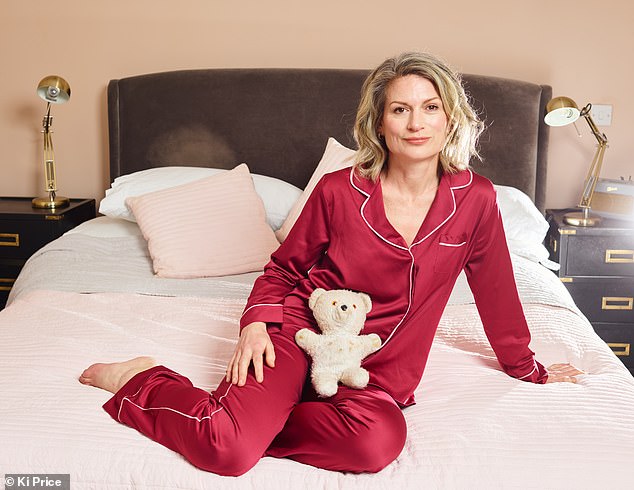
Sleeping with my childhood teddy
Yes, I sound like a lunatic, but the periods I have slept with the bear I’ve owned since I was a baby have broadly coincided with better sleep. It’s lonely lying awake at night, and having someone (OK, something) to hold soothes my nervous system, boosting the chances of sleep. One study found college students who held a stuffed animal in group therapy could comfort themselves better. 3/5
Mindfulness
A practice in which you learn to be present and acknowledge your thoughts, without becoming overwhelmed by them, mindfulness was found to have a ‘moderate to large’ effect on ‘treatment-resistant insomnia patients’ after six months in the journal Frontiers in Sleep.

Focusing on my breath for 20 minutes as I allow uncomfortable emotions to emerge, then pass like clouds overhead, helps slow my racing mind in the evenings, says our writer
I was won over in 2023 after interviewing Mark Williams, emeritus professor of clinical psychology at Oxford University, and meditation teacher and journalist Dr Danny Penman, co-authors of the brilliant Deeper Mindfulness.
Focusing on my breath for 20 minutes as I allow uncomfortable emotions to emerge, then pass like clouds overhead, helps slow my racing mind in the evenings.
I do this on the sofa, listening to Williams’ audio recordings from Deeper Mindfulness, which you can access using a QR code in the book. You can also use the skill in bed to relax.
Mindfulness isn’t a quick fix – you need to train to reap the benefits, and lately I’ve been too busy to commit. 5/5
Cognitive behavioural therapy
This is the NHS’s gold standard, first-line treatment for insomnia and involves identifying and challenging unhelpful thoughts such as ‘I’m a failure if I can’t sleep’. It’s said to help 70 to 80 per cent of insomniacs, but I tried it in my 20s and it did not lead to better sleep. 2/5
Keeping my phone out of my bedroom
Two years ago I bit the bullet, bought an alarm clock and started leaving my smartphone in the kitchen overnight. Without its constant, insidious distraction, my stress levels fell and I have slept better, on average, since. A no-brainer for insomniacs. 5/5
Writing down my thoughts
Keeping a notebook and pen by my bedside so I can write down my next day’s schedule helps declutter my mind.
A study in the Journal of Experimental Psychology: General found five minutes of writing a detailed to-do list before bed helped people fall asleep ‘significantly faster’ than those who wrote a list of things they had already done, which tallies with my experience. 4/5
Magnesium supplements
When I immediately started falling asleep quicker after taking a magnesium supplement (£12.95 for a two-month supply from Amazon) last year, I wondered if I’d found a miracle cure.
A mineral that helps modulate the nervous system, regulate production of the stress hormone cortisol and potentially support the production of melatonin, magnesium supplements are all the rage on social media among fans of actress Gwyneth Paltrow and singer Taylor Swift, both of whom have talked about using them.
But the evidence is limited that the supplements can actually improve sleep by any tangible quality, and after a few months, I noticed the benefits dwindled. I suspect the placebo effect was as helpful as the magnesium. 3/5
Exercise
My lifelong fitness habit, I sometimes think, is the main thing standing between me and insanity. Exercise lowers stress and physically exhausts me, leading to improved sleep.

Studies have found weight training leads to marginally longer sleep duration and better sleep quality than cardio
But exercising as soon as I wake – I’ve been doing a combination of weights and cardio (spinning and running) for 30 minutes to an hour – has made it more effective still for me. Now, my body seems to recognise when it’s supposed to feel awake.
Though studies have found weight training leads to marginally longer sleep duration and better sleep quality than cardio, I can’t say I notice a difference.
What does help is hauling myself out of bed to exercise even if I’ve hardly slept – the feel-good endorphins released from working out always counter the despair caused by sleep deprivation. 5/5
A lunchtime walk
No matter the weather, I try to walk our dog every lunchtime. Both the exercise and exposure to daylight, which helps regulate our circadian rhythm, help. When I don’t have time, I sleep noticeably worse as a result. 5/5
Reading
Just as a study in the journal Trials found that 42 per cent of participants who read before bed for a week reported improved sleep quality, reading helps me too, although I would caveat that by saying Lee Child levels of excitement don’t lend themselves to nodding off as much as a dry tome on philosophy.
Research suggests that print books are more likely to improve sleep than e-readers, which of course emit light, but I find a Kindle works best, allowing me to close the gadget when I’m drowsy rather than faff around switching off a bedside light. 4/5
A low-sugar, high-fibre diet
Simple midlife dietary changes, such as swapping the honey in my breakfast yoghurt for cinnamon and adding kidney beans to my salad at lunch, have definitely helped.
A study of 77,860 women in The American Journal of Clinical Nutrition found a diet high in refined carbohydrates (white bread, white pasta, pastries, biscuits) was linked to an 11 per cent higher likelihood of sleep problems and a 16 per cent higher risk of developing insomnia over three years.
Of course, after a bad night, the Snickers come out. But they’re fewer and farther between now, so I cut myself some slack.
After all, worrying about sleeping, as every insomniac knows, is the biggest obstacle of all. 5/5