


Recently in the news, it has come to light that LG Display’s development of 8K TV panels has been put on ice (via FlatpanelsHD). For those keeping tabs on the television set market, this comes as no great surprise: TLC gave up on its 8K ambitions back in 2023, and, likewise, Sony kicked the 8K bucket in 2025.
With LG now also bowing out of the 8K TV market, this leaves Samsung Display as the only major player in the space — an industry position I reckon will prove untenable in the long run. Samsung has been shipping 8K flat panels since 2018, but how much longer before its operation bites the dust in the same vein as its competitors?
The era of 8K is still a ways away
8K isn’t ready for prime-time television

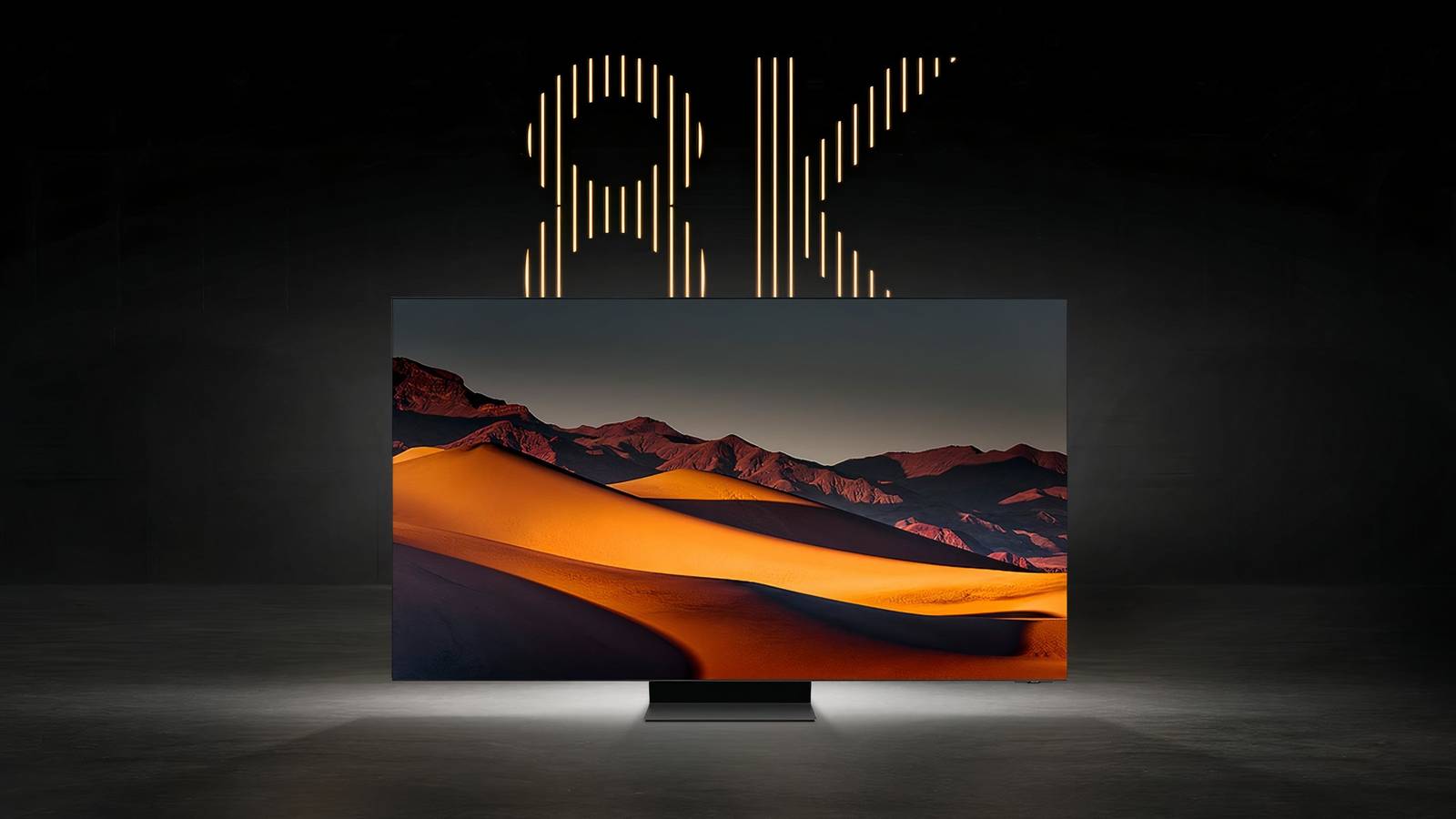
The harsh, brutal truth of the matter is that 8K televisions don’t make sense in 2026, and it all boils down to this one impermeable factor: there are essentially no mainstream streaming services, cable or satellite packages, or optical disk media formats that support the full 7,680 x 4,320 pixel resolution of the 8K UHD standard.
The sheer sharpness of 8K is technically impressive, to be sure, and as someone who’s visually sensitive to low-res displays (fifteen minutes on a VGA monitor is enough to give me a tension headache), I always welcome each and every additional pixel I can get my hands on across all my devices. That being said, without the content to go alongside it, all that extra resolution may as well be locked behind an inaccessible paywall.
8K’s problem isn’t a technological one — it’s a pragmatic one.
There are a variety of reasons why we haven’t seen the proliferation of 8K video content quite yet, ranging from storage, bandwidth, and latency concerns, to source material conversion difficulties, cost, and the laws of diminishing returns (on consumer-sized display panels, the jump from 4K UHD to 8K UHD is far less profound than the transition from FHD to 4K UHD was, which itself was less noticeable than the switch from SD to HD was).
Ultimately, these hurdles have created a classic chicken-and-egg situation, where there’s no 8K multimedia content out there to justify the purchase of an 8K TV, and there’s no 8K TVs out on the market to justify the cost and effort of creating and distributing 8K content. 8K’s problem isn’t a technological one — it’s a pragmatic one.
At least 3D TVs were ambitious
I’d pick 3D over 8K any day of the week

In my opinion, the hype, release cycle, and subsequent wind down of 8K TVs draws undeniable parallels to two other historic television panel technologies: active shutter 3D and passive polarization 3D. Heavily pushed by the audiovisual industry in the wake of 2009’s smash-hit Avatar feature film, 3D TVs quickly became the high-tech equivalent to owning a plasma panel in 1997 or an OLED unit in 2007.
In retrospect, we all know how badly things went for the 3D TV market. Both a lack of available video content (sound familiar?) and cost played a role in the technology’s demise, though it also faced hurdles pertaining to suboptimal viewing angles, the need for clunky glasses, and the inducing of headaches and nausea in some viewers.
…I feel the 3D TV era was a far more memorable era of TV gimmickry than today’s fading 8K equivalent is.
Even with these issues in mind, I feel the 3D TV era was a far more memorable era of TV gimmickry than today’s fading 8K equivalent is. 3D TVs weren’t just sharper than their predecessors; Rather, they represented a fundamental paradigm shift in audiovisual fidelity. They were quirky, imaginative, and filled with character. In other words, viewing content in 3D conveys a sense of whimsy that 8K simply can’t measure up to.
In all honesty, I have my doubts about whether 3D and 8K will ever take off at the consumer level (though I’d love to be proven wrong). In the meantime, I’m perfectly content with the status quo of TV manufacturers refining the fundamentals like frame rate, blooming, color depth, HDR, burn-in reduction, and motion blur. And, looking further ahead, perhaps R&D budgets would be better spent on emerging new technologies like the fabled MicroLED of tomorrow.