



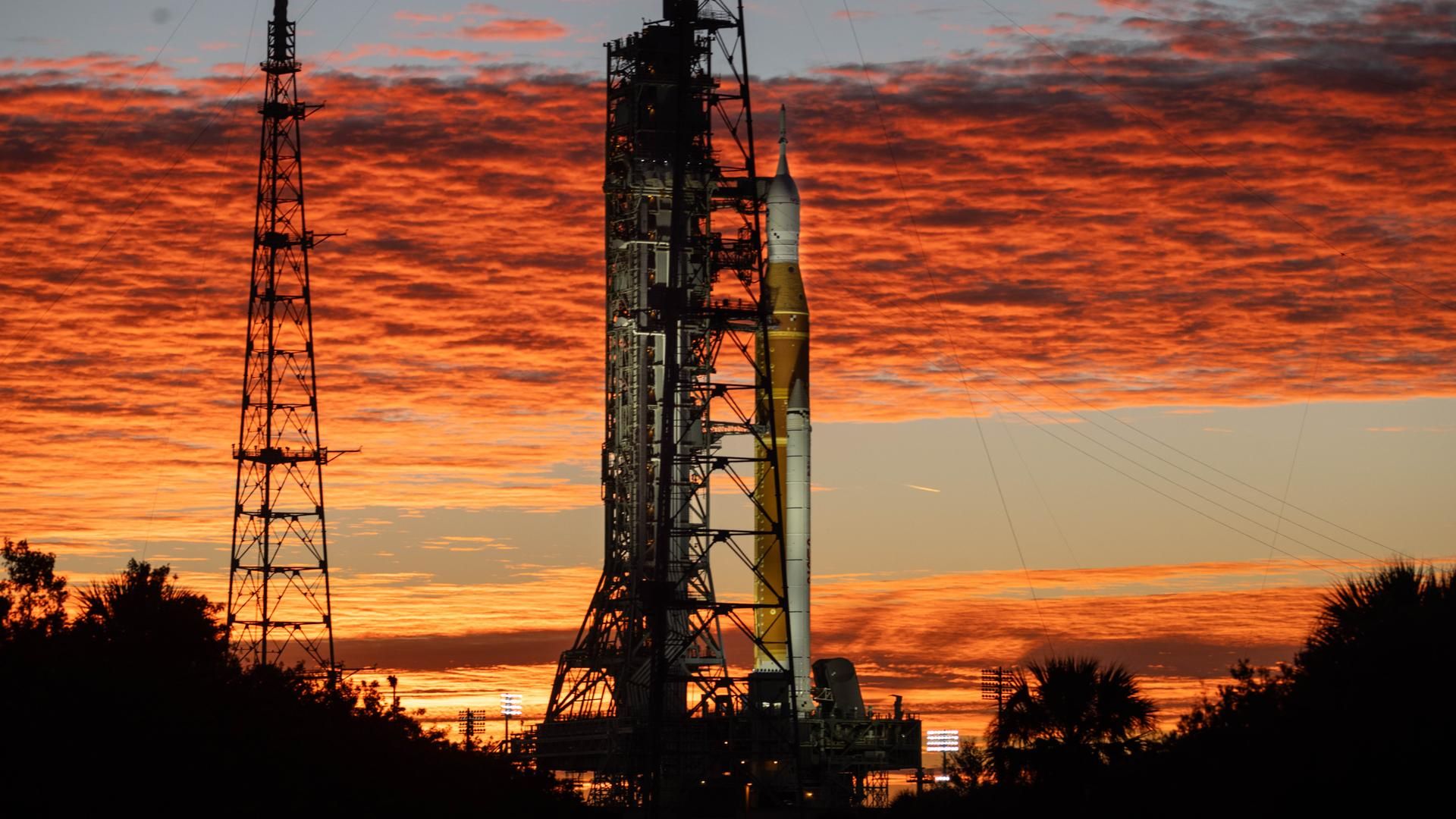
NASA’s Artemis 2 moon mission will put its astronauts in danger — but just how much danger is tough to say.
The agency announced on Thursday (March 12) that it’s targeting April 1 for the launch of Artemis 2, which will send four astronauts on a 10-day journey around the moon and back to Earth.
Article continues below
“I wouldn’t actually put a number on it,” Lori Glaze, acting associate administrator for NASA’s Exploration Systems Development Mission Directorate, said during a briefing on Thursday (March 12) following completion of the Artemis 2 flight readiness review.
Reporters repeatedly pressed Glaze and John Honeycutt, chair of the Artemis 2 mission management team, for numbers during that briefing. And a few did come up.
For example, Honeycutt noted that new rockets have historically launched successfully on their debut flights about 50% of the time. So that may have been the expectation for Artemis 1, the first flight of the Artemis program’s Space Launch System (SLS) rocket. (Artemis 1 was a success, sending an uncrewed Orion capsule to lunar orbit and back in late 2022.)
Human spaceflight programs that are launching regularly could probably expect a failure rate of about 2% — 1 in 50 — on their second or third liftoffs, Honeycutt added. But Artemis’ cadence isn’t exactly regular, given that there will be about a 3.5-year gap between the first and second missions if Artemis 2 does indeed get off the pad in early April.
“That basically means we’re probably not 1 in 50 on the mission going exactly like we want to, but we’re probably not 1 in 2 like we were on the first flight,” Honeycutt said.
“That’s what I would tell you,” he added. “I think we’re being really careful not to really lay probabilistic numbers on the table for this mission, just given the small amount of data.”
The range Honeycutt cited is consistent with numbers released recently by the NASA Office of Inspector General (OIG), in a report about NASA’s handling of its Artemis Human Landing System Contracts — awards given to SpaceX and Blue Origin to develop and operate crewed moon landers for the program.
In the report, which was posted online Tuesday (March 12), the OIG estimated that there’s a 1-in-30 risk of failure overall during a crewed Artemis mission to the lunar surface, and a 1-in-40 risk during the moon operations phase.
The OIG report also puts this risk threshold into context, comparing it to that of other NASA human spaceflight programs. For example, the relevant number is 1 in 200 for a 210-day commercial crew mission to the International Space Station — that is, one flown by SpaceX with its Falcon 9 rocket and Dragon capsule. (Boeing also holds a NASA commercial crew contract but has yet to fly an operational astronaut flight to the orbiting lab.)
The risk of crew loss during the Apollo moon missions was a rather frightening 1 in 10, according to the OIG report. And the managers of NASA’s space shuttle program, which flew from 1981 to 2011, “thought they were operating at a 1 in 100 loss of crew threshold, but years later determined the actual number was 1 in 10 for the early flights,” the OIG report reads.
Honeycutt’s reluctance to put a hard number on the Artemis 2 risk therefore makes a lot of sense. As that example from the space shuttle days shows, estimates made using scant data are likely to be imprecise and in need of future revision.

There are other complications as well, which are related to the relatively small sample sizes and diversity of dangers involved in human spaceflight.
“We have pursued loss of mission, loss of crew-type number assessments, but I’m not sure we understand what they mean,” Honeycutt said.
As an example, he explained that the agency’s modeling work identifies micrometeors and orbital debris (MMOD) as the biggest single risk to the human spaceflight enterprise.
“It’s real, right? But when have the last two bad events occurred? Going uphill, in that highly energetic event,” Honeycutt said, presumably referring to the space shuttle Challenger and Columbia accidents in 1986 and 2003, respectively, which killed a total of 14 astronauts. (Challenger exploded 73 seconds after liftoff, and Columbia broke apart during reentry due to damage the orbiter sustained during launch.)
“So, you know, we can fool ourselves sometimes into thinking, ‘Really? Is that the biggest risk to the mission — MMOD?'” he said.
Honeycutt seemed to realize that such admissions, valid and honest as they are, would probably spawn stories like the one you’re reading now. “Well, this oughta make for some good reading over the next few days,” he said with a smile, drawing laughter from the journalists in the room.