



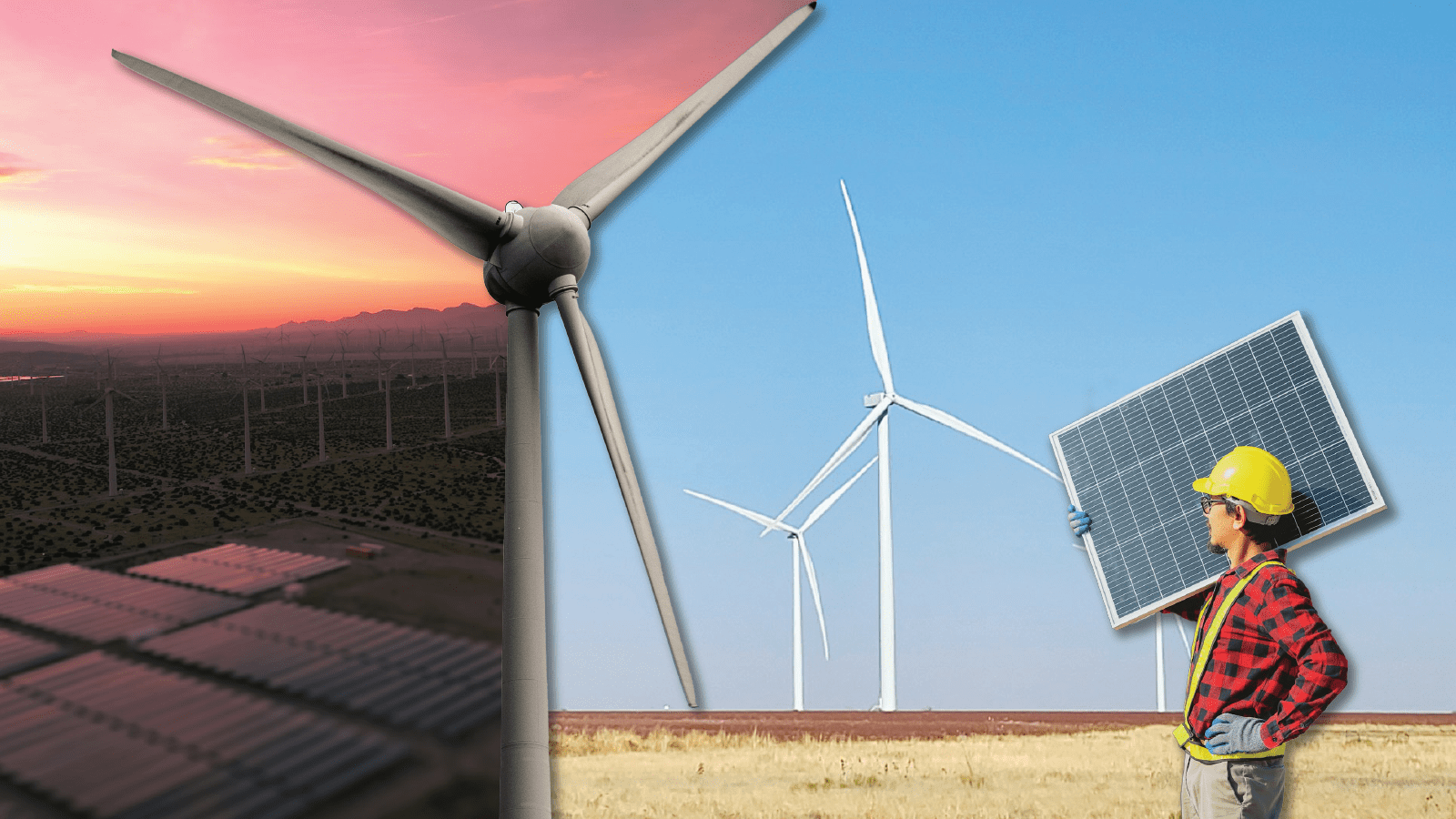
Despite their polar-opposite politics, California and Texas have achieved the same distinction: They’re both national leaders in producing renewable energy.
Wind and solar today account for 40% of power generation in California and 30% in Texas, well above the national average of 17%.
California and Texas alone account for more than one-third of the U.S.’s solar and wind power generation and over half of its battery storage capacity — shares that continue to grow.
The policy approaches used by California and Texas differ dramatically.
“California has used centralized state control to achieve lots of wind, solar, and storage, while Texas has accomplished the same outcomes via open-access and competitive choice,” said Beth Garza, senior fellow with R Street’s energy and environmental policy team and former director of the Electric Reliability Council of Texas Independent Market Monitor, in an email.
Both state governments have invested in power generation, but while California procured clean energy, “Texas created the Texas Energy Fund to provide low-interest loans and cash completion bonuses for new natural gas-fueled generation,” Garza added.
Rather than halt the growth of renewables, the expansion of natural gas in Texas came at the expense of coal. And all of the growth in electricity generation in both states over the past 15 years has been met by solar panels and wind turbines.
Simple dollars and cents continue to propel the expansion of renewable energy in the two states.
“The economics of solar and energy storage as new resources drive them to the top” in California’s state power purchases, said Brendan Pierpont, Director of Electricity at Energy Innovation, in an email. And in Texas’s free market system, “wind, solar, and energy storage are leading the way because they’re winners economically,” there as well, he added.
The biggest difference is that Texas uses a lot more energy, including more total clean energy, despite having a smaller population than efficiency-minded California.

The U.S. Energy Information Administration recently forecast that the U.S. will install a record-shattering amount of new power capacity in 2026, with solar panels and battery storage accounting for nearly 80% of those additions. Texas is expected to install 40% of that new solar capacity and 53% of the batteries, with California accounting for a further 6% and 14% of each, respectively.
Comparing the states’ energy policies
California established a renewable portfolio standard in 2002. This policy required that in-state utilities supply 20% of total electricity generation from renewables by the end of 2010. That standard was subsequently increased several times, most recently in 2018 to require that 60% of the state’s power be renewable in 2030, and 100% zero-carbon (including nuclear power and hydroelectricity) by 2045. California is on track to meet its goals if rapid in-state clean energy growth continues.
Texas established its own renewable portfolio standard in 1999, three years ahead of California, but with much more modest goals. Texas’ initial standard mandated that utility companies in the state add just two gigawatts of renewable power capacity by 2009, which amounted to less than 2.5% of the state’s total. That standard was later increased to 5.9 gigawatts by 2015, or about 4% of Texas’ total power capacity.
But in 2005, the Texas state legislature took a different tack by passing a law establishing competitive renewable energy zones. These were regions identified as having high potential for wind power but that required a network of electrical transmission lines to deliver those electrons to population centers. Between 2008 and 2019, Texas built 3,600 miles of transmission lines in these zones, which accounted for nearly one-quarter of all new transmission built nationwide during that period.
This policy proved prescient, as wind became the cheapest source of new power generation in the U.S. in 2011. The wind energy industry grew and thrived in Texas, which today generates more annual wind power than the next three states combined.

Everything is bigger in Texas – including energy bills
In part because it mandated solar and wind power before the costs of renewable energy fell below fossil-fueled alternatives, California’s electricity rates have long been somewhat higher than the national average. Conversely, in part because Texas’s competitive renewable energy zones created the conditions for wind energy production to grow once the technology became relatively cost-effective, the Lone Star state’s electricity rates have been below the national average since 2009. Texas also has more industrial activity than California, which translates to more power demand but also greater utilization of power plants, and more electricity customers, helping to keep rates lower.

But our energy bills don’t depend only on electricity rates; the cost also depends on how much we consume. And Californians’ average electricity bills remain slightly lower than the average Texan’s today, because the typical Californian simply uses much less electricity.
In California, “most residents live in mild climates that don’t require as much heating and cooling as compared to Texas,” said Carey King, research scientist and assistant director at the University of Texas at Austin Energy Institute, in an email. But the state’s energy efficiency programs have also played a big role.
“California invested heavily in efficiency, with incentives for appliance efficiency and strong building codes that more than helped offset growing demand,” Pierpont said.
California created the country’s first energy conservation standards for buildings and appliances in the 1970s and established the California Energy Commission to continue advancing them.
“That efficiency, combined with a less extreme climate, means California households use half as much electricity as Texas households,” Pierpont added.
But California’s heavy regulatory hand has also created obstacles to building infrastructure quickly enough to meet the state’s needs.
Dramatically different permitting systems
In January 1970, President Richard Nixon signed the National Environmental Policy Act. This policy mandated that federal agencies consider the environmental impacts of projects as part of their decision-making process. Eight months later, then-California Gov. Ronald Reagan signed the state-level equivalent, the California Environmental Quality Act.
In the subsequent decades, a growing population has increased the demand for housing and energy, but the slow permitting processes created in part by these federal and state laws have constrained infrastructure development, contributing to a housing crisis and rising energy bills in California.
Efforts to streamline the California Environmental Quality Act to allow a faster buildout of cheap, clean energy sources have been met with resistance by people concerned about the weakening of environmental protections, leading to mixed results in the state capitol. The state legislature has passed some limited reforms in recent years for specific categories of projects like infill housing, and lawmakers have signaled their intent to continue working on energy infrastructure permitting reforms.
Conversely, Texas established a lightly-regulated state energy permitting system. And its power system remains largely unconnected to the rest of the country’s electric grid.
Because of its deregulated markets, “it’s easier to get projects done in Texas,” King said.
As Nobel Prize-winning economist Paul Krugman recently wrote, building a house in Dallas costs less than half as much as in the San Francisco Bay Area.
“The same openness to building that has held the cost of Texas housing down has also helped the state become by far the nation’s largest producer of wind energy,” Krugman said.
In exchange for an expedited permitting and connection process, electricity developers in Texas accept higher risks that their power plants will be “curtailed” – turned off when the grid doesn’t need them. When a lot of new solar and battery installations are built in Texas, “there is no guaranteed payback for the existing generators that might lose market share to the new entrants,” King said.
This permissive approach has proven successful in inducing the rapid growth of clean energy deployment in the state, first from wind in the 2010s and today predominantly from solar and battery storage.
Climate-worsened grid vulnerability
Both states are vulnerable to high electricity demand during extreme summer heat waves. California’s power supply can also become unstable when threatened by wildfires, and Texas’s by hurricanes and winter storms.
Read: The many ways climate change worsens California wildfires
Texas’s grid isolation translates into greater risks of widespread power outages during these extreme weather events, because it prevents the state from importing excess electricity from neighboring regions when its own power plants are compromised. That risk came to fruition during a 2021 winter storm that knocked out power to over 4.5 million homes. Hundreds of Texans died as a result, and the storm is estimated to have cost the state $130 billion. But Texas’s rapid deployment of solar power and especially batteries in the ensuing years, along with winterization measures, helped prevent a similar fate during another winter storm in January 2026.
Read: How mismanagement, not wind and solar energy, causes blackouts
California’s most recent widespread power outages occurred during an extreme heat wave in August 2020 that triggered rolling blackouts for nearly half a million residents. By the summer of 2021, the California power grid was better able to withstand extreme heat, in part due to adding much more solar power and battery storage. During a 2024 summer heat wave, the California grid operator reported that the state was even able to export energy to other states in need. California is also planning to expand its transmission connections to neighboring western regions in part to increase its resilience to extreme weather events.
Two contrasting ways for clean energy to win
The California and Texas examples illustrate that whether the power sector is heavily regulated by climate-minded policymakers or unshackled in a permissive free market, clean energy now dominates new electricity deployments. That’s because solar and wind have become the cheapest sources of new electricity, battery costs to firm up their intermittency have likewise plummeted, and they don’t face the same supply chain limitations as natural gas turbines. Clean energy is the cheapest and fastest option to meet today’s rapidly growing demand.
The biggest obstacles in meeting that growing electricity demand nationwide come in the form of slow permitting and interconnection processes, exacerbated by an old power grid with insufficient electrical transmission capacity. But Texas has illustrated that when those constraints are lifted, unleashed cheap, clean energy can meet rising power demand, even in a conservative state where lawmakers might prefer to see fossil fuels proliferate.