

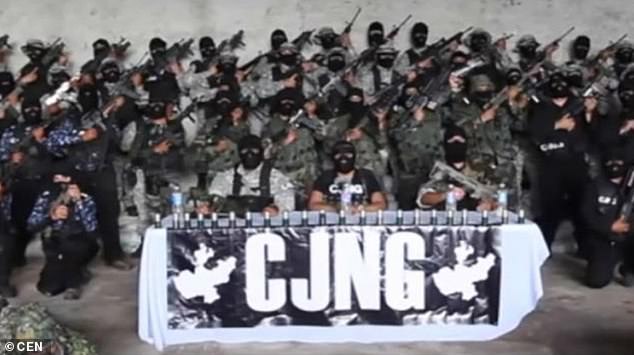
El Mencho’s CJNG cartel has long been considered one of the most brutal in Mexico after its bloodthirsty leader used extreme torture and violence to instill fear into its rivals.
Jalisco New Generation Cartel (CJNG) head Nemesio Oseguera Cervantes, 59, was eliminated on Sunday in a joint Mexican military and US-backed operation in Tapalpa, a town of 20,000 people in the Sierra Madre mountains.
Also known as El Mencho, the kingpin displayed a savagery that many deemed was extreme even by narco standards.
Partaking in cannibalism, grisly footage from 2020 saw CJNG hitmen torturing a half-naked man before standing on his head and cutting open his chest with a knife.
As the victim screams in agony, a cartel member can be heard shouting: ‘So you can see that’s how we Jalisco people are… we’re going to exterminate you all,’ while another adds: ‘Pure Mencho’s people, we are the Jaliscos’.
The operative who brutally cut open the victim’s chest then begins to pull out his organs before eating them for the camera as the other hitmen laugh around him.
But there have been several mass killings and massacres, including the 35 bound and tortured bodies dumped in the streets of Veracruz during an evening rush hour in 2011.
Just two years later, CJNG operatives allegedly raped, killed, and set fire to a 10-year-old girl whom they mistakenly believed was a rival’s daughter.

El Mencho’s CJNG cartel has long been considered one of the most brutal in Mexico

In a gory video shows members of the CJNG cartel beheading an unnamed man

Four beheaded men were seen hanging from a highway overpass last year in Mexican cartel war massacres

Nemesio ‘El Mencho’ Oseguera Cervantes was killed by Mexican federal forces on Sunday
In 2015, CJNG assassins executed a man and his elementary-school-age son by detonating sticks of dynamite duct-taped to their bodies, laughing as they filmed the ghastly scene with their phones.
‘This is ISIS stuff,’ one DEA agent who has investigated the cartel told Rolling Stone in 2017. ‘The manner in which they kill people, the sheer numbers – it’s unparalleled even in Mexico.’
In one video that is making its rounds on social media following El Mencho’s death, an alleged video of the rival MF Cartel can be seen tied to a tree in Sinaloa.
The brutal clip, from November last year, captured an apparent CJNG member preparing a makeshift flamethrower before spraying the bound man with a stream of fire. The MF member is quickly engulfed in the orange flames.
‘We’ve seen it become very bloody, and a lot of people attribute that to El Mencho himself,’ said Scott Stewart, a senior cartel analyst. ‘Wherever they try to muscle in, it creates bodies.’
Captured CJNG members have also previously testified about how El Mencho hates disobedience and likes to make his victims beg forgiveness before killing them.
‘This is a guy who’ll execute your whole family based on not much more than a rumor,’ a source told Rolling Stone.
‘He just has zero regard for human life.’
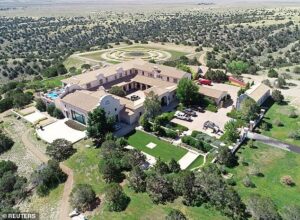
Last March, forensic teams made a discovery that chilled even hardened investigators – a secret compound near Teuchitlán, Jalisco, where the CJNG allegedly ran a full-scale ‘extermination site’.
Buried beneath the Izaguirre ranch, authorities found three massive crematory ovens.
They contained piles of charred human bones, and a haunting mountain of belongings – over 200 pairs of shoes, purses, belts, and even children’s toys.
Experts believe victims were kidnapped, tortured, and burned alive, or after being executed, to destroy evidence of mass killings.
Just a few weeks prior, authorities in Zapopan, a suburb of Guadalajara, unearthed 169 black bags at a construction site, all filled with dismembered human remains.
The bags were hidden near the CJNG territory, where disappearances are widespread.
Activists said families reported dozens of missing young people in the area in just a matter of months.
In October 2024, the town of Ojuelos, Jalisco, woke up to yet another horror – the decapitated bodies of five men dumped by a dirt road.
Their heads were found in a separate sack, left beside a cardboard sign with a blood-soaked warning from CJNG.

Two men were found strangled to death last year at Acapulco beach – police say cartel members ‘tortured’ them ‘around the neck’

Two hundred pairs of shoes were discovered at Izaguirre ranch, the skeletal remains of dozens of people were found

The body of a high-ranking Sinaloa cartel member, who had been kidnapped and murdered, was found on a highway surrounded by boxes of fenantyl and other drugs
Locals said they heard screaming the night before, followed by cars speeding away.
Police were called after plastic bags containing the body parts were discovered by drivers.
Authorities immediately deduced that the fact that the bodies were dumped in such a public place, as well as the sheer brutality of the killings, was a strong indication that the cartel was involved.
Its leader, El Mencho, was on Sunday killed in a joint operation between US and Mexican military forces.
The kingpin was flanked by loyalists armed with heat-seeking grenade launchers capable of piercing tank armor.
The CJNG is considered one of Mexico’s most powerful drug cartels that plays a key role in trafficking methamphetamine and fentanyl to the US.
El Mencho’s brutal control of the drug-trafficking routes from Latin America to the US, using speedboats and submersibles to ship cocaine and methamphetamine from Colombia and Ecuador via the Pacific, is thought to have made him billions.
Following his death, authorities have said they are actively working on containing the cartel’s reactions and reinforcing security after the highest-profile blow against cartels since the recapture of former Sinaloa cartel boss Joaquín ‘El Chapo’ Guzmán a decade ago.
El Mencho, who was also one of the United States’ most wanted fugitives, was killed during an attempt to capture him, as his followers attempted to fight off Mexican troops.
Mexico’s Defense Department said in a statement that the army launched an operation in the southern part of Jalisco state to capture Cervantes, involving the Mexican Air Force and special forces.
The cartel counterattacked, and in the ensuing confrontation, federal forces killed four members of the criminal group and wounded three others, including its leader, who died later during transfer by air to Mexico City, according to the statement.
El Mencho was originally from the western state of Michoacan. His ties to organised crime went back at least three decades.

A firefighter extinguishes a burning bus set on fire by organised crime groups in response to an operation in Jalisco to arrest a high-priority security target, at one of the main avenues in Zapopan, state of Jalisco, Mexico, on February 22, 2026

Nemesio Ruben Oseguera Cervantes a.ka. El Mencho, reputed leader of the Jalisco New Generation cartel, with his son Ruben Oseguera Gonzalez, known as El Menchito

A National Guard convoy in Mexico City, Mexico, on February 22, 2026, escorts a Rhino, an armored tactical vehicle used for high-impact operations and critical security situations, after federal forces kill Nemesio Oseguera Cervantes

A firefighter extinguishes a burning bus set on fire by organised crime groups
In 1994, he was tried for trafficking heroin in the US and sent to prison for three years. Upon returning to Mexico, he quickly rose through Mexico’s drug trafficking underworld.
Around 2009, he founded the Jalisco New Generation Cartel, which became Mexico’s fastest-growing criminal organisation, moving cocaine, methamphetamines, fentanyl, and migrants to the United States, and innovating in violence with the use of drones and improvised explosive devices.
The Jalisco cartel had carried out daring attacks on the Mexican army, pioneering the use of drones and even going into battle with the state armed with helicopters.
In 2020, it assassinated the head of Mexico City’s police force using grenades and high-powered rifles.
It recruited aggressively, experimenting with new ways to reach potential members online, and generated revenue through fuel theft, extortion, and timeshare fraud, among other activities.
The Jalisco cartel has a presence in at least 21 of Mexico’s 32 states and is active in almost all of the United States, according to the US Drug Enforcement Administration. But it is also a global organization, and the loss of its leader could be felt well beyond Mexico.
‘El Mencho controlled everything; he was like a country’s dictator,’ Mike Vigil, former chief of international operations for the DEA, said.