



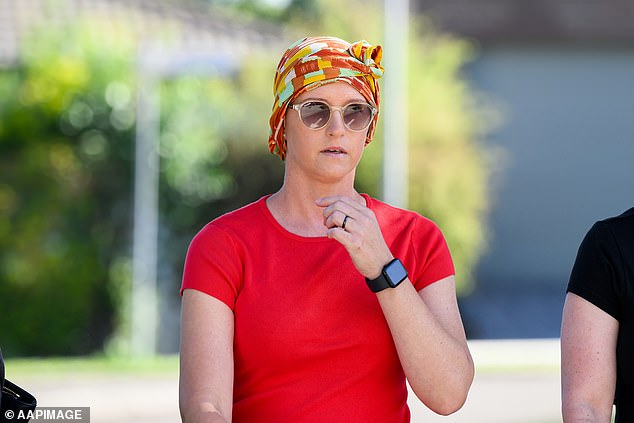
Amy Scott – the police officer who single-handedly stopped Joel Cauchi’s deadly stabbing rampage at Westfield Bondi Junction – has arrived at the inquest into the attack that claimed six lives.
Inspector Scott, who is currently battling a rare and aggressive form of breast cancer and undergoing chemotherapy, managed a small smile while wearing a bandana as she walked past the waiting media before greeting a colleague inside the building.
Inspector Scott ran to the fifth level of the Sydney shopping centre in 2024 after being alerted to the terrifying rampage.
She confronted Cauchi and fatally shot him in the chest when he refused to drop the knife.
Coroner Teresa O’Sullivan commended Inspector Scott’s ‘extraordinary’ bravery, saying her actions saved lives.
‘Inspector Amy Scott, whose heroism has been a centre piece of this inquest. Not only did she act unhesitatingly and with enormous courage and service…but she attended court throughout the inquest to provide comfort to others. She combined skill and compassion with great humility,’ Ms O’Sullivan said.
‘She now faces a health challenge… I wish her and her family all the very best for the road ahead.’
The coroner will determine if more could have been done in treating Cauchi when he lived in Toowoomba, Queensland, and afterwards when he moved to Brisbane.
The 40-year-old had stopped taking antipsychotics before the move and did not find another psychiatrist in the state capital.

Amy Scott – the police officer who single-handedly stopped Joel Cauchi’s deadly stabbing rampage at Westfield Bondi Junction – has arrived at the inquest into the attack that claimed six lives

Bondi Junction hero Amy Scott has been diagnosed with a rare and aggressive form of breast cancer earlier this year

Inspector chased and shot dead Joel Cauchi following his murderous rampage at Westfield Bondi Junction on April 13 2024 (pictured)
He was homeless at the time of the Westfield attack.
Australian Society of Psychiatrists executive director Pramudie Gunaratne hoped the recommendations would be a ‘turning point’ towards genuine mental health reform.
‘What we saw on that day was a young man who was seriously unwell but left in free fall without mental health support for four years,’ she told AAP.
‘The most gut-wrenching thing about all of this is that even after such an incredible tragedy, little seems to have changed.’