

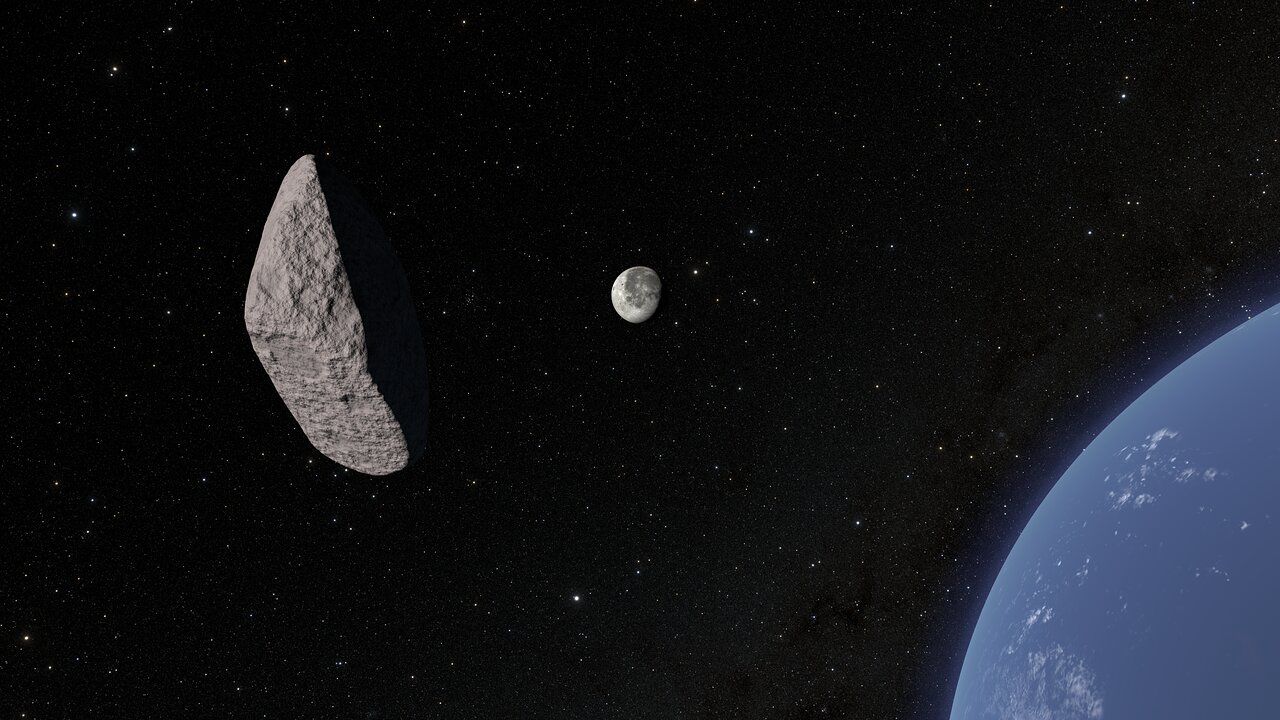
The James Webb Space Telescope has helped scientists determine that asteroid 2024 YR4, which previously had a 4.3% chance of crashing into our moon, will not impact our lunar companion at all. Instead, it will instead safely cruise past the moon at an altitude of 13,200 miles (21,200 kilometers).
However, it was quickly found that 2024 YR4 would miss the Earth — but it remained unclear whether it’d hit the moon instead. Specifically, there was a 4.3% chance that it could strike the moon on Dec .22, 2032 instead. The uncertainty was the result of 2024 YR4’s orbit around the sun not being known as precisely as needed in order to decide for sure whether it would hit the moon or miss it.

Astronomers thought they would have to wait until 2028 to get the next chance to observe 2024 YR4 and refine its orbit before getting some clear answers, but researchers at the Johns Hopkins University Applied Physics Laboratory (JHUAPL) realized that there would be a chance for the James Webb Space Telescope (JWST) to observe 2024 YR4 between Feb. 18 and Feb. 26 this year.
During that week, the asteroid was moving against a faint field of stars whose positions have been precisely measured by the European Space Agency’s Gaia mission. By tracking the object’s motion against those stars, the James Webb Space Telescope (JWST) was able to refine its orbit to high precision. It wasn’t an easy measurement; the field of view of its Near-Infrared Camera is just 2.2 square arcminutes, and the asteroid is one of the faintest targets the JWST has ever observed.

The scientists at JHUAPL worked with the space telescope’s engineers, alongside the European Space Agency’s Near-Earth Object Coordination Centre and NASA’s Center for Near-Earth Object Studies, to aim the telescope precisely.
The new measurements mean that astronomers have now ruled out a collision with the moon. Instead, 2024 YR4 will pass 13,200 miles above the lunar surface — still a very close encounter, but posing no danger.
Had the impact happened on the near side of the moon, it would have provided scientists with their first up-close view of a large impact, and provided a stunning sight for observers on Earth, resulting in a brilliant flash and a new crater about 0.62 miles (1 kilometer) across. The energy imparted would have been equivalent to 6 million tons of TNT, or basically a large nuclear detonation. Ejecta thrown up by the impact would mostly have rained back down onto the surface of the moon, but millions of pounds of debris would have still escaped the lunar gravity and fallen towards Earth instead, possibly creating a unique meteor shower lasting a few days. The debris would also have been a hazard to satellites in orbit around the Earth, and, as some of the debris could linger in Earth orbital space for years, that hazard would have been long-lasting.
However, now that we know 2024 YR4 will miss its target, we’ll just have to wait for the next asteroid to worry about, and remain ever vigilant for any that may threaten Earth.