
A group of female ESB employees have told the Irish Mail on Sunday they do not feel ‘safe’ after the State company refused to reverse a transgender changing room policy that allows staff to use the facilities for the gender they identify as.
The women’s concerns were raised internally with management and trade unions but bosses at the semi-State firm have declined to alter the access arrangements – and have yet to act on a second commitment that they made more than 12 months ago to provide ‘universal private facilities’.
One of the women told the Irish Mail on Sunday: ‘We were stonewalled. We tried to get up as far as the chief executive, Paddy Hayes. He referred it back to HR. They’re basically saying, “This is what we want, we don’t care.”‘
However, the ESB has moved to compromise the wording of a related policy that had made the use of preferred pronouns mandatory for all employees.
Both of the inclusion measures were introduced in May 2024, when the ESB implemented its first-ever Gender Identity and Expression Policy.
The policy was developed by the company’s Diversity, Equality and Inclusion team.
Aside from its Northern Ireland Electricity Networks arm, the policy applies to the entire ESB group and its 9,600 employees in Ireland, the UK and Bahrain.
The policy reads: ‘All managers and team members must support the right of all employees to access toilet, shower, and changing facilities which match their gender identity, where such facilities are available.
‘The respect and dignity of all employees will be upheld. Employees with questions or concerns are encouraged to contact their HR Business Partner.’
After the new policy was introduced, a group of women in the company attempted to raise the matter with HR.
They formed a group called the Safe and Sound Adaptive Challenge Group to raise concerns about the implications of the new rules.
The group consists of female employees of long standing within the ESB.
These women, who occupy senior positions, say they represent many other younger women who fear their careers would be affected if they spoke out.
The group’s main concern is that anyone who identifies as a woman can now use the female bathroom and changing room facilities, regardless of their biological sex.
However, they are also concerned about their right to be ‘gender-critical’. Being gender-critical is defined as believing that biological sex cannot be changed and is distinct from any gender identity someone may legally adopt.
A frequent flashpoint between those who are gender-critical and those who are not involves access to toilets and changing facilities.
‘In head office, our women’s changing room is in the basement,’ one gender-critical woman told the MoS.
‘It’s through three locked doors and long corridors to get in there. So you’re in a locked room, through three swiped doors in the basement with your clothes off…
‘There are women that have been in all sorts of traumatic situations being put in that position and they’re just not using facilities. And I suppose that’s the problem.’

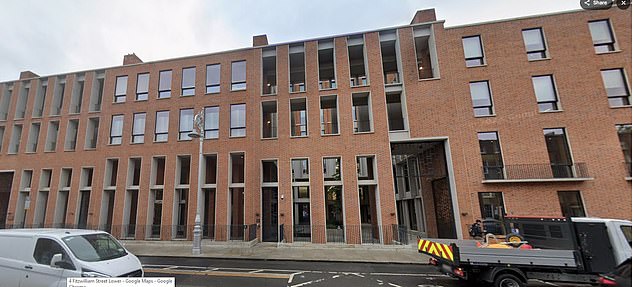
The semi-State body’s headquarters on Fitzwilliam St in Dublin – their gender-identity policy applies to the entire ESB group and its 9,600 employees across Ireland, the UK and Bahrain
A second female employee said she has now stopped using the changing rooms at HQ in Dublin’s Fitzwilliam Street.
Since a refurbishment in recent years, the building is designed to accommodate as many as 2,000 employees.
‘I used to use them in the mornings,’ she told the MoS. ‘They were busy with lots of different women. You’d meet the same women time and time again.
‘If I were to go down there now, early in the morning, the same time, there might be one woman there, or two women there.’
Both women also spoke about being approached by employees of different cultures and faiths.
‘There are men and women from over 50 different countries working, particularly in head office.
‘So they are of all the faiths, all the religions, all the cultures, as well as you know, middle-aged and older Irish women.’
‘They say it’s about respect and dignity for everybody. We’re saying what about the respect and dignity of the women who don’t want to be in that position?’
To raise their concerns the group tried to speak with management and unions but they feel their concerns were not taken sufficiently on board.
In one briefing document prepared for their trade union in early 2025, the group pointed out that the ESB’s ‘policy on single sex spaces is at odds with the recommendations of Reem Alsalem’, the UN’s Special Rapporteur on violence against women and girls.
Ms Alsalem is a renowned figurehead frequently cited by women concerned about the protection of female-only spaces.
Her view is that these spaces are crucial for the privacy, safety and dignity of women and girls.
She has also warned that the legal redefinition of gender can undermine these protections, potentially increasing the risk of voyeurism, sexual harassment and physical attacks.
Ms Alsalem has also said that women should be able to discuss issues about sex and gender identity freely, without fear of recrimination.

Reem Alsalem, the UN Special Rapporteur on violence against women and girls, is a renowned figurehead often cited by women concerned about the protection of female-only spaces
In their union briefing document, the group claimed there had been ‘no meaningful engagement with employees’ prior to the introduction of the new policy.
In addition to objecting to the facilities and bathrooms policy change, the group said the ESB has ‘failed to protect the legal rights of employees with gender-critical beliefs’.
It also sought to raise their concerns in a short speech to a National Safety Committee meeting of the ESB in January 2025, attended by Nicholas Tarrant, the managing director of ESB Networks.
‘The ESB has refused to pause the policy until a respectful and dignified solution for all employees is determined,’ the speech reads.
‘The introduction of this policy has seriously damaged trust between women across every business unit in ESB and the company.’
Since then, the ESB appears to have begun to move towards addressing the concerns raised.

UK Prime Minister Keir Starmer, Taoiseach Micheal Martin and chief executive of the ESB Group Paddy Hayes taking part in a Business Roundtable this week in Cork
The second version of the company’s Gender Identity and Expression Policy, published in February 2025, contained a new provision.
‘Employees who have a need or desire for increased privacy, regardless of the underlying reason, will be provided access to universal private facilities if available, should they choose to use them,’ the policy reads.
‘Across its locations, ESB has a mix of private and shared facilities. ESB commits to providing more universal, private facilities when the opportunity arises.’
While this commitment could offer a solution, no such private facilities have yet been put in place in the year since the promise was made. This remains the case even after a September 2025 risk assessment also recommended private facilities.
According to the risk assessment, ‘the likelihood that a transgender person accessing bathroom and changing facilities matching their gender identity will be the victim or perpetrator of verbal or physical aggression is very low’.
It adds: ‘There is no evidence nationally or internationally of elevated risk. ESB’s policy is in line with national legislation and IBEC guidelines.’
The document concludes that it would ‘require a freak combination of factors’ for a situation of aggression to occur.
But it acknowledges: ‘It is conceivable that should an incident arise, it would have serious impact on the victim. This applies to both the physical and psychosocial harm.’
As a result, the assessment recommends the ESB ‘invest in additional universal (individually segregated and lockable) toilet, shower and changing facilities over time, so that employees and visitors with concerns related to dignity and privacy will have facilities options to support them’.
An ESB spokeswoman told the MoS: ‘ESB is a supportive employer that continually strives to deliver an inclusive environment for all our colleagues.
‘ESB introduced its Gender Identity and Expression Policy following consultations to ensure a respectful, inclusive workplace for all, drawing on industry guidance and established public sector practice.
‘Our Head Office at Fitzwilliam 27 is a modern building which has facilities to safely cater for all of our people.
‘ESB remains committed to continual engagement with employees through our many feedback channels to maintain a workplace that is safe, healthy, and inclusive for everyone.’