



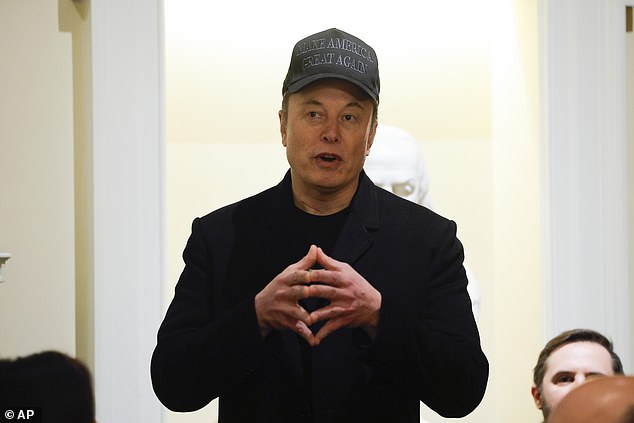
The Department of Government Efficiency has claimed that it saved American taxpayers $105 billion in savings, including millions of dollars the Defense Department says were being spent on wasteful DEI programs.
DOGE, headed by ‘First Buddy’ Elon Musk provided its third weekly update on its federal cost cutting efforts Sunday night, claiming it saved a total of $105 billion – up from $65 billion it had claimed the week before, ABC News reports.
The controversial department has said that the figure is based on a ‘combination of asset sales, contract/lease cancelations and renegotiations, fraud and improper payment deletion, grant cancelations, interest savings, programmatic changes, regulatory savings and workforce reductions.’
Among the contracts that were canceled were some $80 million that the Department of Defense has deemed to be wasteful spending.
In a video posted to social media on Monday, Press Secretary Sean Parnell listed some of those contracts, including one for $1.9 million for DEI trainings in the Air Force and a $3.5 million contract at Defense Human Resources Activity for support of DEI groups.
Some of the money also went to public universities, with $6 million going to the University of Montana to ‘strengthen American democracy by bridging dividers’ and $1.6 million to the University of Florida ‘to study social and institutional detriments of vulnerability and resilience to climate hazards’ in the African Sahel.
‘This stuff is not a core function of our military… This is a distraction,’ Parnell said.
‘We believe that these initial findings will probably save $80 million in wasteful spending,’ he noted, adding that Monday’s actions were ‘just the start’ and more savings would be announced later in the week.

The Department of Government Efficiency headed by Elon Musk has claimed that it saved American taxpayers $105 billion in savings
Much of the money DOGE said it saved, however, came from its controversial cuts to the United States Agency for International Development, totaling $8.7 billion.
The department posted on its Wall of Receipts that it canceled a USAID contract for Ukraine Confidence Building Initiative worth $256 million, from which DOGE claims it saved $170 million that has not yet been fulfilled.
Another newly canceled contract listed on DOGE’s website is one for USAID’s Global Health Training, Advisory and Support Contract program – a multi-year effort that started in 2021 and was capped at $682 million through 2029.
DOGE says it saved $284 million by terminating that program.
The single biggest contract that the department said it canceled this week is a seven-year IT services contract from USAID vendor Salient CRGT Inc, which had a $597 million ceiling.
But the agency’s figures have been called into question, as the 2,299 contracts listed on the Wall of Receipts only amounts to $8.8 billion in alleged savings.
The department also claims on its website, though, that it has terminated $660 million worth of real estate leases as well as $10.3 billion in federal government grants.
Still, that would only amount to $19.7 billion in savings – a far cry from the $105 billion the department said it has saved.

Department of Defense Press Secretary Sean Parnell said the department canceled $80 million contracts it deemed to be wasteful spending
Amid the discrepancies, DOGE has quietly erased some of the contracts it listed as having canceled after the New York Times found that it triple-counted the same cancelation or claimed credit for contracts that ended years or even decades before Musk’s onslaught of the federal government.
One such contract from a seven-year blanket purchase agreement with the Internal Revenue Service with a $1.9 billion cap for ‘IT strategy and modernization’ is no longer on the department’s website after the vendor, financial management and IT company Centennial Technologies, told the Times the contract was actually canceled last fall – under the Biden administration, according to ABC News.
DOGE also had to revise down its largest claimed savings contract from $8 billion to $8 million after the contract’s vendor claimed that the $8 billion listed on its procurement records was likely a clerical error.
A third contract that was removed from DOGE’s Wall of Receipts was a five-year USAID contract under the Asia Futures Activity Initiative, aimed at serving the department’s Asia Bureau to solve ‘interconnected challenges of economic growth, democratic governance and resilience in the face of increasing health, climate and food security threats.’
It further appears DOGE deleted a $149 million contract for the National Institutes of Health awarded to software company Advanced Automation Technologies from its savings page.
The listing for that contract last week linked to a different NIH contract for leasing and maintaining refrigerated gas tanks.
But an NIH contract with the same ID as the one listed on the DOGE site is capped at just $1.4 million.

Much of the money DOGE said it saved, however, came from its controversial cuts to the United States Agency for International Development , totaling $8.7 billion
As the agency has been forced to delete its mistakes, the total amount of savings that the initiative has claimed it redeemed from canceling contracts has steadily declined – from $16 billion to now less than $9 billion.
It also lists more than 940 contracts where the contract obligations have already been fulfilled – meaning that 40 percent of the contracts the department says it terminated will not actually result in any savings.
DOGE’s Wall of Receipts also still includes claims DOGE achieved $106 million in savings by canceling a pair of contracts that the US Coast Guard signed for administrative help.
Those contracts, though, were actually completed in 2005 and 2006 – when George W. Bush was president, according to the Times.
Other figures DOGE claims to have saved are harder to track, as much of the data is missing information about which agency the canceled leases were under.
And even though it said it canceled 3,389 grants and lists the names of the awarding agency and the amount of each grant, the site does not list the name of the grants or their purpose.