



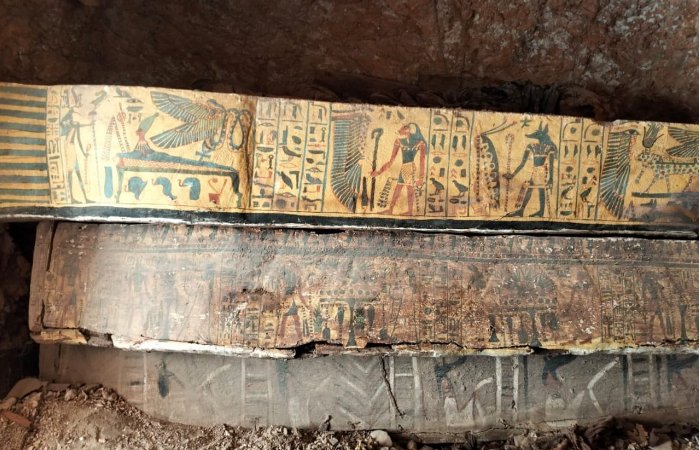
Jan Bartek – AncientPages.com – Archaeologists working in Luxor, Egypt, have uncovered a significant cache of colorful coffins containing mummies, along with a collection of rare gold artifacts dating back to the Third Transition era.
This discovery was made in the southwest corner of the Sinab cemetery in the Qarna region, located at the westernmost part of Akasr. The excavation was conducted by the Egyptian Archaeological Mission in partnership with both the Supreme Council of Antiquities and the Zahi Hawass Foundation for Archaeology and Heritage.

Image credit: Egypt’s Ministry of Tourism and Antiquities
Experts report that among these findings are coffins belonging to Amun singers and eight exceptionally rare mummified bodies—an extraordinary addition to Egypt’s archaeological record. Sharif Fathi, Minister of Tourism and Antiquities, emphasized that this discovery not only enriches Egypt’s heritage but also underscores the government’s ongoing support for archaeological research as part of a broader strategy to preserve cultural heritage and underscore its civilizational significance.

Image credit: Egypt’s Ministry of Tourism and Antiquities
Fathi further stated that his ministry is committed to restoring and scientifically studying such discoveries in accordance with the highest international standards. These efforts aim to ensure proper preservation and display, showcasing Egypt’s rich civilization while promoting cultural tourism—particularly in Luxor Governorate, renowned as an open-air museum celebrating human history.
Dr. Zahi Hawass, former Minister of Archaeology, President of the Zahi Hawass Foundation for Archaeology and Heritage, and Head of the Expedition, has announced a significant archaeological discovery that sheds new light on the Third Transition period. This finding offers valuable insights into this historical era.

Image credit: Egypt’s Ministry of Tourism and Antiquities
According to Dr. Hawass, excavations uncovered a rectangular room carved into rock that functioned as a funeral parlour. Within this space, archaeologists discovered 22 wooden coffins arranged in multiple layers according to a specific pattern. The ancient Egyptians optimized available space by arranging the coffins in 10 horizontal rows and separating their lids from the bodies to increase capacity in the chamber.

Image credit: Egypt’s Ministry of Tourism and Antiquities
Additionally, the team found pottery vessels believed to have been used in embalming rituals to preserve materials associated with mummification. This discovery provides important information about burial practices and funerary customs during this time period.

Image credit: Egypt’s Ministry of Tourism and Antiquities
The team is actively investigating the origins of this cache, aiming to identify its original owners. Notably, most of the coffins are inscribed with functional titles rather than personal names—the most frequent being “vocalist” or “Amun vocalist.” This discovery offers valuable insights into the roles and social classes of chanters and vocalists during that historical period.

Image credit: Egypt’s Ministry of Tourism and Antiquities
Due to the fragile condition of the wooden coffins, the restoration team implemented urgent conservation measures. These included treating deteriorated wood fibers and weakened plaster layers, carefully cleaning surfaces to remove stains while preserving vibrant colors, and thoroughly documenting each item through detailed photography and architectural records prior to storage.
See also: More Archaeology News
According to Dr. Afifi Rahim, the mission’s supervisor, this cache dates back to Egypt’s Third Transition era (Dynasties 21–25). Despite many coffins lacking personal names, mummies remain inside them. The excavation continues as researchers seek out the original graves from which these artifacts were removed.

Image credit: Egypt’s Ministry of Tourism and Antiquities
Additionally, eight canopic jars were discovered inside a large honorary vase—some still sealed with their original clay stoppers in various sizes. These jars present a significant opportunity for further study; ongoing restoration and translation efforts are expected to yield important new information for scholars worldwide.
Written by Jan Bartek – AncientPages.com Staff Writer