

A footnote in Formula One history is someone many of us thought was a washed-up American TV executive with bushy eyebrows and John McCririck-like sideburns.
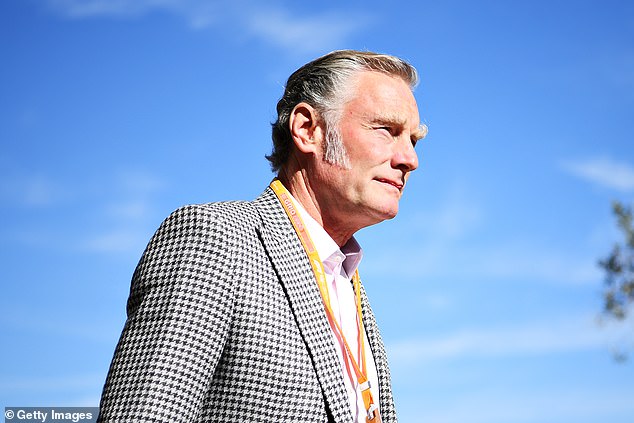
He wore an extravagant collection of bespoke double-breasted blazers of varying patterns. His name was Sean Bratches, and he made fools of all us doubters, certainly in one significant regard.
For it was his initiative to go ahead with the Netflix series Drive to Survive that has converted a once ear-splittingly loud sport mostly for blokes, into a modern phenomenon for all ages, classes and sexes. Or a ‘phenom’, as Sean might say.
Indeed, the F1 movie that broke box-office figures last year – Brad Pitt’s most successful film commercially – stood on the shoulders of Drive to Survive’s cut-through.
The cameras moved in after Liberty Media bought the business from Bernie Ecclestone, and CVC Capital, in 2017. That deal was done for between £5billion and £6bn. Now a single team, led by Ferrari, are valued at up to £4.8bn. Netflix and the impact of Sean RH Bratches, formerly a senior figure at ESPN and a keen lacrosse player in the Eighties, is a strand of the growth, helped by the serendipity of early broadcasts coming out during lockdown.
What else was there to do back then other than sit back and watch a fun, fluffy, sometimes acted-for-the-cameras confection? Just you weren’t so keen if you were a diehard F1 fan. Too much showbiz for the purist.

Sean Bratches (above) made the decision to go ahead with the Netflix series Drive to Survive

Drive to Survive has helped Formula One gain a much wider appeal than ever before
Regardless, the ubiquitous boom microphones still hover overhead across all 24 paddocks telling its version of the season, and you wonder whether a private indiscreet word spoken privately to a friend will be aired to your embarrassment. And drivers, half aware of the spying eye, might tense up in ostensibly private discussion, though the teams have a right to veto coverage they don’t like before it is streamed.
Netflix’s incursion is a price most of the F1 cast are prepared to accept with varying degrees of reluctance, aware of its overall importance to Formula One’s fortunes. Although especially aimed at an American audience and entry-levellers everywhere, the Netflix experiment has worked better than in most other sports. F1’s intriguing culture lends itself to fly-on-the-wall eavesdropping.
Netflix stands in a line with the BBC, followed by Fleet St newspapers, as one of the biggest media promoters of the sport over the years.
The BBC’s coverage of James Hunt’s 1976 title win in the soaking wet in the foothills of Mount Fuji stands out, part of a TV rights deal brokered by Ecclestone that ran through the Seventies and Eighties and was even more transformational than Netflix.
Hunt wrote under his own byline the front-page splash in the Daily Mail that day in Japan with the help of his amanuensis, my late colleague Ian Wooldridge: ‘By all the laws of humanity I should not be motor-racing champion of the world,’ having driven through terrifying spray to pip Niki Lauda to the title. Hunt’s intro shows that no degree of hyperbole is entirely new in the presentation of Formula One tales for the titillation of mass audiences.
Which brings us on to Drive to Survive’s eighth series, which is airing now ahead of next Sunday’s opening race in Melbourne, where Lando Norris starts his championship defence for McLaren. Norris’s team appear to be third fastest going into the season, with Mercedes on top and Ferrari close behind, with Red Bull fourth, and then a big drop to the rest of the field. Haas and Alpine are perhaps next closest.
Speaking of Red Bull, Netflix leaned on their star protagonist, their hardy perennial pantomime villain, Christian Horner, who was sacked by Red Bull in July. He awaits his next crack at Formula One, and has secured serious financial backing to buy into Alpine, though he might be up for Ferrari if their high hopes fall flat on their face and he were given total control of affairs in Maranello. Which, if they had eyes to see, he would be.
One of the most captivating episodes is centred on Horner and his former Spice Girl wife Geri. It is only 38 minutes long, but I can reveal that he turned down overtures to star in a spin-off series based on him, and his life and wife, alone.
It would have looked too try-hard, too cringy, so he was probably wise to shun extra exposure, rather than play the slightly elder statesman awaiting his next job.
We see one scene that surely played a part in his defenestration: the 2025 season launch, at the O2. He went on stage, only to be roundly booed. ‘S***!’ said Lewis Hamilton. And Horner’s drivers Liam Lawson Max Verstappen were shocked: ‘Mate, how in London?’

Geri Halliwell and Christian Horner feature in one of the more captivating episodes

A shocked Lewis Hamilton said ‘s***’ as he heard the reaction to Horner’s entrance at the O2
Horner got off stage and sat down next to his Red Bull nemesis Oliver Mintzlaff, bruised and battered by his churlish treatment, rather than rejoin him in triumph. It was a public humiliation, a weakening of his position, in front of sponsors and drivers. Yes, in London, a Brit ribbed by his own.
‘He went up there, like “I’m going to rock the room,” but the room rocked him,’ smirked his detractor Toto Wolff, of Mercedes.
Horner countered: ‘When you become a serial winner the audience doesn’t want to see that.
‘In F1, there’s an element of pantomime. We are like the Kardashians on wheels. I am past caring what people think.’
Later with Geri, in a stables at their Oxfordshire home, he says of his sacking: ‘All done and dusted. I feel a real sense of loss and hurt.
‘I didn’t really get a chance to say a proper goodbye. I never imagined to be in this position. Your immediate reaction when you’re delivered a s*** sandwich like that is, “F*** them.” I’ve had something taken away from me that wasn’t my choice, that was very precious to me.’
The series has little access to Hamilton but his replacement as Mercedes No 1 George Russell is quite forthright, needling Verstappen, the four-time world champion with whom he is hardly bosom pals.
‘The Verstappens clearly have a lot of power in Red Bull,’ he argued. ‘They like to manipulate situations quite a lot. ‘For whatever reason, they don’t like Horner and they are trying to get Horner out.
‘I wonder if all of this (Verstappen to Mercedes rumours) are a bit of a play and a stir, trying to put pressure on Red Bull that he’ll only continue there if Christian is gone.’
Horner disagreed, saying: ‘I think this was a decision that was made by Oliver Mintzlaff with Helmut (Marko, the now deposed motorsport adviser to the wider Red Bull group) advising from the sidelines.

Max Verstappen (left) and George Russell (right) have plenty of needle in the series
‘Ultimately things changed within the business, within the group. And after Dietrich (Mateschitz, Red Bull’s founder) died, I was probably deemed to have maybe too much control.’
What else? McLaren’s internal title tensions between Norris and Oscar Piastri were dealt with on a superficial level, but no great fireworks were lit. Enter Flavio Briatore, de facto Alpine supremo, in his sumptuous and stylish home.
The wily old owl Briatore well-positioned to take over from Horner as chief pantomime villain. After all, he chucked his driver Jack Doohan under the bus pronto. ‘I’m not a dictator,’ explained Briatore. ‘But you do whatever I tell you to do or you are out.’
Noting the emotional side of young drivers, the Italian opined: ‘Sometimes you want a stick to beat them over the head.’
That is old-school chat for a modern audience. Yet theatrical goldust to Netflix and Formula One. Ka-ching!