

Military and spy chiefs have demanded Sir Keir Starmer commit to doubling defence spending as Britain faces a ‘1936 moment’.
Former ministers, security advisors and retired top brass wrote to the Prime Minister urging him to increase military investment to five per cent of GDP.
They insisted Britain is unprepared for conflict with Russia and must urgently reequip its hollowed out armed forces.
Currently Britain spends 2.4 per cent of GDP, or just over £60billion. The structured path to 5 per cent would require cuts to other budgets, additional taxation or further government borrowing.
Signees included former Defence Secretary Ben Wallace, ex-National Security Advisor Lord Kim Darroch and Professor Anthony King, a War Studies academic.
Former head of the Army Lord Dannatt, former chair of the Commons Defence Select Committee Tobias Ellwood and Sir Richard Dearlove, previously head of MI6, also supported the letter to Downing Street.
They accused Sir Keir’s administration of falling ‘dangerously short’ of meeting investment targets.
The move reflects growing unease about Britain’s defences in the context of rising Russian aggression, US destabilisation of the Nato defence alliance, and the return of Islamic State.

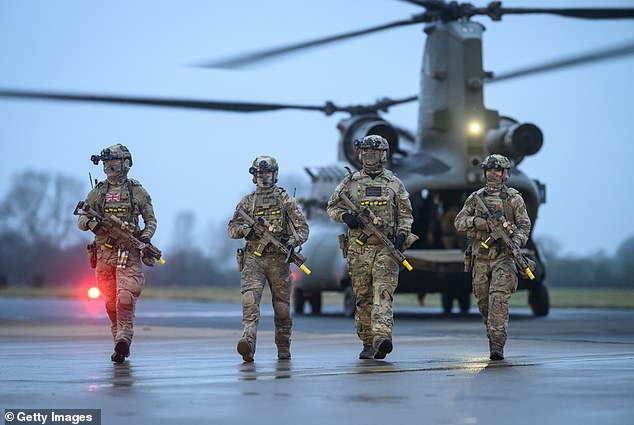
Military and spy chiefs have demanded Sir Keir Starmer commit to doubling defence spending as Britain faces a ‘1936 moment’. Pictured: Special Operations Forces practising their rapid deployment techniques last month

Former ministers, security advisors and retired top brass wrote to the Prime Minister urging him to increase military investment to five per cent of GDP. Starmer pictured today in Cardiff
Meanwhile, the Kremlin’s invasion of Ukraine will enter its fifth year next week and there is no indication Russia wants a peace deal.
US President Donald Trump has damaged relations within Nato over Greenland while jihadists are on the rise in Africa and the Middle East.
Signatories insisted the UK is ‘not war ready’ and should spend more on defence and reach spending targets faster.
The reality is that the British Army is at its smallest since Napoleonic times, Royal Air Force and Royal Navy fleets are shrinking and the UK’s nuclear submarine capabilities have been pared to the bone. Simulations have indicated that this country only has enough ammunition to sustain eight days of fighting against a peer adversary.
The Daily Mail has called for similar rises in military spending after highlighting these issues as part of its Don’t Leave Britain Defenceless campaign.
The letter, drafted by the Defence on the Brink podcast team, including former Army intelligence officer Phil Ingram, read: ‘Britain lacks the mass, readiness and resilience needed to produce a credible deterrent in an era of intensifying threats.
‘Britain’s actions fall dangerously short of matching our rhetoric and our meeting of Nato treaty obligations. We are deluding ourselves if we believe Russia and our other adversaries are unaware of this.
‘With defence spending at 2.4 per cent and a longer-term Nato goal of 3.5 per cent is simply not enough to rebuild mass, close funding gaps and get our Armed Forces into a state of readiness.’
They suggested Britain was facing a ‘1936 moment’, a reference to the threat posed by Nazi Germany before World War Two, including its breach of the Versailles Treaty that year by marching into the demilitarised Rhineland.

The saga of Britain’s Ajax armoured vehicle has exposed the UK’s weaknesses around equipping its Army for contemporary warfare
They have called for Sir Keir to announce a ‘bold, credible and measurable path’ to spending five per cent of GDP on core defence.
The move follows the Government’s failure to publish its Defence Investment Plan and reports of a £28billion blackhole in military budgets over this parliament.
The DIP has been postponed repeatedly. Reports have indicated no government money has been set aside for major projects.
While in this financial year around £2billion has been shaved off the budget covering the running costs of the UK’s armed forces.
Chancellor Rachel Reeves is thought to oppose any major uplift in defence spending, despite the glaring threat to national and European security.
The letter to the Prime Minister continued: ‘You must recognise that we are facing our 1936 moment: global conflict is highly likely if we don’t invest in deterrence now.
‘Public concern about defence has doubled and, according to polling, is an equal priority with the NHS and the cost of living. It is time for a serious conversation about the real threats we face.
‘Even the lead author of the 2025 Strategic Defence Review, Lord Robertson of Port Ellen, has argued for greater investment, stating that ‘if the government wants to accelerate then they will have to spend more money.
‘Since arriving in office your government has heaped unfunded new costs on the Department, above-average pay rises, the Chagos Islands deal and extra National Insurance on the defence industry. These liabilities have resulted in real-time reductions in available funds across the services, undermining frontline readiness.’
The threat to the UK includes Russia actively threatening UK security through cyber attacks, surveillance of undersea cables and drone activity around RAF and USAF bases in this country.
While the government has pledged to meet the updated Nato spending standard of 5 per cent by 2035, 1.5 per cent includes security infrastructure projects such as mending roads. Only 3.5 per cent is core defence spending.
Britain has not spent 3.5 per cent of GDP on defence since 1994. While 5 per cent on defence was last spent in 1986.
Other signees included former Defence Secretaries Sir Grant Shapps and Sir Michael Fallon, Falklands hero Simon Weston, Tim Collins, Andy McNab, ex-Royal Navy commander Tom Sharpe and former British defence attache in Afghanistan Colonel Simon Diggins.
A government spokesman said: ‘The Prime Minister has made a historic commitment to spend 5 per cent of GDP on defence and security from 2035. This is a generational increase and we are well on track to meet that target.
‘As demands for defence increase, we are delivering the largest sustained increase in defence since the Cold War, with an additional £5billion this financial year and £270 billion across this parliament.
‘We make no apologies for delivering the largest pay rise in decades to our hard-working personnel and a £9 billion housing strategy to renew tens of thousands of military homes after years of neglect.’