
Before there was Keely Hodgkinson, before there was Jess Ennis, before there was Kelly Holmes or Sally Gunnell, Mary Rand was the original Golden Girl of British athletics, a trailblazer for women’s sport and an Olympic heroine.
Rand died on Friday at the age of 86 in Lake Tahoe, Nevada. She had made her home there in recent years with her daughter, Sarah, in an area on the shores of the lake called Incline Village, where she doted on her grandsons and her dachshunds.
Rand was a brilliant, naturally gifted athlete from Wells, in Somerset, who became the first British woman to win track-and-field gold at the Olympics when she leapt to a glorious triumph in the long jump at the Tokyo Games in 1964.
Rand, who had a two-year-old daughter, Alison, by the time she appeared in Tokyo, won silver in the pentathlon at those Olympics, too, and added a bronze in the women’s 4x100m relay. She remains the only British athlete to have won three medals at a single Games and is one of only 10 British women to win track-and-field Olympic gold.
Rand travelled to those Tokyo Olympics in the company of Mary Peters and Ann Packer, two of the other standout stars of British athletics, but it was Rand who dominated the Games. She was voted the BBC Sports Personality of the Year in 1964. ‘She worked hard and played hard,’ Peters said in a tribute. ‘She was the most gifted athlete I ever saw.’
Rand became a darling of the British public and the British press. One newspaper called her ‘Marilyn Monroe on spikes’ and Mick Jagger, the Rolling Stones’ front man, declared that she was his dream date.


Trailblazing British track and field Olympian Mary Rand died on Friday at the age of 86

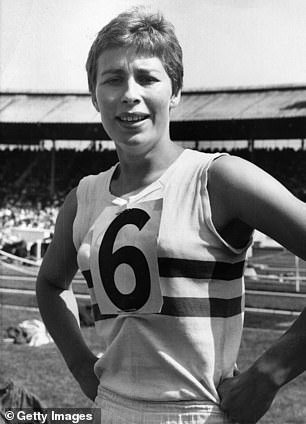
Rand (pictured in 1966) remains the only British athlete to have won three medals at a single Games and is one of only 10 British women to win track-and-field Olympic gold
She courted some controversy when she left her first husband, the British rower Sid Rand, and married American decathlete, Bill Toomey, with whom she had two more daughters, Samantha and Sarah.
She split from Toomey and married her third husband, John, after they were set up on a blind date. ‘A friend told me he had a truck and a Harley,’ Rand said when I went out to Nevada to meet her before Tokyo 2020, ‘and I said “a truck and a Harley are all I need”. John was the best thing that ever happened to me.’
I spent a couple of days with Mary at Lake Tahoe. She was the best company, a woman who still seemed slightly bewildered by the whirlwind of achievement, glory, love and adoration that had surrounded her back in the 60s.
She was 80 by then and we laughed about how she had lived life fast back in the day. ‘I did all sorts of crazy stuff back then,’ she said. ‘I guess I was a little impetuous.’ She was at the heart of a loving family. She had eight surviving grandchildren — one of Alison’s children died — spread across the States. ‘My children are my finest achievement,’ she said.
When Sarah asked her mum to come and live with them, Mary’s grandsons, Tommy, 13, and Ryan, 12, agreed they would share a room again so Mary could have her own space. She brought her dachshunds, Clyde and Daisy, with her from California and they sat at her feet in the kitchen, staring up at her as she talked.
There were no pictures of any of her feats in the house. The idea that her life should have become a shrine to something she did more than 50 years ago was anathema to her. Her grandsons were aware of what she achieved — ‘We’re lucky that she’s our grandma,’ one of them, Tommy, said when he came home from school — but it is hardly a daily topic of conversation.
‘I was the first one in the British team to win a gold medal in Tokyo and people said it inspired everybody,’ she said in Lake Tahoe. ‘I didn’t realise that but I think some people thought: “Mary can do it so we can do it”.

Rand became a darling of the British public and one newspaper called her ‘Marilyn Monroe on spikes’

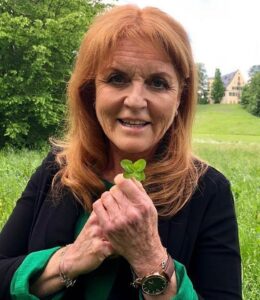
Rand (pictured in 2012) settled in Nevada in her latter years and she was the original Golden Girl of British athletics
‘Some time later, we went to Buckingham Palace for a ceremony. We wore our medals and there was a long hallway and it was lined with soldiers looking very serious and standing to attention.
‘I was the last one with my three medals around my neck and as I was walking, the medals were bouncing and clinking together and this one soldier started smiling. I thought: “I got him”.’
She only returned to the UK intermittently once she made her home in the US and when the authorities in Wells, where she grew up, wanted to organise a parade for her before the 2012 London Olympics, she hesitated to agree.
‘I thought nobody would know who the hell I was,’ she said. ‘What I did in Tokyo was so long ago. I thought it would be embarrassing. But they assured me that it would be OK and that people would be interested and they did a big parade and gave me the freedom of the city and hundreds of people turned up. It was one of the greatest moments of my life.’