
A top BBC executive has said that a racial slur was edited out of the Bafta Film Awards before it was broadcast – after apologising because another one shouted by a Tourette’s campaigner made it to air.
Chief content officer Kate Phillips said the corporation ‘understands how distressing’ it was that the N-word remained in the coverage when it aired two hours later despite catching another racial slur before it aired.
Tourette’s campaigner John Davidson could be heard shouting as black Sinners stars Michael B Jordan and Delroy Lindo presented the award for special visual effects.
Mr Davidson said he is ‘deeply mortified if anyone considers my involuntary tics to be intentional or to carry any meaning’, while the BBC apologised for not editing it out.
But questions are mounting over the handling of the incident at the Royal Festival Hall in London on Sunday and why the slur remained in the broadcast and later on iPlayer.
Warner Bros, the film studio behind Sinners, is also said to have raised immediate concerns about the incident and requested it be removed from the BBC broadcast.
Ms Phillips said in a note to BBC staff: ‘I wanted to write to you following Sunday’s Bafta Film Awards. I’m so sorry that a racial slur was not edited out of our broadcast.
‘We understand how distressing this was. Award attendees were pre-warned about the possibility of involuntary verbal tics associated with Tourette Syndrome at the start of the show, and Alan Cumming addressed it during the broadcast. Of course, this doesn’t lessen the impact and upset.
‘The edit team removed another racial slur from the broadcast. This one was aired in error and we would never have knowingly allowed this to be broadcast.

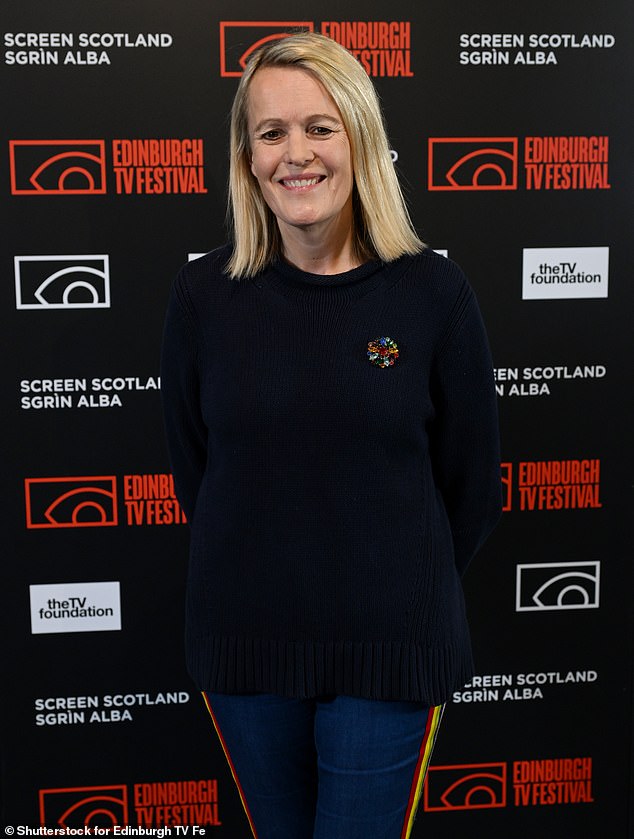
BBC chief content officer Kate Phillips attends the Edinburgh TV Festival in August 2024

Michael B Jordan and Delroy Lindo present the Special Visual Effects Award on stage during the Bafta Film Awards at the Royal Festival Hall on Sunday, when the slur was shouted out
‘We take full responsibility for what happened. When I was made aware it was audible on iPlayer, I asked for it to be taken down. As I’m sure you’re aware we put out a statement yesterday morning apologising that the remark was not edited out prior to broadcast.
‘I wrote to our Embrace network colleagues yesterday and am grateful for their thoughtful responses to me. Please know that you can reach out to me, or to any member of our ExCo team, if you’d like to talk further about this. Again, I am so very sorry for the distress caused.’
Ms Phillips has worked for the BBC for 13 years and was appointed into her current role last July having held previous jobs as BBC One controller and ‘director of unscripted’.
Film studio Warner Bros is believed to have raised immediate concerns about the slur and requested it be removed from the BBC broadcast.
Warner Bros is understood to have spoken directly with Bafta staff following the incident.
Warner Bros representatives are also believed to have been reassured this request would be passed on and Bafta was in touch with the studio throughout the evening.
But questions remain as to why the slur was allowed to remain in the edit that was uploaded to BBC iPlayer after the broadcast ended at 9pm last night.
The version with Davidson’s outburst was allowed to remain online for more than 12 hours and was only taken down at 11.30am today.
Citing BBC sources, BBC News reported that the producers responsible for editing the show ahead of broadcast ‘simply did not hear the slur’ shouted when Jordan and Lindo were on stage – but had caught the other occurrence in time.
Dawn Butler, Labour MP for Brent Central, accused the BBC of ‘an obvious bias’ and a ‘failure of duty of care’, insisting the slur ‘should never have been aired’.
The politician described its broadcast as ‘painful and unforgivable’ and has written to outgoing director-general Tim Davie asking for an explanation on why it was left in.
Warner Bros, the BBC, production company Penny Lane and Bafta have all been contacted for comment by the Daily Mail.
Meanwhile, film-maker Jonte Richardson has said he is stepping down as a Bafta judge over the academy’s handling of the incident.

John Davidson (Ieft) and Kirk Jones at the Bafta Film Awards at London’s Royal Festival Hall on Sunday. Mr Jones directed I Swear, which tells the story of Mr Davidson’s life with Tourette’s
In a statement on LinkedIn, Mr Richardson said: ‘After considerable soul-searching, I feel compelled to withdraw from the Bafta emerging talent judging panel.
‘The organisation’s handling of the unfortunate Tourette’s N-word incident last night at the awards was utterly unforgivable.
‘I cannot and will not contribute my time, energy and expertise to an organisation that has repeatedly failed to safeguard the dignity of its black guests, members and the black creative community.
‘This is particularly unfortunate given that this year’s cohort boasts some incredible black talent, especially one of my favourite shows of 2025 Just Act Normal.
‘However, when an organisation like Bafta, with its own long history of systemic racism, refuses to acknowledge the harm inflicted on both the black and disabled communities and offer an appropriate apology, remaining involved would be tantamount to condoning its behaviour.
‘I hope Bafta leadership comprehend the damage they and the BBC have caused and take the necessary steps to ensure their production staff are inclusive enough to prevent such an issue in the future.’
Mr Richardson is a former touring musician who has worked in both the UK and US film and TV industries, with the likes of Beyoncé, Denzel Washington and Queen Latifah.
His resignation came before Mr Davidson released a statement of his own, saying he was ‘deeply mortified if anyone considers my involuntary tics to be intentional or to carry any meaning’.

Bafta judge Jonte Richardson is stepping down over the academy’s handling of the incident
The campaigner confirmed he chose to leave the auditorium early as he was ‘aware of the distress my tics were causing’.
Mr Davidson said: ‘I wanted to thank Bafta and everyone involved in the awards last night for their support and understanding and inviting me to attend the broadcast.
‘I appreciated the announcement to the auditorium in advance of the recording, warning everyone that my tics are involuntary and are not a reflection of my personal beliefs.
‘I was heartened by the round of applause that followed this announcement and felt welcomed and understood in an environment that would normally be impossible for me.’
During the broadcast, the awards ceremony’s presenter Alan Cumming apologised for the language viewers may have heard.
Referencing this, Mr Davidson said: ‘In addition to the announcement by Alan Cumming, the BBC and Bafta, I can only add that I am, and always have been deeply mortified if anyone considers my involuntary tics to be intentional or to carry any meaning.
‘I was in attendance to celebrate the film of my life, I Swear, which more than any film or TV documentary, explains the origins, condition, traits and manifestations of Tourette syndrome.’
‘I have spent my life trying to support and empower the Tourette’s community and to teach empathy, kindness and understanding from others and I will continue to do so.

John Davidson at the Bafta Film Awards at the Royal Festival Hall in London on Sunday
‘I chose to leave the auditorium early into the ceremony as I was aware of the distress my tics were causing.’
Also today, the Telegraph’s senior culture writer Liam Kelly has revealed I Swear director Kirk Jones said he had ‘lengthy meetings’ with Bafta before the ceremony.
Recalling their chat on February 13, Mr Kelly wrote today: ‘When we spoke in a Bristol café nine days beforehand, Jones told me that there had been ‘lengthy meetings with Bafta’ about making sure that Davidson would feel comfortable on Sunday night.
‘If I Swear had won the outstanding British film award (which ended up going to Hamnet), Jones would have collected the statuette with Davidson. I asked what would happen if he experienced a tic on stage, in front of millions.’
The journalist said Mr Jones replied: ‘I did ask that question. I said, ‘What if he sees Leonardo DiCaprio and he shouts ‘You c**t!’ or something?’ I think it’s an hour delay. But it could be an interesting night.’
In a statement released last night, Bafta apologised for the incident, and said it takes ‘full responsibility’ for putting its guests in a ‘difficult situation’.
A spokesperson from Bafta said: ‘At the Bafta Film Awards last night, our guests heard very offensive language that carries incomparable trauma and pain for so many. We want to acknowledge the harm this has caused, address what happened and apologise to all.
‘One of our guests, John Davidson MBE, has Tourette syndrome and has devoted his life to educating and campaigning for better understanding of this condition. Tourette syndrome causes involuntary verbal tics, that the individual has no control over.
‘Such tics are in no way a reflection of an individual’s beliefs and are not intentional. John Davidson is an executive producer of the Bafta nominated film, I Swear, which is based on his life experience.

I Swear stars Robert Aramayo, who won best actor on Sunday for his performance in the film
‘We take the duty of care to all our guests very seriously and start from a position of inclusion. We took measures to make those in attendance aware of the tics, announcing to the audience before the ceremony began, and throughout, that John was in the room and that they may hear strong language, involuntary noises or movements during the ceremony.
‘Early in the ceremony, a loud tic in the form of a profoundly offensive term was heard by many people in the room. Michael B Jordan and Delroy Lindo were on stage at the time, and we apologise unreservedly to them, and to all those impacted. We would like to thank Michael and Delroy for their incredible dignity and professionalism.
‘During the ceremony, John chose to leave the auditorium and watch the rest of the ceremony from a screen, and we would like to thank him for his dignity and consideration of others, on what should have been a night of celebration for him.
‘We take full responsibility for putting our guests in a very difficult situation and we apologise to all. We will learn from this, and keep inclusion at the core of all we do, maintaining our belief in film and storytelling as a critical conduit for compassion and empathy.’
Speaking at the Warner Bros afterparty, Lindo told Vanity Fair that he and Jordan ‘did what we had to do’ while presenting but he wished ‘someone from Bafta spoke to us afterwards’.
According to the NHS, Tourette syndrome is a condition that causes people to make sudden, repetitive sounds or movements which, in rare instances, can result in offensive language being used, that cannot be controlled.
It says there is no cure but treatment can help to manage the tics.
Mr Davidson was made an MBE in 2019 for his efforts to increase understanding of Tourette syndrome and help families deal with the condition.
The film, I Swear, tells the story of the Scottish campaigner’s life with the condition, which he developed when he was 12.
It stars Robert Aramayo who won best actor for his performance in the film, which also won best casting. He was also named EE Rising Star.
Scottish actor Thierry Mabonga appears in the film as Mr Davidson’s lawyer, and posted on TikTok yesterday to comment on the incident.
In his video, he said: ‘This is the condition, the disease of Tourette’s syndrome. John cannot control what he says. In fact, that’s the whole point of why we’re making this film.
‘We’ve made this film to educate people about Tourette’s syndrome – how can you say that he can’t be there at the awards? This is a film about his life. This is a film about him. Absolutely he has to be there, and it’s great that he was there.’
He shared an additional video where he said ‘someone who has Tourette’s should not apologise for having it’, and he referenced when Mr Davidson met Queen Elizabeth II, and said: ‘If the Queen understood that, I don’t know why people don’t understand.’
The BBC apologised for not editing the racial slur out of the broadcast, and a spokesperson for the corporation said: ‘Some viewers may have heard strong and offensive language during the Bafta Film Awards.
‘This arose from involuntary verbal tics associated with Tourette syndrome, and as explained during the ceremony it was not intentional.
‘We apologise that this was not edited out prior to broadcast and it will now be removed from the version on BBC iPlayer.’
Charity Tourettes Action said it ‘deeply understands’ the harm of the racial slur, but called for understanding of the condition.
A spokesperson for the charity said: ‘We also want to address the negative comments that have surfaced following John’s involuntary vocal tics during the ceremony.
‘We deeply understand that these words can cause hurt but, at the same time, it is vital that the public understands a fundamental truth about Tourette syndrome, tics are involuntary. They are not a reflection of a person’s beliefs, intentions or character.
‘People with Tourette’s can say words or phrases they do not mean, do not endorse and feel great distress about afterwards.
‘These symptoms are neurological, not intentional, and they are something John – like many others with Tourette’s – lives with every single day.’
It went on to say that it had found the ‘backlash’ to the incident ‘deeply saddening’ and added that Mr Davidson had made a decision to leave the ceremony early.
Tourette Scotland, which has worked with Mr Davidson, added that there was ‘no meaning’ behind his outburst and that the Tourette’s community is ‘kind and very empathetic, and would never like to upset anyone with their tics’.