



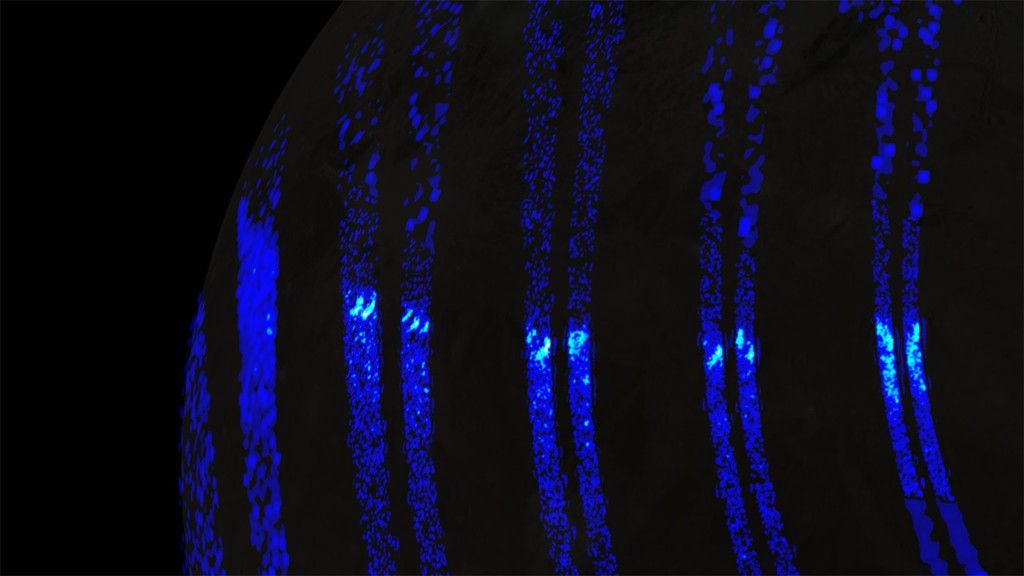
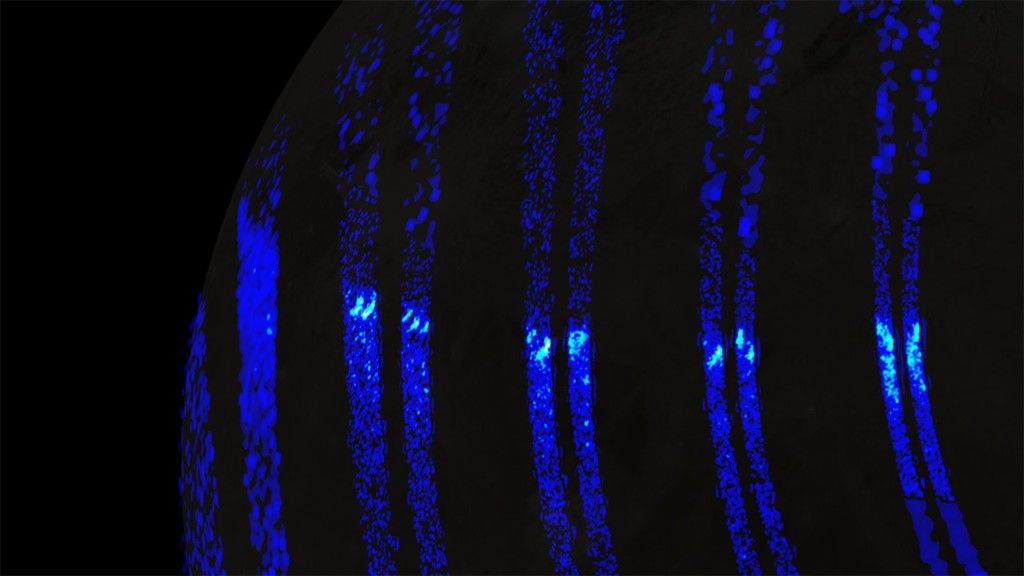
A fleeting flyby of Ganymede has revealed that its shimmering auroras may behave far more like Earth’s than scientists expected.
During a close pass on July 7, 2021, NASA’s Juno spacecraft captured the most detailed ultraviolet views yet of a Jovian moon’s glowing polar lights. The new analysis, completed by a team led by the Laboratory of Atmospheric and Planetary Physics (LPAP) at the the University of Liège, shows that Ganymede’s auroras are not smooth, continuous ovals. Instead, they splinter into small, bright patches — structures that mirror features seen in Earth’s own auroral displays.
While we know auroras aren’t unique to Earth — they’ve been seen on Venus, Mars, Jupiter, Saturn and Uranus — Ganymede is the only moon we know of that has its own magnetic field, which is a crucial ingredient for auroras. On Earth, the aurora occurs when charged solar particles slam into the magnetosphere, which directs them toward the poles. These particles then interact with gases in the atmosphere and glow various colors, including green and red. On Ganymede, the auroras are produced via interactions with Jupiter’s vast magnetosphere rather than the solar wind.
“Observations of Ganymede’s auroras prior to Juno were limited by the spatial resolution of ground-based observations, and they could not resolve the small-scale structures typical of planetary auroras,” said Philippe Gusbin, whose master’s thesis inspired the study. Juno’s ultraviolet spectrograph resolved details just a few kilometers across, revealing the “beads” in the aurora.
Because Juno’s encounter with Ganymede lasted less than 15 minutes — and the spacecraft will not return — researchers cannot yet determine how often these “bead” features appear. That task may fall to JUICE, the European Space Agency mission en route to Jupiter, which is expected to begin extended studies of Ganymede after its arrival in 2031.
A study about these results was published on Jan. 6 in the journal Astronomy & Astrophysics.