

Heart-stopping audio recovered from an Air Canada cockpit recorder laid bare the overlapping errors at LaGuardia International Airport in the minutes before the plane slammed into a firetruck.
The cockpit audio revealed how one air traffic controller granted permission for Flight 8646 from Montreal to land on Runway 4, while another controller granted permission for the firetruck to travel down the same runway at around 11.40pm on Sunday.
In addition, the truck’s surface safety system failed to trigger alerts for controllers. It was unclear why the device was not working.
Air traffic controllers were then left pleading with the firetruck to stop seconds before it crashed into the Bombardier CRJ-900, which was barreling down the runway at 150mph.
The impact killed both pilots onboard the aircraft and left 41 others injured.
National Transportation Safety Board investigators are now working to determine what may have caused the deadly crash, honing in on potential issues inside both the air traffic control tower and the firetruck at the scene, which they say may not have been equipped with a device that would trigger an alert inside the air traffic control tower.
‘We rarely, if ever, investigate a major accident where it was one failure,’ NTSB Chairwoman Jennifer Homendy told The Wall Street Journal.
‘Our aviation system is incredibly safe because there are multiple, multiple layers of defense built in to prevent an accident. So when something goes wrong, that means many, many things went wrong.’
But Air Canada Flight 8646’s descent into LaGuardia airport started off normally, the data from the cockpit recorder shows, according to senior aviation investigator Doug Brazy.

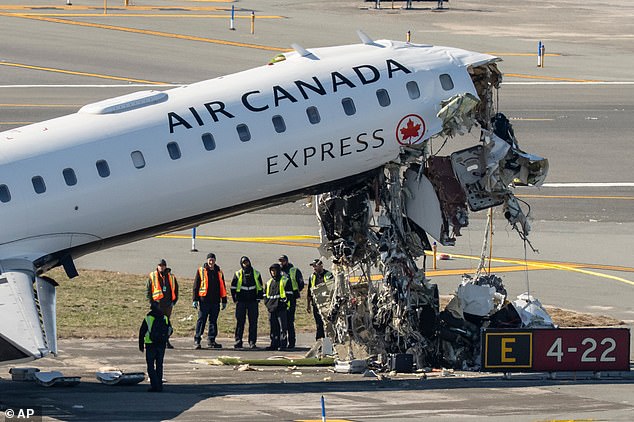
Audio recovered from Air Canada Flight 8646’s (pictured) cockpit recorder laid bare the miscommunication errors at New York’s LaGuardia International Airport in the minutes before the plane slammed into a firetruck

National Transportation Safety Board investigators are also looking into the possibility that the firetruck (pictured) did not have a working transponder
In the first two minutes and four seconds before the collision, the pilots followed procedure and radioed air traffic control for clearance to land.
An air traffic controller then responded that the flight was cleared to land on Runway 4, noting that it would be the second in line for landing on the runway.
About 30 seconds later, Air Canada’s flight crew lowered the plane’s landing gear, set its wing flaps for a final descent and confirmed the landing checklist was complete.
The two Port Authority firefighters – who were responding to reports of a ‘foul odor’ on another plane – then radioed the tower themselves with about one minute before impact.
But the transmission was ‘stepped on’ – meaning that either a microphone was turned on at the same time the firetruck radioed the tower or someone else was communicating on the same frequency, and the transmission was interrupted.
‘That would be significant because it could mean somebody might not hear the other part of the communication,’ Homendy said at a news conference on Tuesday.
Meanwhile, the Air Canada flight continued to descend, with one of the pilots informing air traffic control that it reached 500 feet above ground level and was on a stable approach.
Just 14 seconds later, officials said, the controller asked which vehicle needed to cross the runway.
Someone inside the firetruck responded and the air traffic controller could then be heard clearing the emergency vehicle to ‘cross Runway 4 at taxiway delta.’

Senior Aviation Accident Investigator Doug Brazy laid out the timeline of the Air Canada flight’s final descent on Sunday night

It remains unclear whether it was the same air traffic controller that gave both the Air Canada plane and the firetruck the go-ahead to proceed to the runway. LaGuardia’s air traffic control tower is pictured in 2011
At around the same time, inside the Air Canada cockpit, an enhanced ground proximity warning read out altitudes of 100, 50, 30, 20 and just 10 feet above ground.
With just nine seconds left before impact, the air traffic controller seemed to realize his error and instructed the firetruck to stop.
One second later, the landing gear touched down on the runway, and soon, authorities said, First Officer Mackenzie Gunther transferred control of the aircraft to the captain, Antoine Forest.
As the plane then raced down the runway, the air traffic control tower could once again be heard instructing the firetruck to come to a stop – before the recording comes to an abrupt end.
It now remains unclear whether it was the same air traffic controller that gave both the Air Canada plane and the firetruck the go-ahead to proceed to the runway.
Two controllers had been on duty at the time – with one managing active runways and LaGuardia’s airspace, while the ‘controller in charge’ was responsible for the safety of operations.
One was also functioning as a ‘ground controller,’ directing all movement on taxiways rather than active runways, but Homendy said it was unclear which of the two controllers was handling that position.
She noted that it is a standard practice at LaGuardia, one of the nation’s largest airports, to combine positions during the night shift.

The Air Canada flight barreled down the runway at 150mph Sunday night
The two controllers had been working a shift that typically starts at 10.30pm and lasts until 6.30am, when air traffic controllers have historically experienced fatigue.
‘The midnight shift, as a reminder, is one that we have many times at the NTSB raised concerns about with respect to fatigue,’ Homendy said.
‘We have no indication that was a factor here, but it is a shift that we have been focused on in past investigations.’
At least one of the air traffic controllers then continued to work for several minutes after the deadly crash.
‘Normally they would be relieved,’ Homendy said during a press briefing. ‘We have questions about that. Was anybody available to relieve that controller? We don’t know that yet.’
Investigators are also looking into the possibility that the firetruck did not have a working transponder – which would have left controllers without a crucial alert about the danger on the runway.
An initial probe showed that the truck’s ASDE-X (Airport Surface Detection Equipment, Model X) surface safety system failed to trigger alerts for controllers, Homendy said at the news conference.
The system, which would have allowed an airport controller to track movement of aircraft and vehicles, did not alert during the Sunday night collision between an Air Canada.
LaGuardia is one of 35 major US airports with an advanced surface surveillance system to help eliminate dangerous runway incursions and prevent crashes.
Controllers in these airports have an ASDE-X display in the tower that’s supposed to show them the location of every plane and vehicle.
Just last May, the FAA urged airports that have advanced surface surveillance systems like LaGuardia’s to equip their vehicles with transponders.

Passengers flying out of New York’s LaGuardia Airport have had to taxi past the still-visible wreckage
While the NTSB hasn’t recommended that vehicles on airport grounds have transponders, they should be standard equipment, Homendy said.
‘Air traffic controllers should know what’s before them, whether it’s on airport surface or in the airspace. They should have that information to ensure safety,’ she said.
Asked about the lack of a transponder in the fire truck, the Port Authority of New York and New Jersey, which operates the airport, said it was ‘unable to comment due to the ongoing investigation.’
As the investigation into the fatal collision now continues, passengers landing at the New York airport were shocked to see the wreckage still sitting on the runway.
‘At first I was just shocked at the proximity, it was right there. It’s shocking, you land and it’s the first thing you see when you’re on the tarmac,’ Sherrie Katanach, who flew in from Chicago, told The New York Post.
‘That was unbelievable to me,’ added Sherman Criner, who was returning from a longshoremen convention in New Orleans. ‘I figured they would get that off the runway as quickly as possible, but from the plane you could see it still sitting there.’
Officials have said the scene will not be cleared until the completion of the NTSB probe.