



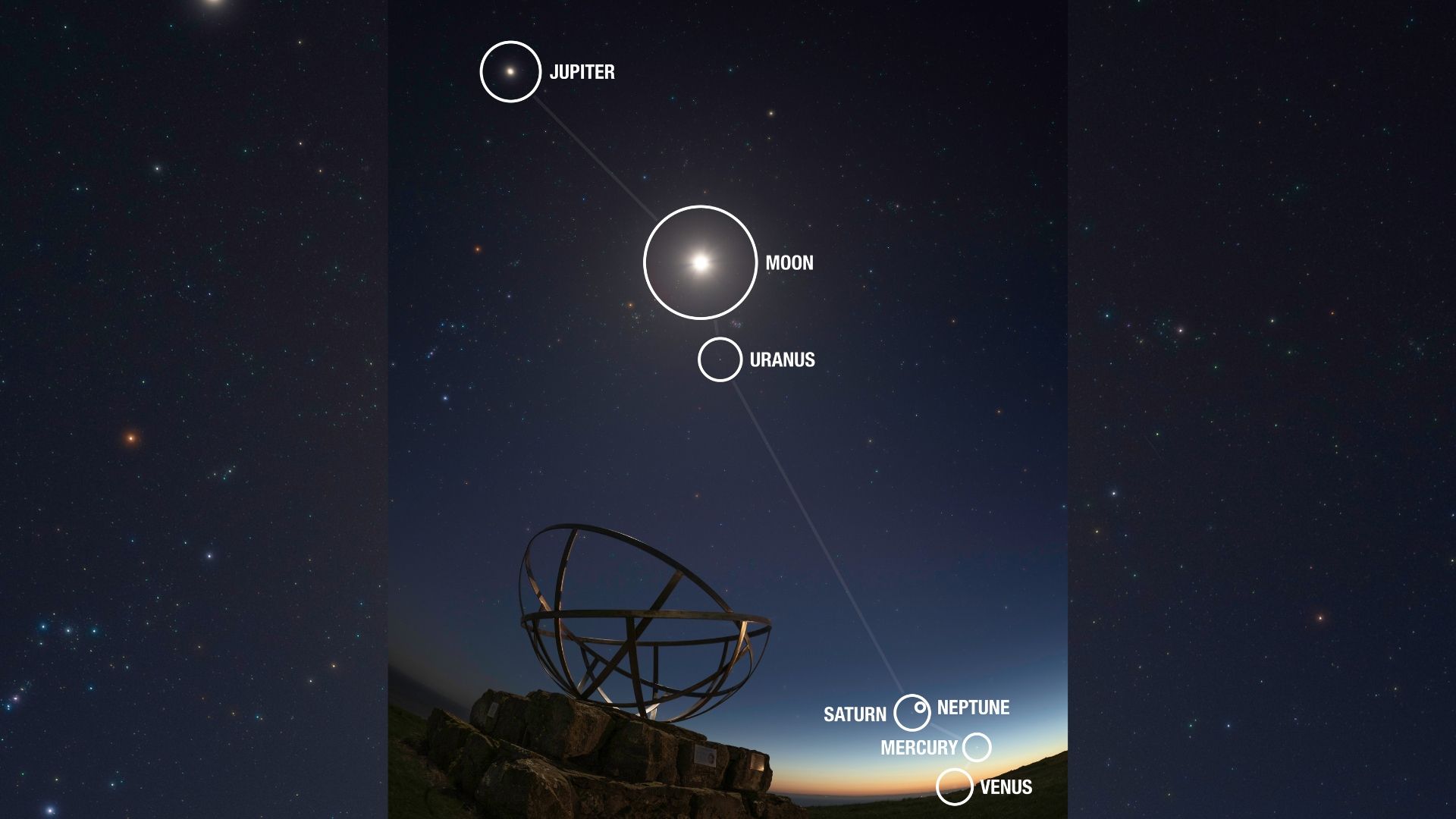

A rare six-planet parade lights up the U.K. sky in a powerful new astrophoto captured by award-winning photographer Josh Dury.
“As the light faded and with clear skies overhead, it was a veritable joy to witness the planetary parade of 2026. With Venus visible shortly after sunset, Mercury and Saturn soon made their presence known,” Dury told Space.com in an email. “The moon and Jupiter were clearly visible, with Uranus being located near to the Pleiades star cluster (M45), and Neptune near Saturn.”
The full parade includes six naked-eye planets of the seven: Mercury, Venus, Jupiter, Saturn, Uranus and Neptune. (Mars is the only one missing from the show.) Until Feb. 28, you can likely spot at least some of these planets above the horizon — but to see all, you’ll likely need binoculars or a telescope, as well as an unobstructed western view. (And that’s assuming the skies will be clear enough in a narrow, half-hour window.)
Dury, an experienced astrophotographer, said even he found it a challenge to capture all these planets. “The framing of the shot would prove challenging due to the scale of the parade of planets,” he said, as it required him to pull out a lens to capture nearly 180 degrees of sky.

More obstacles arose as well: “The brightness of the fading twilight and the first-quarter moon also proved other hurdles. As a result, I needed the light to fade as much as possible to document and confirm the location of the fainter planets,” Dury said.
Dury used an ultra-wide-angle lens to get as much of the sky as possible, showing Jupiter in the southeast at one end and Venus to the left. A Sigma 15mm diagonal fisheye lens let him capture the near 180-degree point of view. The fainter planets shine out thanks to Dury’s use of a diffuse filter, the NiSi Starsoft, “to increase the surface brightness of the planets,” Dury said.
Aside from the celestial views, Dury also included a telecommunication memorial in the shot. The juxtaposition of planets and telecommunications “evokes the narrative of the search for life on other planets amongst the ongoing planetary alignment,” he said.
Dury enjoyed the special moment in the sky, but it also brought out some memories of another alignment last year. “Unlike the great planetary parade in 2025, Mars is now visible on the opposite side of the Sun at dawn,” he said, noting that a year ago it was possible to see all seven naked-eye planets at once.
If you’re looking for a telescope or binoculars to observe the planets, our guides for the best binoculars deals and the best telescope deals can help. Our best cameras for astrophotography and best lenses for astrophotography can help you get ready to capture the next stunning skywatching event.