


Astronomers have unveiled one of the most ambitious maps yet of the early universe, revealing a vast “sea of light” between galaxies that had remained otherwise hidden in previous surveys.
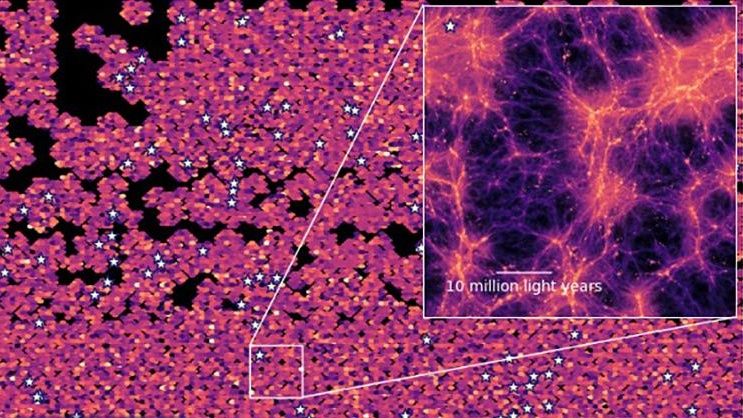
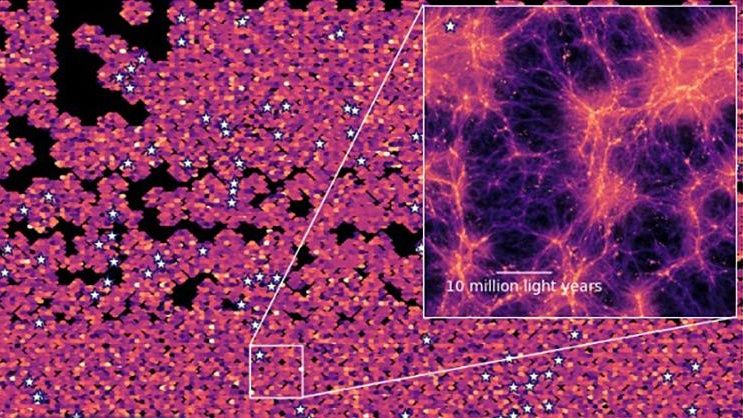
Using data from the Hobby-Eberly Telescope Dark Energy Experiment (HETDEX), researchers created a 3D map of light emitted by excited hydrogen 9 to 11 billion years ago, when the universe was in the throes of “cosmic noon,” its peak era of star formation. This specific form of light, known as Lyman-alpha, is produced when hydrogen atoms are energized by radiation from young, hot stars, creating a distinctive ultraviolet glow that can be traced across vast cosmic distances.
“Lyman alpha radiation is an important characteristic of galaxies at this period in the universe’s history, an era of vigorous star formation,” Robin Ciardullo, co-author of the study, said in the statement. “Previous to this study, the locations of fainter galaxies and gas, which also emit Lyman alpha radiation, have remained largely unknown.”
Other giant maps of the universe have focused on cataloging individual galaxies — cosmic cities of light bright enough to stand out against the dark. Those surveys have been crucial for tracing large-scale structure and studying dark energy. But they miss something important: the faint glow of hydrogen gas and small, dim galaxies that lie between the bright beacons.
“There’s a whole sea of light in the seemingly empty patches in between,” Maja Lujan Niemeyer, lead author of the study, said in the statement.
The new map was created using a technique called Line Intensity Mapping. Instead of identifying galaxies one by one, astronomers measured the combined light from hydrogen’s characteristic Lyman-alpha wavelength across huge swaths of sky. Hydrogen, the universe’s most abundant element, emits this ultraviolet light when energized by young stars. By tracking that glow, scientists can trace not just bright galaxies but also the diffuse gas that surrounds and connects them.
The result is less like a sharp city map and more like a heat map of all illumination — capturing the full “sea of light” that threads through the cosmic web. That makes it a powerful new tool for studying how galaxies formed and evolved within their environments, and the role intergalactic gas played.
The map was built from an enormous dataset comprising over 600 million spectra collected by HETDEX, originally designed to measure the universe’s expansion and probe dark energy. By mining this archive and using supercomputers with custom programming to analyze the large data set, researchers reconstructed a 3D view of hydrogen distribution across a vast cosmic volume. Because matter clusters under gravity, the team could use the positions of known bright galaxies to help interpret the fainter background glow, revealing hidden structures that previous surveys could not directly detect.
By charting hydrogen during the universe’s most active star-forming era, astronomers gain a clearer picture of how galaxies drew in gas, formed stars and assembled into the large-scale structures we see today. The work also signals a broader shift in cosmic cartography: future surveys may rely increasingly on intensity mapping to reveal not just the brightest objects in the universe, but the full, glowing framework that binds them together.
“This study is an exciting first step in using intensity mapping to understand the processes involved in how galaxies form and evolve,” Caryl Gronwall, co-author of the study, said in the statement. “The combination of the pioneering Hobby-Eberly telescope with new complementary instruments is ushering in a golden age for mapping the cosmos.”
Their findings were published March 3 in The Astrophysical Journal.