
The cosmos is full of surprises, and the James Webb Space Telescope seems to be a cosmic gift that keeps on giving, serving up puzzles faster than we can solve them.
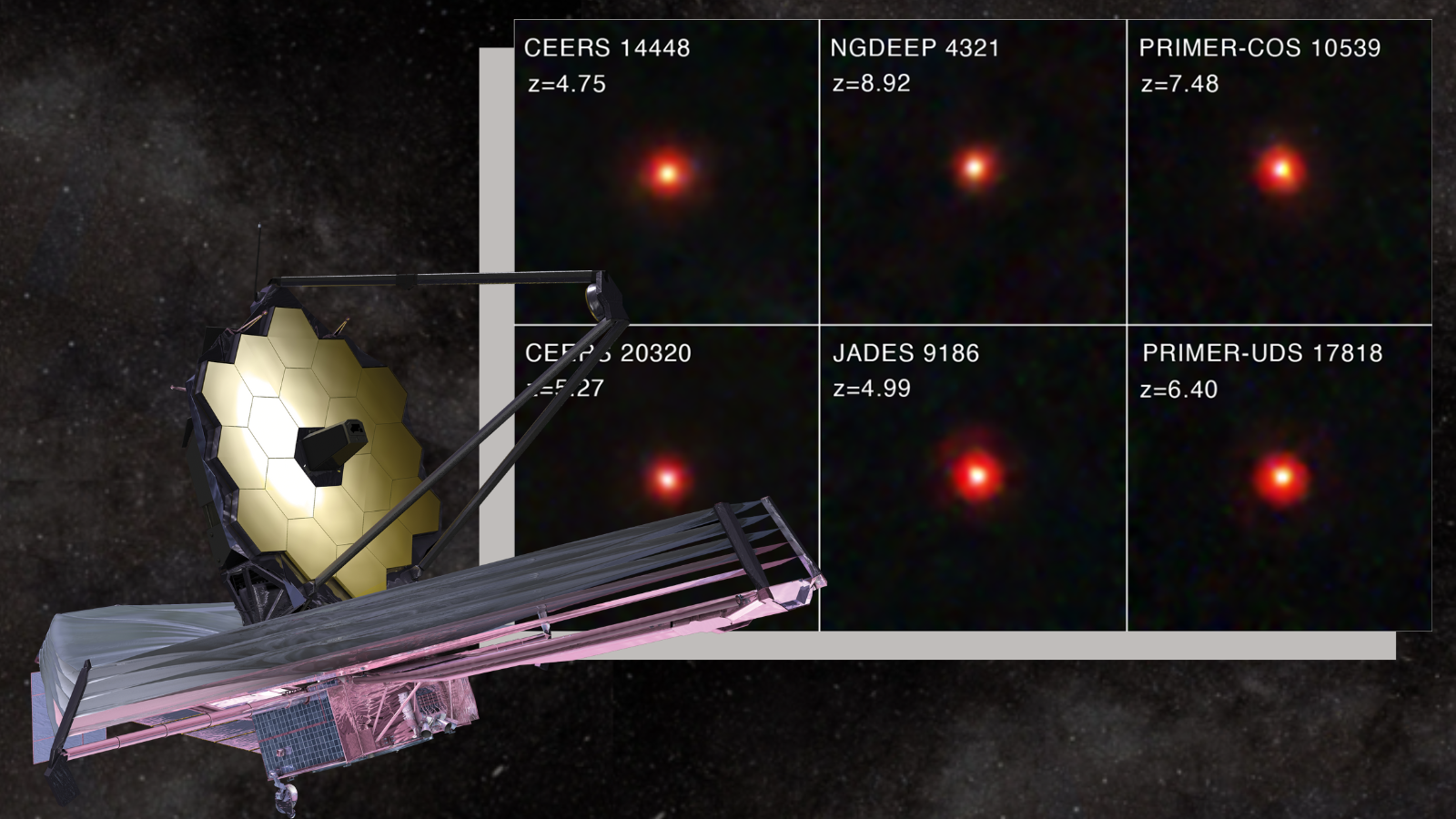
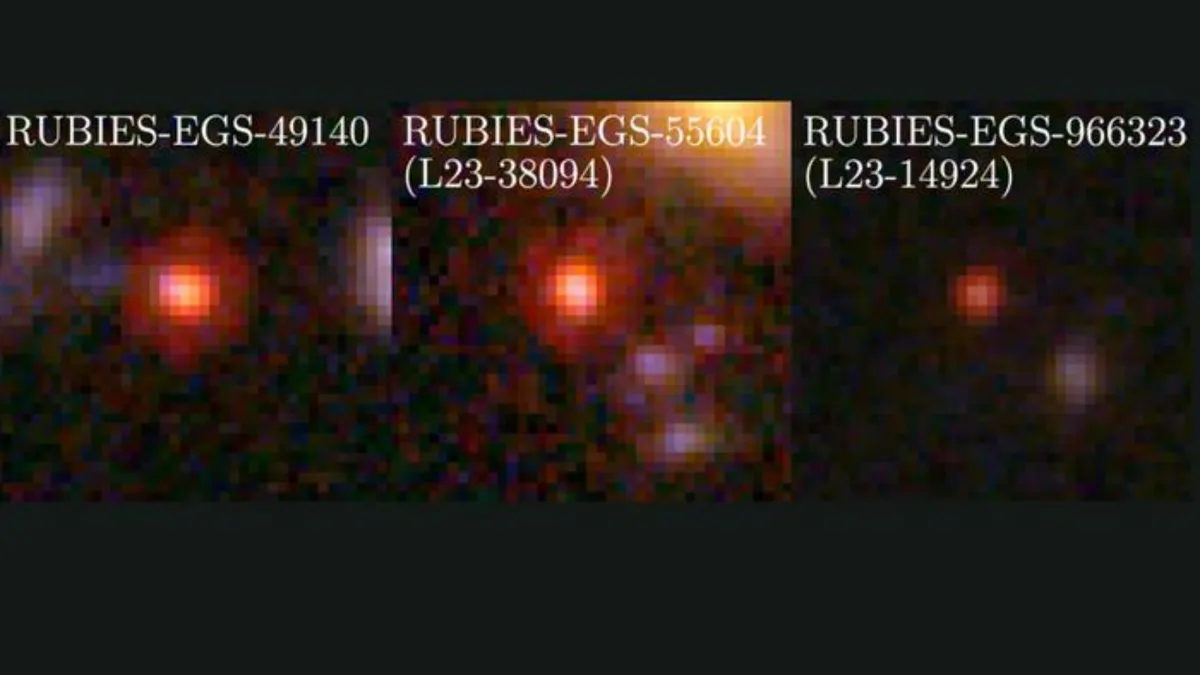
One of the most intriguing, and dare I say, enigmatic populations to pop up in the James Webb Space Telescope‘s (JWST) groundbreaking observations are the Little Red Dots (LRDs). These aren’t just any old cosmic curiosities; they’re very distant objects in the universe whose light has been stretched to longer, redder wavelengths due to the universe’s expansion, meaning we’re seeing them as they appeared in the early universe.
These particular LRDs are characterized by a distinct V-shaped spectrum, showing off a blue ultraviolet continuum and red optical light. Mysterious, right? But what if the initial hunch about these fiery pinpricks was … a little off?
Article continues below
For a while, the cosmic rumor mill had a consensus: these Little Red Dots were likely powered by giant, hungry black holes, relentlessly gobbling up surrounding matter. It’s a popular culprit in the universe’s whodunits.
But the more astronomers looked, the more these LRDs seemed to have remarkably distinct properties compared to other known black hole populations, throwing a bit of a wrench into that tidy explanation. So, a team of cosmic detectives cooked up a rather audacious idea, which they report in a new study published on arXiv: What if these LRDs aren’t baby black holes at all, but rather globular clusters in their messy, glorious formation?
Imagine, if you will, not a ravenous black hole, but a bustling cosmic construction site. In this new hypothesis, LRDs are indeed globular clusters in the making, and their glow comes from a very young stellar population, while their peculiar V-shaped spectrum is explained by something even wilder: a hypothetical, extremely massive star, significantly larger than typical stars, believed to be short-lived and highly luminous — a Supermassive Star, or SMS for short. Think of it as a cosmic beacon, a temporary but incredibly bright powerhouse, guiding the formation of the entire cluster.
This elegant explanation for their peculiar glow, however, isn’t without its own set of fascinating challenges. The beauty of this new scenario lies in how neatly it ties up loose ends. For starters, the number of LRDs we see at specific redshifts, that cosmic distance-equals-time marker, naturally evolves into what we expect for present-day globular cluster populations. It’s like finding a blueprint that matches the finished building. Researchers even estimate the total number density of these LRDs formed across all redshifts to be around 0.3 per cubic megaparsec, a number remarkably similar to local globular clusters.
And here’s another kicker: the observed redshift range for LRDs perfectly lines up with the age distribution of metal-poor globular clusters, which we already know are often associated with the very earliest stages of structure formation in the universe.
Talk about a compelling match.
Of course, a good cosmic mystery always has a few red herrings, or at least, some tricky details. This forming globular cluster model doesn’t quite nail every single observation, especially when it comes to that transition zone in the V-shaped spectrum. And while the spectral profiles broadly fit, the observed temperatures and sheer brightness of LRDs hint at powerful winds that our current models for Supermassive Stars just don’t fully capture yet. It’s a bit like having a puzzle piece that almost fits, but needs a little sanding around the edges. Indeed, the LRDs are cooler and more luminous than our current SMS models predict.
Plus, our SMS atmosphere models still need to include things like molecular opacities and models for stars cooler than 7,000 Kelvin, which could clear up some of these discrepancies. These wrinkles aren’t dealbreakers, but rather invitations for astronomers to refine their cosmic blueprints.
So, what’s next in this galactic detective story? To truly confirm that these Little Red Dots are indeed globular clusters in their infancy, future observations will need to sniff out specific chemical abundance patterns. We’re talking about signatures like enhanced helium and nitrogen, or tell-tale anti-correlations between sodium and oxygen, or even aluminum and magnesium. If we find those, it would be a smoking gun, connecting LRDs directly to the multiple stellar generations we suspect exist within mature globular clusters.
If this hypothesis holds, LRDs won’t just be pretty lights; they’ll offer us a direct window into how globular clusters formed, and even open up a new realm of extreme stellar astrophysics with incredibly intense radiation fields. What’s more, their incredible brightness hints that we might be able to spot similar systems even further back in time, giving us a peek at the very first generations of stars.
If confirmed, these Little Red Dots will be cosmic time capsules, revealing secrets of the universe’s fiery youth.