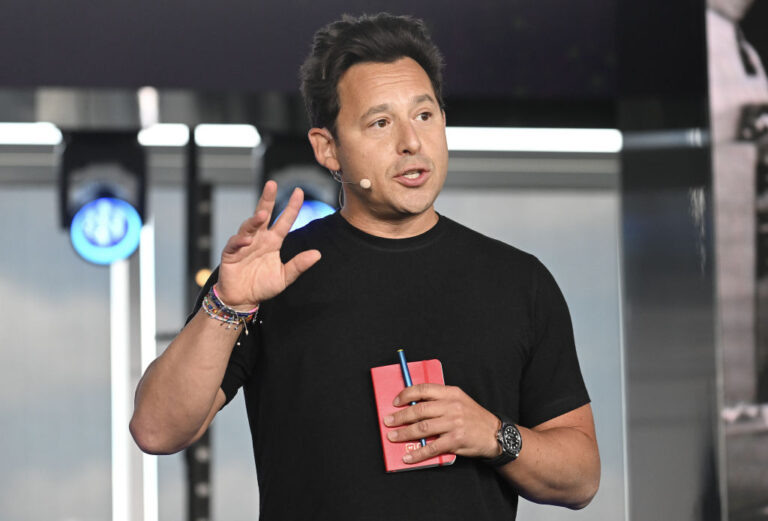




There is a new key term to know as part of this artificial intelligence revolution, at least according to Antonio Gracias, the founder of Valor Equity Partners.
While chatting at this year’s Upfront Summit in Los Angeles, he spoke about the term he coined — proentropic — a descriptor for startups designed to thrive in chaos and disruption. Such upheavals include the increasing volatility of climate and geopolitics and, of course, technology.
The term has its roots in physics, where entropy is a measure of the amount of disorder or uncertainty in a system. The second law of thermodynamics is that the disorder in a system will increase over time, and it cannot be stopped; it’s natural for a system, akin to real life, to always move toward a state of more disorder.
Gracias admitted that the term might be hard to understand and that he started thinking about it back in 2013, when he thought that a combination of deglobalization and technological change would globally “shift all the power structures.”
He said the world has been leaning toward chaos since at least the end of the last century as “human populations [have] gotten bigger and technologies have changed.”
“We are looking at businesses that are really good at predicting that future state and figuring out where to go,” he said, citing his portfolio company SpaceX as an example.
“It’s not just that they’re in a market today [that] they think works, but [they’ve] baked into their strategy and their people a way of thinking about the world that’s probabilistic” — meaning that anything can change at any moment in time.
Techcrunch event
San Francisco, CA
|
October 13-15, 2026
It “really takes into account what might happen at the edge cases and actually benefits from them,” he added.
Elsewhere in the conversation, he spoke about the firm’s strategy of conviction and again referenced the world’s macro situation. “We’re going into a period now in the economy where if you really want to build a better world, you’re going to have to have moral courage.”
He spoke about the intersection of climate, energy, and hardware, using Tesla as an example. “You can build great stuff with not a lot of compute if you know how to integrate the software and the hardware, he said. Gracias also spoke about what he thinks the future of this moment in time will be.
“The prevailing narrative is that artificial intelligence is going to be terrible. Job losses, social unrest,” he listed off. “And I think this is not true. I’m going to work really hard in the next five to ten years to make it not true.” Instead, he thinks the opportunities are greater than ever.
For example, he thinks that as low-code/no-code tools become more effective, more people will be able to start companies and thus unleash unseen levels of productivity. “Who knows what they will build,” he continued.
“We will decide whether we have a utopian future or a dystopian future.”