
The Albanese government has unveiled a four-point National Security Fuel Plan as the Middle East conflict increases prices at the bowser.
The plan was released after Prime Minister Anthony Albanese met with state and territory leaders at an emergency National Cabinet on Monday.
The four stages are: ‘plan and prepare,’ ‘keeping Australia moving,’ ‘taking targeted action’ and ‘protecting critical services for all Australians’.
The country is at the second stage: ‘Keeping Australia moving’.
It is understood fuel rationing will be implemented at stage four, The Daily Telegraph reported.
Albanese announced the fuel excise will be slashed by 26.3 cents per litre for three months.
‘Today, we’re announcing that the Commonwealth government will halve the fuel excise on petrol and diesel for three months,’ Albanese said.
‘The halving of the fuel excise will reduce the cost of fuel by 26.3 cents per litre.’

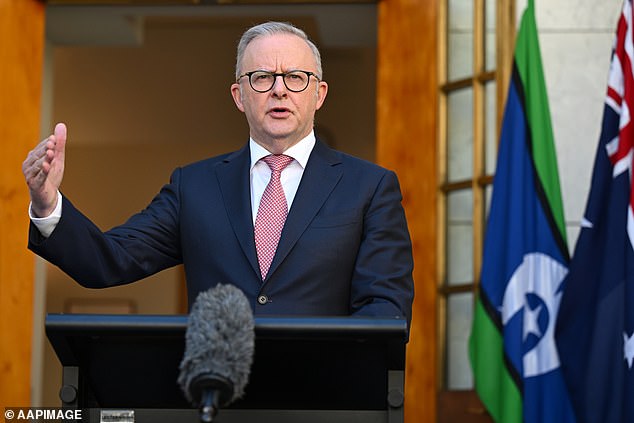
Anthony Albanese (pictured) announced the government would halve the fuel excise
The move cuts the fuel excise from 44.2 cents per litre to 22.1 cents, immediately reducing one of the largest fixed components of the price motorists pay at the pump.
Albanese said states and territories had agreed to work with the Commonwealth to ensure they did not receive a windfall from higher fuel prices through the Goods and Services Tax.
He said the tax cut was designed to provide fast relief for households while encouraging Australians to use less fuel where possible.
‘We’re making fuel cheaper today because we understand Australians are under serious pressure,’ he said.
‘We also want to encourage Australians who can to take public transport, to help save fuel for the areas and industries that need it.’
Albanese pointed to steps taken by several states to reduce public transport fares, saying lower fuel demand in major cities would ease pressure on regional supply.
‘The less fuel we use in the cities, the more we can direct to regional areas that are under pressure,’ he said.
The government will also deliver targeted relief to the freight sector, cutting the heavy vehicle road user charge to zero for three months.

Albanese also unveiled a four-level framework depending on the seriousness of the crisis
Albanese said trucking operators, particularly small businesses, were under intense financial strain, facing high fuel costs while waiting weeks or months to be paid for their work.
The government will also defer the next scheduled increase in the road user charge by six months and has urged states and territories to consider matching the move through reduced heavy vehicle registration fees.
Fuel excise is a flat federal tax applied to every litre of petrol and diesel sold in Australia and is indexed twice a year, regardless of global oil prices.
While fuel prices fluctuate daily based on international markets, retail margins and transport costs, excise remains a fixed component, making it a powerful lever for short‑term relief.
Treasurer Jim Chalmers said the package would cut the cost of filling a standard 65‑litre tank by about $19.
The measures are expected to cost the budget $2.55 billion, with a further $53 million in foregone revenue from delaying the road user charge increase.
‘So this relief is temporary, it’s timely, and it’s responsible,’ Chalmers said.
‘It’s all about taking some of the edge off these high petrol prices which are putting such extraordinary pressure on household budgets right around the country.’

Energy Minister Chris Bowen said Australia was still receiving its fuel supplies as expected
Chalmers said the fuel measures would also reduce headline inflation by around half a percentage point in the June quarter.
Albanese said National Cabinet was the appropriate forum to manage the response, pointing to the National Fuel Security Plan’s four‑level framework for managing supply disruptions.
Albanese said he was determined to avoid a repeat of the chaos and fragmentation between states and territories that emerged during the Covid‑19 pandemic.
‘We do not want the country to go through what we went through during Covid,’ he said.
Energy Minister Chris Bowen said he was ‘confident’ Australia’s fuel supply would hold and confirmed the government would work with regional allies in Asia to share oil supplies if needed.