


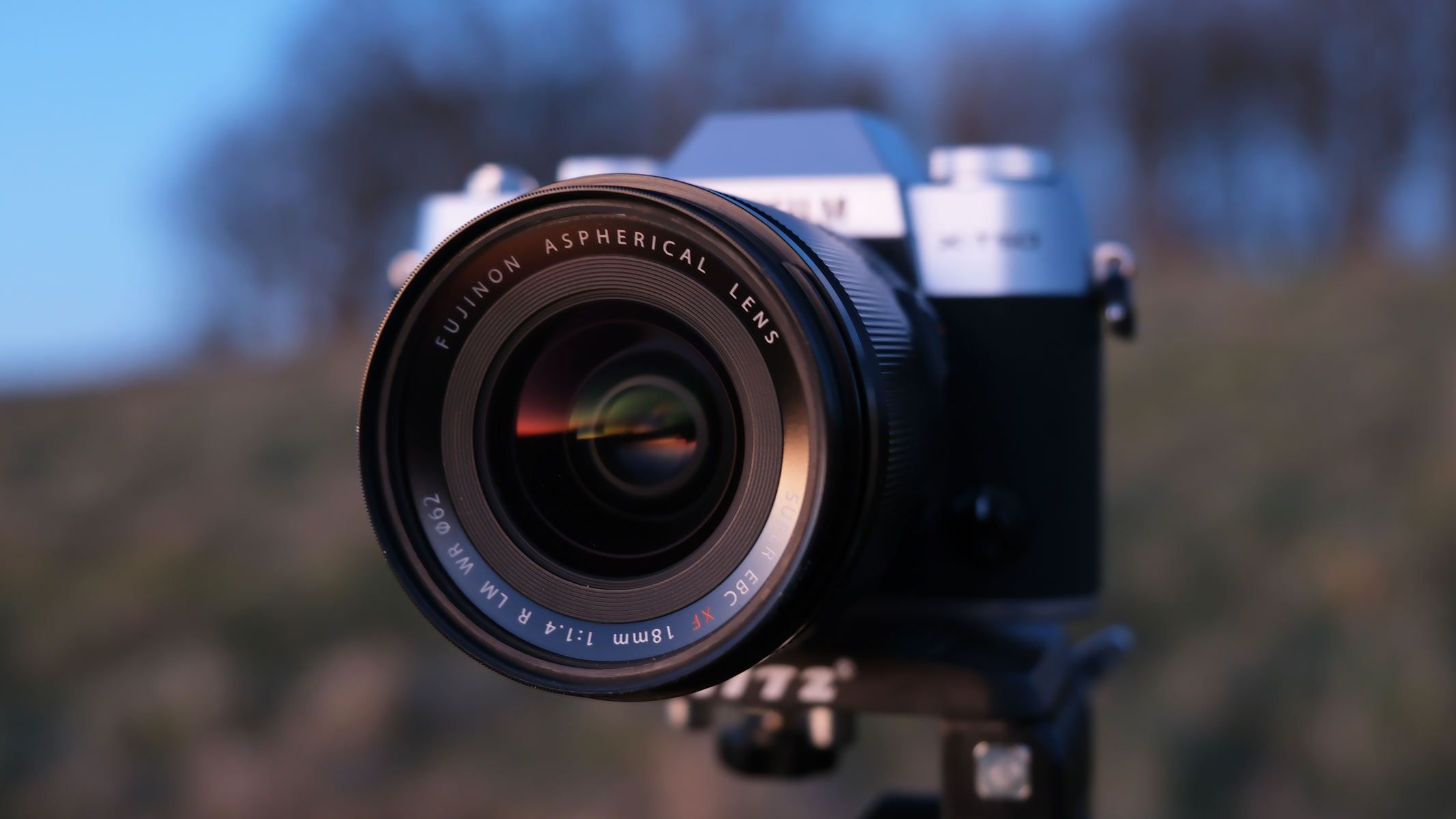
The Fujifilm X-M5 is the lightest and smallest camera in the X-series line-up, alongside the X-T5, X-T50 and X-H2. It was released in late 2024 and is targeted towards content creators and travel users, with good hybrid capability and easy switching of film simulation styles.
Fujifilm X-M5 Review
Fujifilm X-M5: Design
★★★★★

- Vintage styling is attractive and appealing to film lovers
- 26MP APS-C image sensor not ideal for astro, but performs well
- Fully articulating rear screen is useful for awkward tripod compositions, especially without an EVF
The Fujifilm X-M5 has a wonderful vintage housing reminiscent of black and grey film cameras and cuts a small size so you can carry it wherever you go. Despite the compact body, it can be used with all of the Fujifilm XF lenses, although it does start to feel overbalanced with larger zoom models.
It has a 26 MP APS-C image sensor, which might put off some astrophotographers who prefer full-frame models, but it handled astrophotography well for a camera of its size. It only weighs in at 7.8 lbs, including battery and SD card, making it pretty light for a camera with interchangeable lenses.
This camera has a creative streak with the addition of the new film simulation dial, where you can change the film recipe depending on your photography style. While I mostly shot in Provia/Standard for astrophotography, it was fun to use this dial for different photography styles, like portrait and landscape. Shooting in these different styles doesn’t change the format, so you can either shoot the style ‘baked-in’ in JPEG format or keep it non-destructive with RAW.
The three-inch, fully articulated touch screen is handy for shooting on a tripod as you can adjust it to any working angle, something that is not available on mid-range Fujifilm models like the X-T50 and X-T5.
It has a range of onscreen touch controls like focus, zoom (with a power zoom lens) and custom functions assigned to a directional swipe. The X-M5 still has the tactile, manual controls that are classic features of any Fujifilm camera. It features a mini-joystick for menu and focus point selection, a command dial for exposure control and the mode dial for selecting shooting style. A switch lever on the shutter button made it super intuitive to turn on and off as it was right near my right index finger, although left-handed users won’t benefit.
The X-M5 is a beginner camera with a focus on creativity and content creation, with the film simulation dial, vlog mode on the mode dial and red instant video record button. While it lacks the high resolution that some intermediate photographers may want, it also stands as a great learning camera with the ability to grow with different lenses for the reasonable $899 price tag.

Fujifilm X-M5: Performance
★★★★

- Amazing astro results for a non-specialist APS-C camera
- Combined with an appropriate lens nebulas are easily imaged
- High ISO sensitivities introduced a bit too much noise, for our liking
To test this camera for astrophotography, I went to a Bortle 4 area in a field in South West England during late February with nighttime temperatures of 41 degrees Fahrenheit (5 degrees Celsius).
For a non-specialist astrophotography camera, I was amazed with the astro results I got during testing. When paired with the right lens, I managed to get some decent shots of constellations and deep-space objects.
Using the XF 16-55mm f/2.8 R LM WR II lens, I was able to get a pretty good shot of Orion’s belt with the Orion Nebula (M42) glowing purple below it. With a superfast XF 18mm f/1.4 R LM WR lens, I captured the Big Dipper asterism, the full constellation of Orion, Sirius and the planet Jupiter. I even captured some star clusters like the Pleiades and Beehive cluster, albeit on a wider scale but it is still impressive to see a small camera capture a faint deep space object.
A lens with a fast aperture really helped this camera perform in the astro space but it performed well with the recommended kit lens. Shooting with the XC 15-45mm f/3.5-5.6 OIS PZ lens, I managed to capture Orion and Sirius in good detail. The kit lens suited the small size of the X-M5 body better than the larger XF lenses.
Whilst being able to shoot a range of night objects, the high ISO performance hindered the overall image quality. I shot around ISO 2,000-2,500 and there is a fair amount of luminance noise when zooming into dark space and plenty of color noise throughout the image too, showing up as purple, red and green dots. I pushed the ISO to 25,600 and whilst able to distinguish star patterns, the photo was very noisy and largely unusable.

Fujifilm X-M5: Functionality
★★★★

- Ideal beginner or travel camera for astrophotography
- Battery life suitable for long nighttime shoots
- Compatible with high-end XF lenses but may feel unbalanced when shooting
The best part about the X-M5 is how small and portable it is — it would make a great travel camera or a go-to option for casual shooting without having to take a heavy full-frame with you. I found myself reaching for this camera to take out for street photography more often than bigger cameras like the X-T50 or X-H2, and I wasn’t disappointed with its performance apart from a lack of an electronic viewfinder (EVF) for precise shooting.
While in theory the X-M5 is compatible even with huge XF lenses, it will probably feel unbalanced. The XF 18mm didn’t feel awkward, but with the XF 16-55mm and XF 8-16mm, it felt a bit lens-heavy. If you already own a host of larger XF lenses, you might be better off investing in a larger Fujifilm camera body.
If you are a beginner or want a smaller travel camera, the X-M5 is ideal, and the recommended kit lens, the XC 15-45mm f/3.5-5.6 OIS PZ, is fantastic for getting the basics of photography down with some basic astro functionality.
The battery life has a quoted life of 330 shots in standard mode and I didn’t run out during astro shooting sessions. The battery compartment has a nice nail slide latch that opens easily, should you need to replace the battery during a shooting session.

It has a single SD card slot, mic jack, mini HDMI and USB-C port, so you get access to the major connections you would want from a camera of this size. If you are planning on utilizing the X-M5’s 6K/30p and 4K/60P video capabilities, then I would recommend at least a V30 speed class SD card.

Fujifilm X-M5: User reviews
Amazon customers like the compact size of the X-M5 while not skimping on photo performance. The film simulation dial is praised and one user mentioned using it within hours of getting the camera.
Other users praise the compact and lightweight nature of the camera and say it is ideal for vlogging, street photography and content creators. Downsides reported include the lack of an electronic viewfinder (EVF), difficult ergonomics and a screen that can be difficult to see in bright conditions.
How we tested the Fujifilm X-M5

I tested the Fujifilm X-M5 with the following lenses: Fujifilm XC 15-45mm f/3.5-5.6 OIS PZ lens, XF 16-55mm f/2.8 R LM WR II lens, XF 18mm f/1.4 R LM WR lens and Fujifilm XF 8-16mm f/2.8 R LM WR lens.
I used the camera for a range of different photography styles, including portrait, street, landscape and astrophotography. For astrophotography testing, I went to a Bortle 4 area in South West England in February 2025. The nighttime temperatures reached 41 degrees Fahrenheit (5 degrees Celsius). I photographed a range of night sky objects, including the constellation Orion, the Big Dipper asterism, the Orion Nebula (M42), the Pleaides star cluster (M45), the Beehive cluster (M44) and Jupiter.
Should I buy the Fujifilm X-M5?
If you are a beginner photographer and want to get a camera that will teach you the ins and outs of photography, the X-M5 is ideal. Manual tactile controls get you used to manipulating exposure and the film simulation dial can help with your style. It will equally suit someone who wants to make a lot of video content, as it supports 6K video at 30p and 4K video at 60p. Bear in mind, you will have to make sure to buy a lens with it but this gives you the option to get new lenses as you develop your craft.
Some users may rightfully want an electronic viewfinder (EVF) for more precision during shoots and, while a lack of an EVF on this camera can be annoying for some, it helps to bring the size down. It’s a small but mighty camera that is capable of most styles of photography, as long as you like shooting via a screen.
If the Fujifilm X-M5 isn’t for you
If you are looking for a compact camera that has an even bigger video focus, look at the Canon Powershot V1. It has an internal cooling fan for extended video shooting and a built-in ultra-wide lens for selfie-style vlogging. We photographed some constellations with it, too!
If you already know the photography basics and want a camera that will keep you learning as you grow, try the Fujifilm X-T50. It has an electronic viewfinder (EVF) for photography precision and has more professional photography features like a 40MP APS-C sensor and in-body image stabilization (IBIS). It also features the same Film simulation dial that is on the X-M5.
If you are put off by the fact that this camera has a crop sensor, try a full-frame camera like the Sony A7C II, which has a 33MP sensor, a compact EVF and professional features like IBIS and weather sealing.