


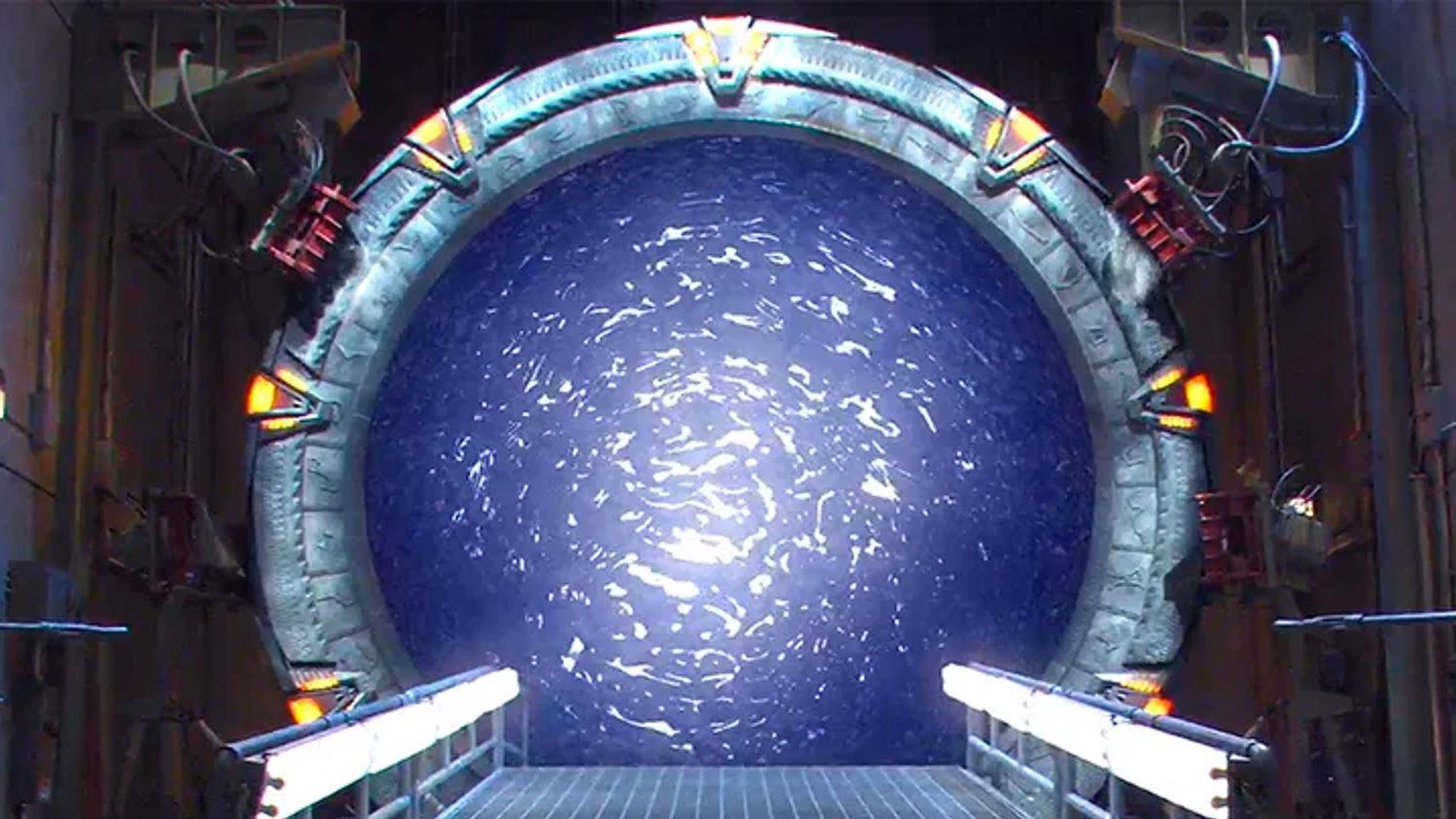
Since the wholly unexpected news that Amazon is set to relaunch “Stargate,” the internet has gone supernova with rumors, theories, fan suggestions, and an insatiable hunger for any scraps of confirmed news.
Back in November, out of the blue, Amazon announced it was officially moving forward with a brand-new entry into the “Stargate” franchise. Martin Gero, who served as a consultant and co-producer on both the “Atlantis” and “Universe” spin-off shows, is behind the new series and it appears that many members of the original creative team are also involved, including franchise figureheads Joseph Mallozzi, executive producer and writer on each incarnation, plus Brad Wright, showrunner and co-creator of all things “Stargate.”

In an interview with Dial the Gate, Gero said discussions were already underway by late 2023, with an early development agreement finalized by June 2024. He added that the quiet period following Amazon’s 2022 acquisition of MGM did not reflect waning internal enthusiasm for the franchise.
“To their credit, Amazon had already identified ‘Stargate’ as a prime candidate for a TV show,” Gero said. “They’re just a very secretive company. They’re a tech company. So the fact that you didn’t hear anything isn’t about their [lack of] enthusiasm, it was about them internally trying to figure out what to get right.”
With writing now scheduled to begin in early 2026, a debut in late 2027 or even 2028 appears increasingly realistic.
“We’re starting the writers’ room on the other side of the year,” Gero said. “These things take about two years, give or take. It might be a little shorter, it might be a little longer, hopefully it’s not longer. Just to set everybody’s expectations, it’s going to be a minute. We wanted to announce early because we didn’t want it to leak … It had been 20 or 30 people inside the company that had known about it, and to make a show you have to hire 400 people … We wanted fans to hear it from us and not from a leak.”
Gero was careful to stress that the new series is not designed to overwrite existing “Stargate” canon. “We’re not here to undo what came before,” he said, framing the project as a new entry point rather than a reset.

“Stargate SG-1” ended after an impressive 10 seasons and more than 200 episodes, with its teams continuing to explore the galaxy as the franchise successfully transitioned into “Stargate: Atlantis.” That epic spinoff lasted five seasons and 99 episodes and concluded with the ancient city splashing down in the Pacific Ocean, just a few miles off the California coast. Finally, the vastly underrated “Stargate Universe” ended after just two seasons and 40 episodes, with the crew of the “Destiny” placed into stasis in an attempt to escape pursuing drone ships. The franchise ultimately went dark in May 2011, leaving behind a stranded vessel, a sleeping crew, and a story frozen in time.
Much has changed in the 14 years since. At its peak, a “Stargate” episode cost roughly $2 million, compared with reported averages of around $9 million for modern “Star Trek.” Moreover, the traditional 22-episode season has all but vanished, with modern audiences often receiving little more than half that number. While Gero stopped short of specifying episode counts, his comments reflected the realities of modern streaming production, signaling shorter, more tightly constructed seasons rather than a return to the franchise’s traditional 20-plus-episode runs.
Production technology has evolved as well. Since the development of “the Volume,” the wraparound LED wall and ceiling system that began life as ILM’s StageCraft on “The Mandalorian,” many more studios around the world have adopted similar virtual production setups. At the very least, opportunities for expanded world-building now exist in ways they never did before.

Across social media platforms, forum threads, and fan-site comment sections, the dominant refrain is a call for continuity without calcification. Rather than a hard reset or nostalgia-soaked revival, many fans argue for a new entry point set firmly within the existing “Stargate” universe, with a fresh team, new stakes, and a sense of forward motion.
There is also a clear appetite for unresolved threads to be acknowledged, even if they are not placed front and center, alongside a broader plea for the show to rediscover its tonal sweet spot. “We have to earn every view,” Gero said. “We’re gonna try to earn every view, be it longtime fans or brand-new people.”
Commenting on X, Mallozzi said, “Martin has been developing this show for a while now. A little over a year ago, he reached out and asked, ‘Want to read something cool?’ That something turned out to be his pilot script for the new Stargate series.”

“Now I obviously can’t say too much about the content at this point – but I can assure you that it embraces everything that made the original Stargates so great: heart, humor, rich mythology, exploration, action, adventure, compelling/endearing characters, and that overall sense of optimism and fun that made you fall in love with Stargate,” Mallozzi said.
No doubt countless ideas were debated over the course of those 18-or-so months, but it appears a plan is now firmly in place. Many questions remain, not least of which is casting. The new series inherits a daunting legacy, as “Stargate” excelled at character-driven storytelling, forging some of television sci-fi’s most compelling relationships, whether it was Jack O’Neill and Daniel Jackson, Rodney McKay and John Sheppard, or Nicholas Rush and Everett Young.
“We’re not casting yet. We’re nowhere near casting yet,” Gero said. “You really want the writing to lead the casting, not the other way around.”

Since that interview, Mallozzi shared on X recently that the writers have convened for the first time to begin fleshing out ideas for the new show. “The first couple of weeks will be spent discussing the Big Picture. Things like… What shape is the gate? What are our character and story arcs? How does our first season conclude? Who are our villains and what do they want?” he wrote.
It has also been announced that the new show will film in London and not Vancouver, as had been assumed. According to Gateworld, the main stages will be in London, but filming will take place worldwide. Production is expected to begin in fall 2026, with a possible September start under discussion.
The London region also makes practical sense for a production of this scale. Beyond standard UK tax breaks, Amazon MGM Studios controls a sizable studio footprint in the area, with owned or long-term leased facilities ranging from Shepperton Studios in Surrey to Bray Film Studios in Berkshire, the latter acquired by the company in 2024.

It also turns out that “Stargate: Atlantis” star Joe Flanagan was personally invited to the writer’s room for the new series by Gero, as revealed in a recent interview with Dial the Gate. Flanagan himself lives in the Malibu area and is even occasionally spotted window shopping in Santa Monica, so he didn’t have far to travel.
While the series has yet to receive an official title, the Stargate project is being produced by Safehouse Pictures, led by executive producers Joby Harold and Tory Tunnell. Additional production partners include Quinn’s House Productions, the banner run by Brad Wright Gero, along with Electric Entertainment from Dean Devlin, Centropolis Entertainment, founded by Roland Emmerich, and Amazon MGM Studios.
Within the US, Amazon offers a dedicated 24-hour “Stargate” channel on Freevee, Amazon’s ad-supported streaming service. This is free to watch with ads and does not require a subscription or additional expense.
Outside of the US, Amazon offers “Stargate” through Prime or a separate MGM+ subscription. Moreover, all three of the “Stargate” television shows are coming to Netflix, both in the US and the UK, in mid-February.