

Defence Minister Richard Marles has refused to rule out fuel rationing in Australia as the conflict in Iran enters its third week and global oil markets come under mounting pressure.
When asked whether the government was considering rationing if the crisis continued, Marles said it was not something he could rule out.
‘Obviously, this is a function of how long this conflict continues and this is not something I can answer in terms of what’s going to happen, but we are taking the measures we are taking right now,’ Marles said.
He told the ABC on Tuesday morning that the government had acted over the weekend to strengthen domestic supply.
‘We have taken steps to put more fuel supply into the system over the course of the weekend, where we released 20 per cent of the stock holdings that are kept in Australia, and that will see around 716 million litres of extra fuel go into the system,’ he said.
‘That’s obviously a significant amount.’
Marles reiterated that Australians should not panic buy and stressed that supply remained steady across the country.
‘Right now, our message to Australians is to just keep going on as you normally would,’ he said.

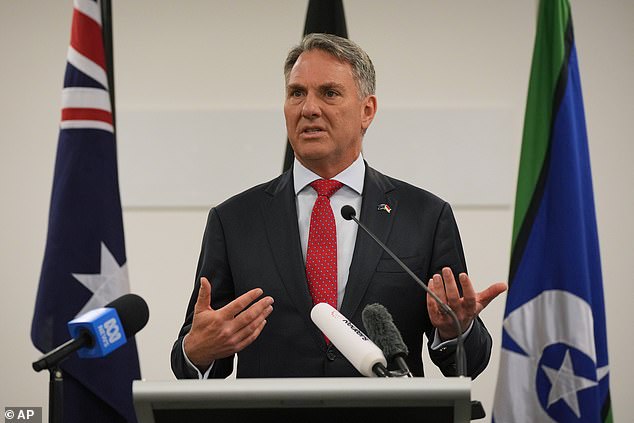
Richard Marles (pictured) would not rule out fuel rationing if the Middle East war continues
‘As we speak, the same amount of ships that are coming in and supplying Australia are doing that.’
Fuel prices are soaring after Iran closed the Strait of Hormuz, one of the world’s most important oil corridors, in response to attacks by US and Israeli forces.
This has pushed petrol prices to well over $2.20 a litre and diesel to more than $2.60 a litre, prompting panic buying, shortages and rationing, particularly in regional areas.
Small-town service station owner Nathan Falvo said his business was facing its worst fuel shortage in 25 years.
Mr Falvo was forced to ration the latest fuel delivery at his petrol station in Robinvale, in Victoria’s far northwest, after running dry over the weekend.
He said the shortage had spread to the town’s two other stations, which have also introduced a $50 sales limit.
‘Basically the whole town, which is one of the fruit bowls of Australia, was out of fuel,’ Mr Falvo said.
‘I’ve been here at this business for 25 years and I’ve never seen this happen before. All three stations were out.’
Some growers were being crushed by skyrocketing fuel prices, which are driving up their transport costs and pushing up the price of fruit and vegetables at the supermarket, Queensland independent MP Bob Katter said.
Katter said some growers were questioning whether they could afford to harvest fruit this season.
‘We are being told farmers are letting fruit rot as the cost of picking it and trucking it to market no longer stacks up, which should send a chill through every government office in this country,’ he said.
The government should halve the fuel excise from 50 to 25 cents a litre, to help primary producers with their transport costs, Katter said.
Such a measure was introduced for six months in 2022 to help motorists with cost-of-living pressures, and promised by the coalition in the lead up to its 2025 election.
Treasurer Jim Chalmers has previously said slashing the fuel tax was not being considered.
The federal government on Friday announced up to 762 million litres of petrol and diesel from companies’ emergency reserves could be released to address shortfalls.
Federal Transport Minister Catherine King said those measures would soon begin making a difference, particularly in regional areas.
Labor has repeatedly said Australia has enough fuel and shortages were driven by unnecessary panic-buying.
Several other Victorian towns including Wedderburn and Bonnie Doon also ran out of fuel over the weekend, according to Victorian Farmers Federation president Brett Hocking.
Fuel deliveries to farms have also been affected, with some farmers facing a two-week wait.
‘Melbourne service stations are also seeing unprecedented demand there as well, that’s putting constraints around the availability of trucks that can deliver fuel up to rural areas,’ Mr Hocking said.
Regional communities in NSW have likewise reported fuel shortages, Premier Chris Minns told reporters on Monday.
Retailers in the state will need to issue a public notice on the NSW FuelCheck website when out of stock, Mr Minns said after a roundtable with industry leaders.
Extra fuel will also be directed to areas facing shortages with the premier promising government intervention if motorists can’t get access to the petrol and diesel they need.