


A high-profile dispute involving a Michelin-starred chef has further delayed a proposed affordable housing development in California near his world-famous restaurant The French Laundry.
Thomas Keller, the famed bi-coastal chef behind two of the town’s most elite eateries, Michelin Guide-listed Bouchon and three-Michelin-starred, The French Laundry has emerged as one of the project’s most prominent critics.
Plans to build up to 150 homes in the Napa Valley town of Yountville have now been paused after residents successfully triggered a referendum, suspending a key zoning change tied to the Yountville Commons project.
Keller, whose restaurant has prices that can reach north of $1,000 per person, raised concerns about communication from town leaders and the pace of the project.
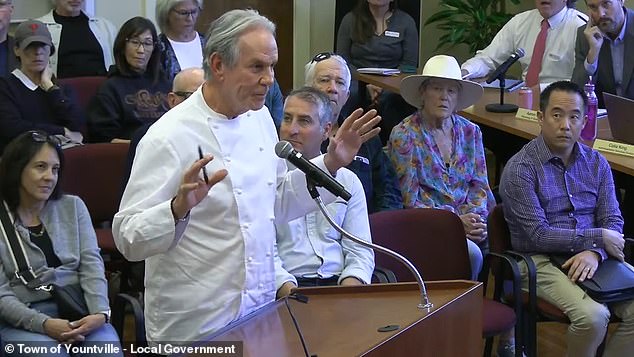
‘I have reached out to each one of you; none of you has reached out to me,’ Keller said during the March 3 meeting. ‘I welcome conversations as you do. So, I’m available. Each one of you has my phone number; you know where I am every day.’
While Keller has said he supports affordable housing in principle, he has raised concerns about aspects of the current proposal.
He said the ‘studio-heavy, dormitory-style approach’ and limited parking may not meet the needs of local workers.
Town clerk Hilary Gaede confirmed that officials received enough verified signatures to suspend the zoning ordinance tied to the project, meaning its future could now be decided by voters.

Celebrity chef Thomas Keller has led opposition to a housing project near his famed restaurant The French Laundry

Keller’s esteemed restaurant The French Laundry (pictured) would be only a two minute drive from the proposed new housing

Keller is also behind Yountville’s Michelin Guide-listed Bouchon (pictured)
The referendum, organized by resident Jessi Bugden, gathered 235 signatures, according to the Yountville Sun, requiring the town council to either repeal the ordinance or place the issue on a public ballot.
If it proceeds to a vote, the project could be delayed until November.
The project, estimated to cost between $40 million and $60 million, would redevelop the former Yountville Elementary School site into a mixed-use housing complex aimed at local workers.
Town manager Brad Raulston has said the development is essential in a town where the cost of living is significantly higher than the national average and many employees commute from outside the area.
Ranch Market owner Arik Housley said the town should take time to better understand the financial implications of the project.
‘That means we owe it to the community to fully understand the financial exposure before moving ahead,’ he said.
Under current plans the site would be divided into 18 parcels, with roughly 120 rental units initially and the potential to expand to around 150 homes built in phases.

Yountville (pictured), which is home to fewer than 4,000 residents, boasts several upscale restaurants – and a cost of living nearly 40 percent higher than the national average

Keller, a famed bi-coastal chef, is behind two of the town’s most elite eateries, one being three-Michelin-starred The French Laundry, where dinner with wine pairings can soar past $1,000 per person

Yountville Commons (plan pictured), a mixed-use development featuring affordable and market-rate housing, has been in the works since its approval last year

The town manager noted that because most of Yountville’s workforce are commuters, the new homes will not fully solve the town’s housing challenges (pictured: food at The French Laundry)
However, some critics argue that outreach has not sufficiently included employers and workers the housing is intended to serve.
Council member Hillery Trippe, the lone vote against the zoning plan, also raised concerns about the design, noting that about 70 percent of the proposed studio units would be under 300 square feet with limited parking.
‘We will be asking people to live in Yountville without a car, which is very tough,’ she said.
The town purchased the former school site for $11 million in 2024 using funds from a 2018 ballot measure that raised lodging taxes to support workforce housing.
The council is expected to revisit the referendum at its next meeting on April 7, where officials must decide whether to repeal the zoning ordinance or allow voters to weigh in.