



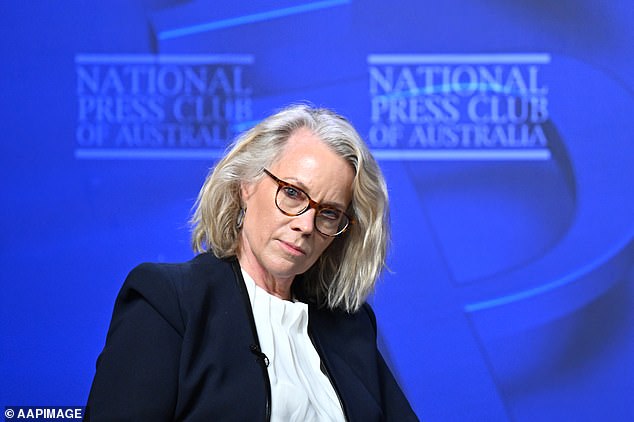
ABC global affairs editor Laura Tingle is stranded in Dubai after airspace across much of the Middle East was shut down amid Iran’s retaliatory attacks following US and Israeli missile strikes that killed Iran’s supreme leader.
Tingle said she hoped to provide Australians with information about what was going on in the region while she is stranded.
‘You have probably heard about ‘massive barrages’ of missiles and drones pouring down on Gulf States, like the United Arab Emirates, from Iran,’ Tingle said.
‘The numbers do sound pretty staggering – for example, the UAE Ministry of Defence spokesperson reported late on Tuesday that ‘since the beginning of the Iranian aggression, the UAE’s air defences have dealt with 186 ballistic missiles and 812 drones’.
‘For the tens of thousands of Australians trapped in the UAE cities of Dubai and Abu Dhabi, that sounds pretty scary. So far, though, the country’s air defence systems, like surface-to-air missiles, have destroyed the vast majority of these weapons, and the damage has been quite minimal, given the amount of weaponry involved.
‘Here in Dubai, you can hear the odd ‘bang’ when one of the incoming projectiles is destroyed in the sky. But over the past couple of days, there have been only one or two plumes of smoke seen here and there.’
Tingle said a significant share of the destruction, and some of the deaths, has been attributed to debris from intercepted missiles falling back to the ground
‘The nagging concern, however, here in Dubai is whether there are sufficient supplies of these air defence missiles and systems to maintain that level of defence if Iran continues its relentless campaign. Things could get pretty nasty if the drone supply starts to run down.’

ABC star Laura Tingle is stranded in Dubai after airspace across the Middle East was shut down as Iran continues its retaliatory attacks in the region
Around 115,000 Australians are also believed to be stuck across the Middle East, with the escalating crisis causing major disruptions to international air travel.
A small number of flights have resumed from Gulf airports as government’s try to move the thousands of people stranded by Saturday’s airspace closure.
A flight bound for Sydney has left Dubai carrying Australians and is expected to land at Sydney Airport after 10.30pm on Wednesday evening.
Foreign Minister Penny Wong earlier confirmed the flight ahead of its departure but warned the situation remained ‘perilous’.
‘This is a consular crisis that dwarfs … any that Australia has had to deal with in terms of numbers of people,’ she told ABC radio.
People are advised to stay in contact with their airlines as the situation is rapidly changing.
While some limited flights are resuming out of the UAE, services are largely grounded, leaving tens of thousands of Australians potentially trapped for weeks.
Asked if people could fly out of the Middle East via Saudi Arabia or Oman, the foreign minister said all options were being considered while noting the conflict had spread to the broader region.
Senator Wong maintained commercial flights remained the best way to get large numbers of people back to Australia.
The war began on Saturday with the killing of Iranian Supreme Leader Ayatollah Ali Khamenei in a joint US-Israeli strike.
President Donald Trump said the U.S. objectives include destroying Iran’s naval and missile capabilities and preventing the country from obtaining a nuclear weapon. He said he expects the operation to take 4 to 5 weeks.
The Iranian Red Crescent Society on Monday said that attacks on 131 Iranian cities have killed at least 555 people so far in the Islamic Republic. Strikes in Tehran apparently took Iran’s state television off the air.
Iran has launched retaliatory missiles and drones targeting Israel and nearby Arab Gulf countries hosting U.S. forces.
Several ships have been attacked in the Strait of Hormuz, where a fifth of all traded oil passes. Shipping companies suspended their vessels’ traffic through the Suez Canal, adding to fears the strikes could rattle global markets.
Elsewhere, fire and smoke poured out of the U.S. Embassy compound in Kuwait after an Iranian attack.
Bahrain, the island kingdom that is home to the U.S. Navy’s 5th Fleet, says it has intercepted dozens of missiles and attack drones, and that one person was killed.
In Israel, 11 people have been killed, including nine in a strike on a synagogue in the central town of Beit Shemesh.
In Iraq, an Iraqi Shiite militia claimed a drone attack Monday targeting U.S. troops at the airport in Baghdad.
And at least 22 people were killed in clashes with police in northern Pakistan and in the southern port city of Karachi after hundreds of protesters stormed the U.S. Consulate there, authorities said.
The escalating conflict has caused canceled flights, deadly protests, suspended shipping and soaring oil prices.
Iran has expanded its attacks to regional oil infrastructure, directly targeting the lifeblood of the region’s economy.