


A long running scientific dispute about the origin of the Silverpit Crater beneath the southern North Sea has now been settled.
New research shows that the structure formed when an asteroid or comet struck the region roughly 43 to 46 million years ago.
The investigation was led by Dr. Uisdean Nicholson of Heriot-Watt University in Edinburgh and supported by the Natural Environment Research Council (NERC). The team combined seismic imaging, microscopic analysis of rock fragments, and computer modeling to produce the clearest evidence yet that Silverpit is one of Earth’s rare impact craters.
The study appears in the journal Nature Communications.
A Hidden Crater Beneath the North Sea
Silverpit lies about 700 meters beneath the seabed in the North Sea, roughly 80 miles off the coast of Yorkshire.
Since geologists first identified the formation in 2002, the three kilometer wide crater and its surrounding ring of circular faults spanning about 20 km have sparked intense debate.
Early research proposed that the feature was created by a high speed asteroid impact. Supporters of that idea pointed to its round shape, central peak, and surrounding concentric faults, which are often seen in known impact craters.
Other scientists suggested different explanations. Some proposed that underground salt movement distorted the rock layers and created the structure. Others argued that volcanic activity may have caused the seabed to collapse.
In 2009, geologists even voted on the issue. According to a report in the December 2009 issue of Geoscientist magazine, most participants rejected the asteroid impact explanation at the time.
The latest findings now overturn that conclusion.
New Seismic Data Reveals Evidence of Impact
Nicholson’s team analyzed newly available seismic imaging and geological samples taken from beneath the seabed.
Dr. Uisdean Nicholson, a sedimentologist in Heriot-Watt University’s School of Energy, Geoscience, Infrastructure and Society, said: “New seismic imaging has given us an unprecedented look at the crater.
“Samples from an oil well in the area also revealed rare ‘shocked’ quartz and feldspar crystals at the same depth as the crater floor.
“We were exceptionally lucky to find these — a real ‘needle-in-a-haystack’ effort. These prove the impact crater hypothesis beyond doubt, because they have a fabric that can only be created by extreme shock pressures.”
These microscopic minerals form only under the extreme pressures generated during asteroid impacts, providing strong confirmation of the event.
Asteroid Strike Triggered a Massive Tsunami
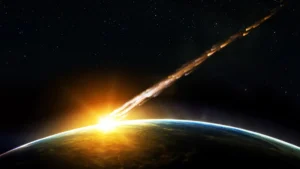
The evidence indicates that an asteroid about 160 meters wide slammed into the seabed at a shallow angle from the west.
Dr. Nicholson said: “Our evidence shows that a 160-meter-wide asteroid hit the seabed at a low angle from the west.
“Within minutes, it created a 1.5-kilometer high curtain of rock and water that then collapsed into the sea, creating a tsunami over 100 meters high.”
The impact would have produced a violent explosion at the seafloor and sent enormous waves spreading across the region.
The “Silver Bullet” That Ended the Debate
Professor Gareth Collins of Imperial College London attended the 2009 debate about the crater’s origin and contributed the numerical simulations used in the new research.
Professor Collins said: “I always thought that the impact hypothesis was the simplest explanation and most consistent with the observations.
“It is very rewarding to have finally found the silver bullet. We can now get on with the exciting job of using the amazing new data to learn more about how impacts shape planets below the surface, which is really hard to do on other planets.”
A Rare and Well Preserved Impact Crater
Dr. Nicholson said, “Silverpit is a rare and exceptionally preserved hypervelocity impact crater.
“These are rare because the Earth is such a dynamic planet — plate tectonics and erosion destroy almost all traces of most of these events.
“Around 200 confirmed impact craters exist on land, and only about 33 have been identified beneath the ocean.
“We can use these findings to understand how asteroid impacts shaped our planet throughout history, as well as predict what could happen should we have an asteroid collision in future.”
Confirming Silverpit as an impact crater places it in the same category as well known structures such as the Chicxulub Crater in Mexico, which is linked to the dinosaur mass extinction, and the Nadir Crater off the coast of West Africa that was recently identified as another impact site.
The research was funded by the Natural Environment Research Council (NERC).