
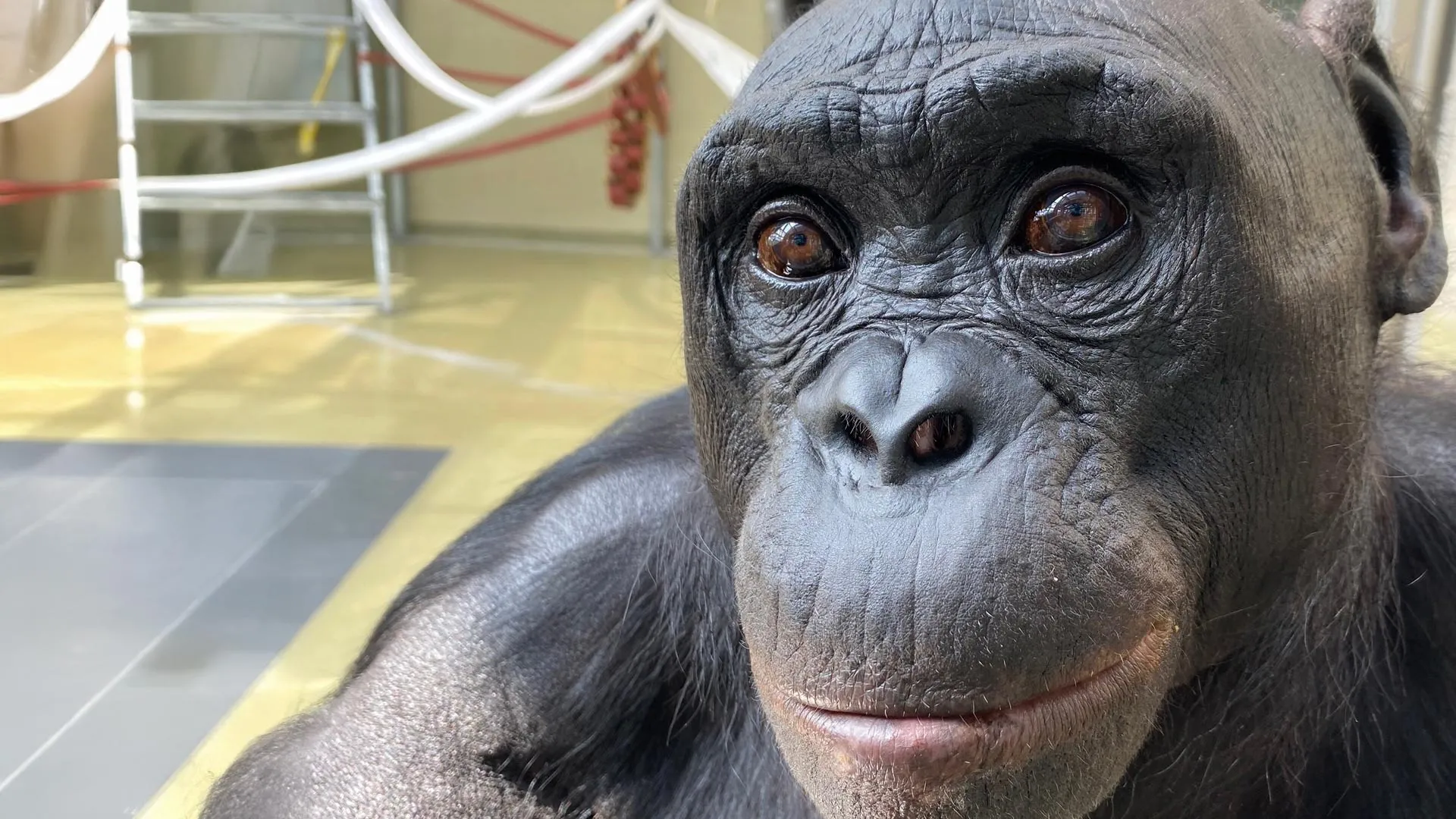
In a set of playful experiments modeled after children’s tea parties, researchers at Johns Hopkins University have shown for the first time that apes can use imagination and take part in pretend play. This ability was long believed to belong only to humans.
Across three carefully designed experiments, a single bonobo interacted with imaginary juice and pretend grapes in a consistent and repeatable way. The results push back against traditional ideas about animal intelligence and suggest that some animals may think more flexibly than previously assumed.
The researchers say the ability to understand pretend objects appears to fall within the cognitive range of at least one enculturated ape. They also suggest this mental skill may have deep evolutionary roots, possibly stretching back 6 to 9 million years to a shared ancestor of humans and modern apes.
“It really is game-changing that their mental lives go beyond the here and now,” said co-author Christopher Krupenye, a Johns Hopkins assistant professor in the Department of Psychological and Brain Sciences who studies how animals think. “Imagination has long been seen as a critical element of what it is to be human but the idea that it may not be exclusive to our species is really transformative.
“Jane Goodall discovered that chimps make tools and that led to a change in the definition of what it means to be human and this, too, really invites us to reconsider what makes us special and what mental life is out there among other creatures.”
The study was published in Science.
How Pretend Play Develops in Humans
Human children typically begin engaging in pretend activities, such as tea parties, by around age two. Even younger infants show early signs of understanding make-believe. At just 15-months-old, babies often react with surprise when someone pretends to empty a cup and then acts as if they are drinking from it.
Despite these well-documented behaviors in children, no controlled experiments had previously tested whether nonhuman animals could understand or track pretend situations. This gap existed even though there have been many anecdotal observations from both the wild and captive settings.
In nature, young female chimpanzees have been seen carrying sticks and treating them like infants. In captivity, at least one chimpanzee appeared to drag imaginary blocks across the floor after playing with real wooden ones.
Designing a Controlled Test of Ape Imagination
Krupenye and co-author Amalia Bastos, a former Johns Hopkins postdoctoral fellow who is now a lecturer at Scotland’s University of St. Andrews, set out to examine pretend play under controlled conditions.
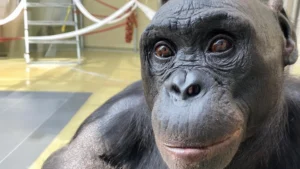
They designed experiments similar to children’s tea parties and tested Kanzi, a 43-year-old bonobo living at Ape Initiative. Kanzi had previously been reported to show signs of pretend behavior and could respond to spoken questions by pointing.
During each test, Kanzi sat across a table from an experimenter. The table was arranged with empty cups and pitchers or with bowls and jars, all set up to resemble a playful social activity.
Tracking Invisible Juice and Imaginary Grapes
In the first experiment, two empty transparent cups sat beside an empty transparent pitcher. The experimenter pretended to pour juice into both cups, then acted out dumping the juice from one cup, shaking it to show it was empty. The experimenter then asked Kanzi, “Where’s the juice?”
Most of the time, Kanzi pointed to the cup that was meant to still contain the pretend juice. He continued to do so even when the experimenter moved the cups around.
To rule out the possibility that Kanzi believed real juice was hidden inside the cup, the researchers ran a second test. This time, one cup contained real juice and the other contained pretend juice. When asked what he wanted, Kanzi almost always pointed to the real juice.
A third experiment followed the same logic but used grapes instead. The experimenter pretended to eat a grape from an empty container and then placed it into one of two jars. After pretending to empty one jar, the experimenter asked, “Where’s the grape?” Once again, Kanzi indicated the jar holding the pretend object.
Kanzi did not respond correctly every time, but his answers were reliably accurate.
What the Findings Mean for Animal Minds
“It’s extremely striking and very exciting that the data seem to suggest that apes, in their minds, can conceive of things that are not there,” Bastos said. “Kanzi is able to generate an idea of this pretend object and at the same time know it’s not real.”
The researchers say these findings open the door to further studies. Future work may explore whether other apes, or even other animals, can engage in pretend play or track imaginary objects. The team is also interested in testing related mental abilities, such as thinking about the future or understanding what others might be thinking.
“Imagination is one of those things that in humans gives us a rich mental life. And if some roots of imagination are shared with apes, that should make people question their assumption that other animals are just living robotic lifestyles constrained to the present,” Krupenye said. “We should be compelled by these findings to care for these creatures with rich and beautiful minds and ensure they continue to exist.”