There was a queue for the queue – and then another queue after that. When legendary American fast-food franchise Chick-fil-A opened its first London restaurant earlier this month, such was the excitement, customers lined up across the road for a ticket merely entitling them to wait outside the restaurant.
‘When I queued for [fried-chicken outlet] Popeyes in Coventry a couple of years ago, we all got free T-shirts,’ moaned 22-year-old Sasha who waited for an hour in Kingston last Saturday to be one of the first inside.
‘There were no freebies this time, but we were all so excited it didn’t matter. People were filming for social media, laughing, it was a party.’
The queue began over the road on Clarence Street – near the station – where a security guard handed customers a ticket allowing them to join a second queue on Eden Street, snaking airport-style into the restaurant.
Viral videos circulating on TikTok showed hungry families, many with young children, finally making it inside only to be met by a third queue: the wait now no doubt compounded by the tantalising smell of fried chicken filling the air.
‘It was utter chaos,’ recalled Ria, one of an army of employees paid to serve up deep-fried chicken to the crowds at the new branch. ‘We sold 10,000 sachets of sauce in a single day,’ she concluded, referring to the chain’s beloved ‘Chick-fil-A’ sauce which is the driving force behind the current mania.
The yellow gloopy sauce, closer in texture to melted cheese than mayonnaise, is essentially vamped ketchup with a ‘smoky’ flavour one customer puts down to ‘pickle juice and paprika’.
But despite the current frenzy in Kingston, it has not always been so.

Between 2003 and 2009, Chick-fil-A was found to have donated $3 million to religious groups opposed to homosexuality as well as a further $2 million in 2010 alone

The queue for Chick-fil-A began over the road where a security guard handed customers a ticket allowing them to join a second queue on another street
Back in 2019, Chick-fil-A made its first foray into the British market with a restaurant in the Oracle shopping centre in Reading.
However, when the restaurant opened on October 10, Reading Pride held a protest attended by more than 60 people shouting ‘cluck off’ and calling for a public boycott. According to organiser Kirsten Bayes, the company’s stance on homosexuality went ‘completely against our values, and that of the UK’.
The protesters were furious that Chairman Dan Truett Cathy, son of original founder Samuel Truett Cathy, admitted that he was ‘guilty as charged’ with regards to supporting the ‘Biblical definition of a family’.
America at the time was convulsed in the debate over gay marriage.
Dan declared: ‘I pray God’s mercy on our generation that has such a prideful, arrogant attitude to think that we have the audacity to define what marriage is about.’
It soon emerged that the company had donated millions of dollars to charities furiously opposed to homosexuality.
Just eight days into service and – following furious protests against the company’s perceived homophobia – the American chicken giant announced it would not renew its six-month lease.
The liberal backlash to the company’s anti-gay-marriage stance was fierce and pronounced. The Jim Henson toy company pulled out of an ongoing collaboration and by way of apology donated money to the gay rights group Glaad.
Chairman Dan Truett Cathy, however, was undeterred, describing the US Supreme Court’s 2013 recognition of same-sex marriages as a ‘sad day for our nation’.
Between 2003 and 2009, Chick-fil-A was found to have donated $3 million to religious groups opposed to homosexuality as well as a further $2 million in 2010 alone, according to a report from LGBTQ advocacy group Equality Matters.
Among the lucky recipients was the Paul Anderson Youth Home, which has taught the young people in its care that homosexuality is a ‘rage against Jesus Christ and his values’.
Chick-fil-A has not been without its supporters. The eccentric Alaskan former vice-presidential candidate and reality-TV star Sarah Palin (‘If God had not wanted us to eat animals, how come he made them out of meat?’) claimed Dan Truett Cathy was being ‘crucified’ for his views.
Finally, in 2019, not long after the furore, the chain began and ended its ill-fated expansion into Britain.
But that was then.
Seven years later, and the world is a very different place. And if this week’s frenzy is anything to go by, something has changed dramatically in our country with regards to consumer conscience.
After the ecstatic response to the new restaurant last Thursday, might the success of this one chicken shop in south-west London be a telling sign that 2010s cancel culture is on the wane, that the obession with injecting the culture wars into business is tiring and that a new generation of young people having been force fed a diet of Black Lives Matter, #MeToo, Time’s Up and Just Stop Oil are now more interested in the ‘what’ a company does, rather than the ‘who’ and the ‘why’?
Join the debate
Would YOU join a boycott or still give it a try?

When the restaurant last opened in the UK, it was met with protests over Chairman Dan Truett Cathy who admitted that he was ‘guilty as charged’ with regards to supporting the ‘Biblical definition of a family’

There are six variations on the chicken sandwich to choose from, ranging from the ‘classic’ – no more than a sweet brioche bun, fried chicken and pickles – to the ‘spicy deluxe with chilli cheddar cheese’
The firm began life in 1946 as The Dwarf Grill, but the first official Chick-fil-A opened in 1967 inside the Greenbrier Shopping Centre in Atlanta, Georgia, with the strap-line: ‘We Didn’t Invent the Chicken, Just the Chicken Sandwich.’
The man behind it was the late Samuel Truett Cathy, a devout southern Baptist who taught at a Sunday school for half a century – and to this day no Chick-fil-A has ever opened on the Lord’s day.
It was Samuel who, allegedly inspired by his mother, tried cooking boneless chicken in a pressure cooker, discovering the method could produce perfectly juicy breasts at the same speed as flipping hamburgers. The Truett Cathy family are now worth an estimated $34 billion.
In the United States, Chick-fil-A is as familiar to fast-food junkies as McDonald’s, Burger King and KFC. The chain – which operates a franchise model – employs 200,000 ‘team members’ across 3,000 restaurants with an annual turnover of more than $22 billion and has, for the past eleven years, topped America’s Consumer Satisfaction Index for fast food brands.
The typical American Chick-fil-A enjoys revenues of $9.4 million per year: double that of the average McDonald’s franchise. However, with just 100 applications approved each year against 40,000 franchise enquiries, you’ve got better odds of getting into Harvard than opening your own Chick-fil-A.
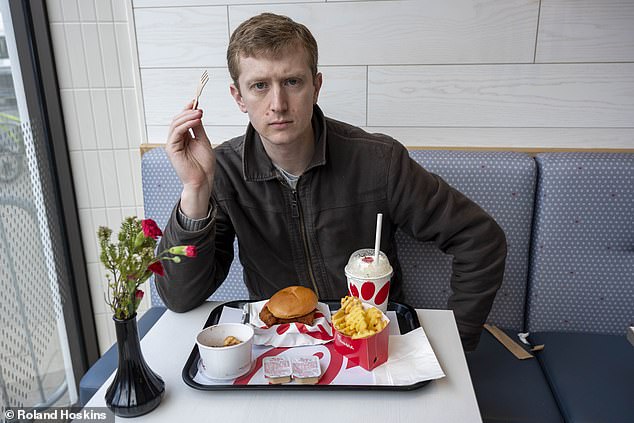
With plain tiles and light wooden furnishings plastered with red and white branding, Chick-fil-A in Kingston looks like any other global fast-food outlet. Unlike other chains, table service is available here, with employees taking orders on iPads with ruthless efficiency.
There are six variations on the chicken sandwich to choose from, ranging from the ‘classic’ – no more than a sweet brioche bun, fried chicken and pickles – to the ‘spicy deluxe with chilli cheddar cheese’.
A classic sandwich with waffle fries and a beverage will set you back just over £10, equivalent to a similar meal from KFC or McDonald’s.
At £6.49 for eight grilled nuggets, however, each one weighing just 11g, some items are certainly more expensive than others.

After the ecstatic response to the new restaurant last Thursday, might the success of this one chicken shop in south-west London be a telling sign that 2010s cancel culture is on the wane?

‘We sold 10,000 sachets of sauce in a single day,’ one employee said, referring to the chain’s beloved ‘Chick-fil-A’ sauce which is the driving force behind the current mania
‘You’ve got to get the sauce, it’s really good,’ 23-year-old Nicholas Parker – who’d travelled an hour across south London – told the Daily Mail. ‘Then get the waffle fries. Get a chicken burger. Get a cookies and cream shake. Get the lemonade… then see how you’re feeling.’
Just before 1pm and as the lunch-rush kicked in, about 50 people waited with varying degrees of patience outside the Eden Street store. Gaggles of girls in school uniform recorded videos on their phones, dancing in front of the Chick-fil-A logo.
Inside, with the sickly smell of deep-fried grub pumping out the kitchen, a battalion of fevered employees raced to hand out menus.
‘The sauce is what is special,’ declared 30-year-old American Marianthi, who had travelled over an hour.
‘I’m known for buying bottles of the sauce in US supermarkets and bringing it back here. I’ve been stopped at the airport and had to explain why I’ve got bottles of Chick-fil-A sauce in my bag.’
The verdict on the British offering? ‘It tastes healthier here,’ said Marianthi as she chowed down cheerfully on her cheap chicken and chunky chips. ‘Probably fewer additives, but the fries aren’t as crunchy.’
Indeed, the company’s waffle-shaped fries came under scrutiny in 2024 after it was revealed pea starch was being added to the recipe to help the potato ‘stay crispier, longer’. Critics were quick to point out that pea starch is often used as a thickening agent in dog food.
Marianthi revealed that she happened to be gay – as so was was her dining companion Theo, 23. And yet, perhaps surprisingly – and in a sign of the changing times – both seemed completely unfazed by Chick-fil-A’s historic homophobia.

‘The sauce is what is special,’ declared 30-year-old American Marianthi, who had travelled over an hour for the opening
‘Maybe we’re betraying our people,’ said Theo – a chicken-shop habitue – dressed all in black and with a touch of chicken fat in his wispy beard.
‘But if I don’t eat this chicken nugget, will it change the company?’ he added.
‘I’m OK with a company upholding its religion,’ continued Marianthi. ‘I’ll still eat their food even though I’m gay. They’re not harming anyone.’
Indeed, this appeared to be the prevailing view in a restaurant full of hungry diners who were more interested in the taste of the chicken than the religious views of the people selling it.
‘It’s not justifiable [the homophobia], but I’m just one guy,’ Alex, in his thirties, said while enjoying a milkshake, having been brought to the restaurant by girlfriend Kirstie after she saw an advert on TikTok.
Not everyone, however, has been so blasé. On opening day last Thursday, a protest organised by the veteran LGBT campaigner Peter Tatchell’s eponymous foundation saw a man dressed in an eight-foot chicken suit display a placard calling for customers to boycott the premises.
‘Chick-fil-A’s funding of bigotry is out of step with British values,’ said Tatchell. ‘There should be no place in the UK for a business that uses its profits to fund prejudice.’
But whether or not Tatchell has a point, I note that nobody is queuing for the neighbouring McDonald’s, Wendy’s or German Donner Kebab branches – all within 50 yards of the new Chick-fil-A.
Quite clearly, for the thousands of chicken lovers, ‘Taste is King’ as the slogan goes. And in the less hysterical world of the 2020s, a company’s politics are for the birds.