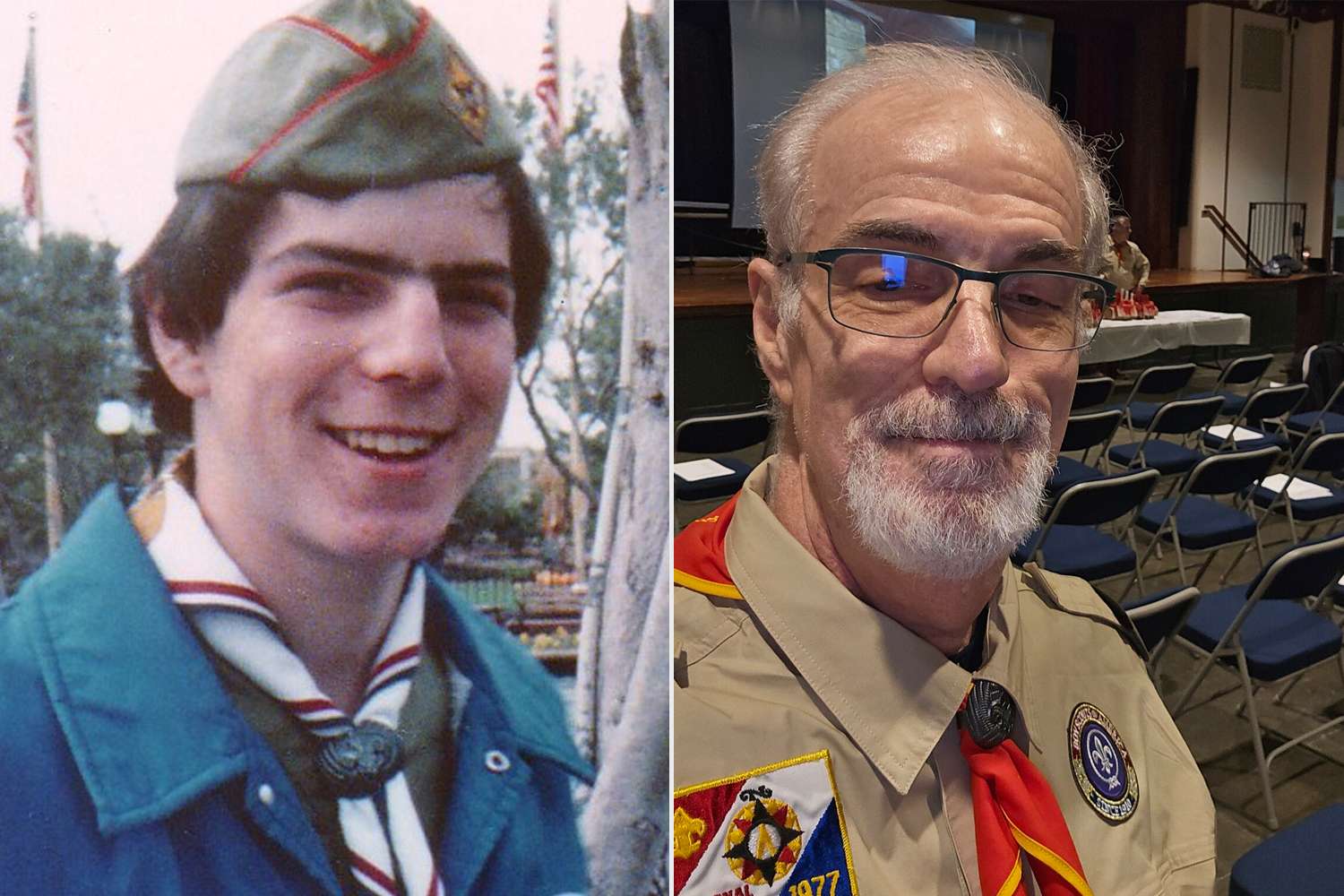
"Returning to Scouting after all these years is still just a personal joy and blessing," Tim Curran tells PEOPLE
:max_bytes(150000):strip_icc():format(jpeg)/tim-curran-031926-5-3185c3f920e04b63aabb78502a4d2065.jpg "45 Years after Ouster as Gay Teen, Tim Curran, now a Scoutmaster")
NEED TO KNOW
- Tim Curran tells PEOPLE he got “choked up” in January, as he told his story to Manhattan’s Troop 662
- As a teen, the Eagle Scout was kicked out of the organization for being gay — and his 1981 legal challenge was the first to expose the organization’s ban on openly gay youth and adult leaders
- Even then, he longed to return, and that day finally came 45 years later
As Tim Curran sat in front of the boys of Manhattan’s Troop 662 for a fireside campout chat in January, most of the group already knew their 64-year-old assistant scoutmaster had been a Boy Scout when he was younger. But what they didn't know was that the man the scouts call "Mr. Tim" is an important part of Scouting history, and civil rights history, too.
Turning to Curran, Scoutmaster Antonio Del Rosario asked, “Can you tell us your story — how you became a scout, and why you were banned?”
When he was 18, Curran was kicked out of the Scouts for being gay.
His 1981 legal challenge — the first to expose the organization’s ban on openly gay youth and adult leaders — rose through the California courts; a similar case filed 10 years later in New Jersey went all the way to the U.S. Supreme Court.
Both challenges were denied, affirming the Scouts’ right to choose their members and exclude others.
But with declining ranks and after declaring bankruptcy tied to the settlement of sexual abuse claims, the Boy Scouts — which has since been renamed Scouting America — embraced the cultural shift, allowing openly gay Scouts in 2013 and welcoming gay leaders two years later.
Although Curran tells PEOPLE, which previously profiled his case in 1983, that his feelings about "returning to Scouting" never changed over the years, a four-decade career as a journalist and documentary filmmaker simply made other demands on his time. Then, in semi-retirement, he was unexpectedly approached and encouraged last fall to join Manhattan’s largest troop as a volunteer leader.
Now, 45 years after the Scouts expelled him, Curran is a Scout once more.
Putting on a new uniform, to which he transferred his 1977 National Jamboree patch from a child’s shirt he no longer fit into, “brought everything back,” Curran says.
But there was one big difference. “When I was a kid, Scouting felt like getting ready for a mission or an expedition. Now, as a 64-year-old adult leader, donning the uniform felt like preparation for a calling," he says.
During the fireside chat, Curran admits he "kind of got choked up several times telling the story because I had not realized how traumatic the whole experience had been."
“And then, really much more importantly, the kids were just sort of wide-eyed,” he says. “They don’t live in the world that I was thrown out of.”
Hearing Curran’s story led Scout Marco Cirica, 11, to invoke one of the 12 core virtues of Scout Law: “Wow, that is really brave,” he remembers thinking. “I thought it was very not okay. And I thought it was unfair and not right, because everybody is equal.”
Marco’s dad, Emanuele Cirica, 51, says his son returned from the weekend “almost looking at me thinking, 'Was your generation crazy or something?' Like he just heard something that would be from, I don’t know, the Dark Ages,” he says. “He was actually angry about it.”

Curran was a self-described “nerdy 14-year-old” when he joined a local troop in Berkeley, Calif., fully embracing the merit badge program — and within four years, he achieved the coveted Eagle rank after founding a troop for deaf Scouts.
“You had to be self-motivated, and Scouting definitely developed that in me,” he says. “I was also kind of bullied and had maybe not a great sense of self. So Scouting really developed my self-confidence.”
When he was 16, Curran came out to a local gay youth group, and when asked to participate in an Oakland Tribune story — a feature that included a photo of Curran with his male date at his 1980 senior prom — Curran agreed.
He also alerted his troop’s leaders before the feature landed on the front page.
“I didn’t want them to find out the hard way,” he says.

Credit: Tim Curran
At the time, no one objected and he continued in the troop’s activities. But as a college freshman at UCLA, he applied to join the staff of the 1981 National Jamboree. In response, Curran says he received a letter saying his application was rejected “and you are hereby removed from Scouting.”
“I sort of deduced what this was probably about,” he says.
In an appeal to his local council executive — supported by his parents and scoutmaster — “I said, ‘Is this because I’m gay?’ ” Curran recalled. “He was very evasive and hemmed and hawed, and finally I got him to say, ‘Yes.’ ”
So Curran, then 18 and angry, opened the phone book and found the ACLU, which took up his cause.
“I couldn’t really think about the grief and loss of my years-long love affair with scouting that had been torn away from me,” says Curran. “I couldn’t process it that way at the time. And so it just got turned into a fierce dedication to fixing an injustice.”
His experience — and that of fellow Eagle Scout and openly gay former troop leader James Dale, whose loss at the Supreme Court established a precedent — is recounted in the 2025 book Morally Straight: How the Fight for LGBTQ+ Inclusion Changed the Boy Scouts – and America.
Following a panel discussion about the book last year in Manhattan, James Delorey, a former commissioner of the Greater New York Councils who hadn't known about Curran’s story, approached him.
“I was struck by how, even though the national organization had done him wrong, he still felt like Scouting had helped make him the great person that he is,” Delorey tells PEOPLE. “He would’ve been completely within his rights to tell Scouting to take a hike.”
But Curran didn’t, and Delorey offered an introduction to Del Rosario’s troop.

Initially, despite getting a summary of Curran's background, Del Rosario didn't realize Delorey was calling about such a "legendary" figure.
Others did. A flare went up, and Del Rosario asked his peers at the local and national levels if it was okay to proceed.
Absolutely, they told him.
“When our kids look at Tim, I want them to see the humanity in him, just like they see the humanity in me and in each other,” says Del Rosario. “When you see the humanity in somebody else, you see the humanity in you, and you become connected.”

Yet Curran’s quiet return is made poignant by more recent headlines as the organization grapples with the adversarial, and vocal, Trump administration.
In February a Pentagon spokesman, citing a presidential executive order used by the Trump White House to purge transgender troops from the military, wrote that the organization's leadership "has made decisions that run counter to the values of this administration and this Department of War, including an embrace of DEI and other social justice, gender-fluid ideological stances."
"This is unacceptable," the spokesperson continued, sharing that the Pentagon and Scouting, which partner on national jamborees and sponsored troops on military bases, were reviewing that partnership.
On Feb. 27, Scouting announced changes to retain that support.
The group immediately dropped a Citizenship in Society merit badge — until then, a requirement for the Eagle rank — that emphasized “the benefits of diversity, equity, inclusion and ethical leadership." They also launched a new Military Service merit badge “developed in cooperation with” the defense department, according to a memo to the “Scouting Family” and obtained by PEOPLE.
But Scouting America rebuffed demands to expel girls, who were welcomed as Cub Scouts starting in 2018, and to rebrand itself again as Boy Scouts of America.
And it pushed back against Pete Hegseth, who described the organization as anti-American and succumbing to “insidious radical woke ideology,” when he claimed in a news conference that Scouting America would now ban transgender people.
“We have transgender people in our program and we’ll have transgender people in our program going forward,” Scouting America President and CEO Roger Krone told the Associated Press last month.
Never miss a story — sign up for PEOPLE's free daily newsletter to stay up-to-date on the best of what PEOPLE has to offer, from celebrity news to compelling human interest stories.
Although “really disappointed” by the policy change, Curran says he understands “that retiring this merit badge was probably necessary to preserve both Scouting’s openness to all kinds of kids and adult leaders, and its important relationship with the military – and service to military families."
“Based on my very long experience, I have faith that Scouting will be able to return to growth and progress sometime in the future," he adds.
As for the politics of it all, Curran maintains that "returning to Scouting after all these years is still just a personal joy and blessing."
“If the Pentagon wants to turn my Scouting membership into a political issue, that’s up to them," he adds.

For now — having mastered the flash cards he created to learn his Scouts’ names — Curran is focused on being a leader and getting back into the Scouting mindset.
“I had to relearn all my knots, and that’s been kind of fun but also a bit challenging because the kids are way more advanced than me now," he says. "I’m just desperately trying to catch up.”
But not all of his skills have gone rusty. At that winter campout he picked up a bow-and-arrow for the first time in 50 years. “I got three in the bullseye,” he says, “so I have not lost it, apparently.”
Ultimately, he says that he's "not a historical figure."
“I am an asterisk, but I am very proud of my asterisk. It is my personal merit badge, being this footnote to history that hopefully no one will ever have to think about. But I'm very glad it's there," says Curran. "I'm very glad it's history, and not the present.”
“Justice delayed,” he says, “is not necessarily justice denied.”