Derek McInnes is correct in describing Hearts as underdogs in the battle for the Premiership. They are. They have nowhere close to the same resources as Celtic and Rangers. By all recognisable parameters, they don’t have the same standard of player either.
They have spent nothing remotely like the same amount of money as the Old Firm on their squad and have only had Islam Chesnokov and Pierre Landry Kabore on full international duty this week.
Scotland’s national coach Steve Clarke caused a degree of upset around Tynecastle when branding the team ‘better than the sum of its parts’ in an attempt to explain why he hadn’t chosen anyone from the league leaders in his squads to face Japan and Ivory Coast, but his remarks could be taken, in the right light, as something of a compliment too.
That Hearts have got themselves into this position – three points clear of Rangers and five clear of Celtic with seven games of the season to play – is testament to the fact that the foundations of the club are solid and that the model and infrastructure they have put together is working.

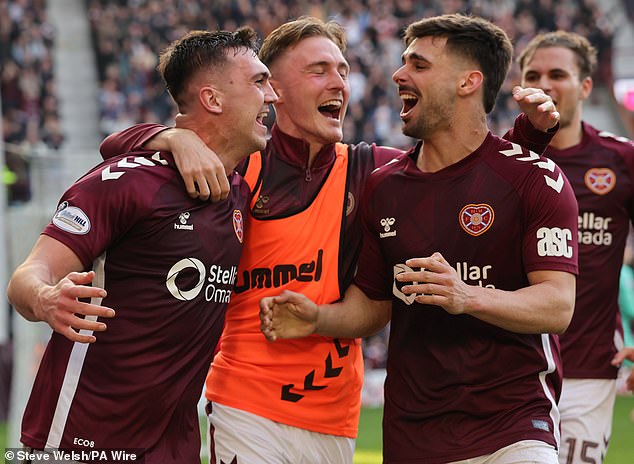
Oisin McEntee celebrates after scoring Hearts’ winner against Dundee

Derek McInnes has fostered a strong collective spirit at Hearts as they go for the title
Hearts’ strength lies in the collective. That’s what the club is now built upon. Not just within the dressing room, but all the way from the input now being provided into scouting and recruitment from Tony Bloom’s Jamestown Analytics to the punters still paying their money into the Foundation of Hearts every month and taking the total raised through that mechanism beyond the £20million mark.
That’s something to be proud of. There might be no Hearts at all were it not for the fact thousands of ordinary punters got behind the foundation when it was set up in 2010 and committed to turning it into a fan-owned operation.
On the home page of the site that interested parties land on to set up their pledges, head coach McInnes is quoted as saying ‘everything we do at this club is built on togetherness – players, staff, supporters all pulling in the same direction’.
In that context, becoming known for creating something better than the sum of its parts should be regarded as a badge of honour rather than any kind of reason for agitation.
When McInnes reiterated that the club’s remarkable tilt for the title this season is being conducted against all odds against two ‘heavyweights’ in Celtic and Rangers in the wake of the 1-0 home win over Dundee last time out, he also explained one of his main reasons for optimism as the campaign reaches the home stretch.
Ahead of the 33-game split, he mentioned that his side has a better record than anyone against the other teams in the top six. Closer examination of the statistics makes it clear what a compelling point that is – and why they should galvanise the Gorgie outfit for the considerable challenges ahead.
In 14 outings against their top-half rivals, Hearts have won nine, drawn three and lost two, accumulating 30 points.
Rangers have won five, drawn seven and lost two, taking 22 points, while Celtic, who have played 15 games against top-six teams, have won six, drawn four and lost five, amassing 22 points as well.

Steve Clarke did not pick any Hearts players for his latest Scotland squad
Yes, certain things have to be factored in. Namely, the chaotic reigns of Russell Martin and Wilfried Nancy on either side of the Glasgow divide.Yet, Hearts’ ability to turn up and deliver on the big days that really matter is proven by those figures.
What’s more, the return of a number of key individuals at a key time in the campaign is reason enough to believe that there will be an uptick in the overall standard of performance following a number of 1-0 wins that have often been a little too close for comfort.
The big one, of course, is Lawrence Shankland. He lit up Tynecastle last weekend in his comeback appearance against Dundee. All of a sudden, the front third, where things have been a little difficult of late, came to life again. He held up the ball, played in team-mates, had one shot saved and even had an ambitious go from the halfway line near the death.
His presence already looks likely to have a spin-off on others. Claudio Braga handled so much responsibility so remarkably well in Shankland’s absence, but will surely feel more able to play his natural game,with the club captain beside him again.
Alexandros Kyziridis hasn’t been as effective as he was earlier in the season, but looked more dangerous with Shankland to provide for and feed off during those 35 minutes.
Cammy Devlin also returned against Dundee after injury. Craig Halkett, Harry Milne, Tomas Magnusson and Stephen Kingsley should be back for Livingston on Sunday. Stuart Findlay, by all accounts, isn’t far away either.

Hearts’ talisman Lawrence Shankland is fit for the title run-in
When McInnes speaks so positively about what lies ahead for his team, getting all his best players back is undoubtedly part of the reason. However, Hearts are a club with a plan. There’s a framework behind what they are doing. Their steady rebuilding of the squad is being executed with an eye still on keeping the finances in check.
That has to breed confidence too. Hearts have an end destination in sight and look to have made a lot of their big calls right.
Can that be said about Celtic and Rangers? The defending champions’ shocking loss to Dundee United last time out was a wake-up call. They are a shambles and have been for some time. They have a 74-year-old head coach in Martin O’Neill who hadn’t been near a dugout for six years until Dermot Desmond had a brainstorm. O’Neill’s a legend there, but it is – and always has been – crazy that he is back in charge.
The anger within their fanbase over the running of the club is entirely justified and certain to resurface over the run-in. Whatever happens in the next month-and-a-bit, Celtic need turned upside-down at every level.
Rangers have put together a couple of wins at St Mirren and Aberdeen to stay on Hearts’ coat-tails, but they’ve hardly been setting the heather on fire either. Chairman Andrew Cavenagh has, at least, spelled out his plan for the future, but a bit more meat really needs to be put on the bones of what the American detailed this week.
The headlines were dominated the promise of £16m for new players to be raised through a share issue, but Rangers still being dependent on extra cash being ploughed in by directors doesn’t exactly fit with the concept of running sustainably. Putting an above-inflation rise on season ticket prices hasn’t been universally popular either.

Martin O’Neill has returned to the dugout at the age of 74 at dysfunctional Celtic

Rangers chairman Andrew Cavenagh has hiked up season ticket prices
Ditching the sporting director role needs explained in greater detail too. It seems a strange move in this modern era.
Cavenagh offered little to suggest why he believes a slimmed-down executive will work and there needs to be a bit more info, too, on the exact remit of the consultancy role held by Stig-Inge Bjornebye.
Time will be the judge of whether Cavenagh’s vision works. He has learned lessons from a turbulent first year and there’s clearly more cash there, but doubts remain over how firm a base Rangers are really working from. Doubts also remain on whether Danny Rohl is the answer as head coach.
Just like Celtic, few would suggest Rangers are better than the sum of their parts. You sense Cavenagh and co are still getting their heads around the place. At Parkhead, meanwhile, heads must roll.
Hearts feel different. Of the three clubs fighting for the title, the Jam Tarts, as a whole, are the more stable, more structured, more strategic. Their roadmap is planned and pinned on the wall.
Their ultras fly banners at every game urging everyone to ‘believe’ – and they should.
The financial disparities McInnes talks about should make the difference in any normal season, but this has been no normal season. Indeed, there is no good reason, based on the evidence available, to feel that Hearts cannot go on to make it an unforgettable one.