Like many tech industries, the home theater business is prone to throwing around buzzwords that make products sound more futuristic than they really are. For one example, every TV maker has suddenly started bragging about the AI in their image processors, riding on the popularity of ChatGPT and Google Gemini. In reality, some form of AI is required for all image processing — that 10-year-old LCD sitting in the corner has AI, too. There might be some new software tricks at play, but that’s too far into the weeds for marketing purposes.
Today, I’m going to talk about something you’ve seen pushed on TVs for a while now: quantum dots. The goal in this piece is to demystify them, explaining why they’re important, but not necessarily a must-have for any set you’re about to buy. In fact, some of the best panels on the market don’t use quantum dots at all, and the tech might be completely eclipsed by 2036.
What are quantum dots, and how do they work?
Schrödinger’s cat is taking a nap

The first thing to understand is that no, quantum dots don’t make any exotic use of quantum mechanics, at least any more than the chair you’re sitting on or the lamp next to you. There’s no entanglement going on, no exploitation of the wave function or probabilities. It’s mostly just a term TV makers use to signify “small” and “advanced.”
In fact, what’s going on isn’t even operating at the quantum scale except for the light involved. Quantum dots are particles about 2 to 10nm (nanometers) in size, contained in a film sandwiched between other layers in a display panel, typically in front of blue LED backlights. The trick is that when light is passed through these dots, they emit different colors based on their size. Larger particles skew red, while the smaller ones skew green. Pure blue can be let through as needed.
This wouldn’t necessarily be important except that before quantum dots, LED-based TVs relied exclusively on diffusers and less efficient filters positioned in front of white lights. Quantum dot TVs are therefore capable of getting a lot brighter, and moreover, producing a wider range of colors.
The trick is that when light is passed through quantum dots, they emit different colors based on their size. Larger particles skew red, while the smaller ones skew green.
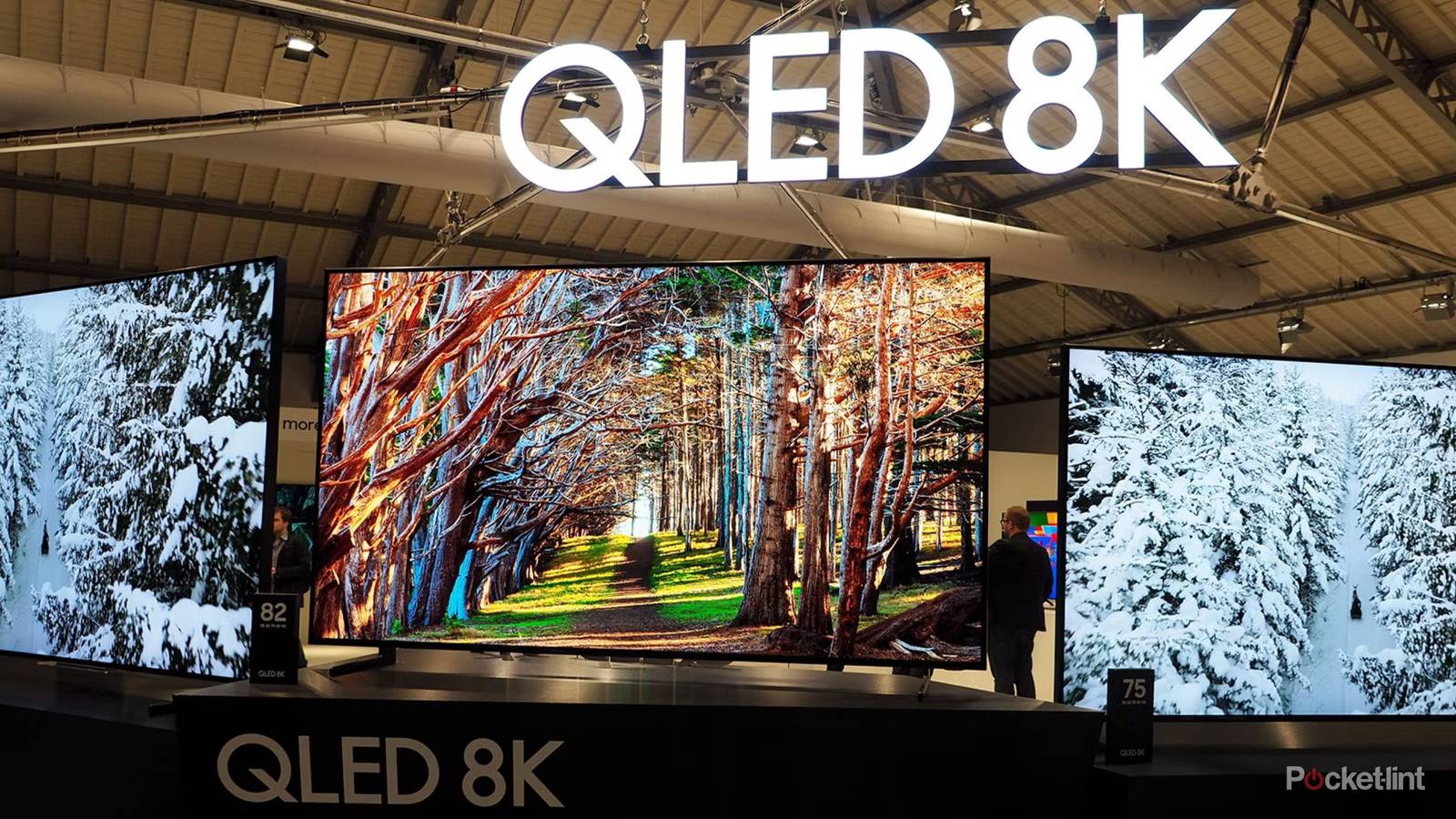
The primary use of the technology is in LCD and mini-LED TVs, usually marketed under jargon like QLED or QD mini-LED. With these, there’s no fundamental difference in application beyond the fact that mini-LED sets use thousands of backlights instead of hundreds, allowing more precise contrast. Mini-LED TVs do tend to be even brighter than QLED LCDs, though, to the point that highlights in HDR (high dynamic range) content can be harsh on the eyes at higher settings. If you’re searching for a TV that’s suitable for all viewing conditions, mini-LED is the way to go at the moment.
What about OLED, you’re asking? There is in fact a variation called QD-OLED, but this operates somewhat differently, owing to the fact that on an OLED TV, each pixel is self-illuminating. Specifically, QD-OLED substitutes white OLEDs for blue ones to take advantage of the quantum film. As with other quantum dot formats, this lets a TV produce brighter images and more vibrant colors, if usually not as bright as QLED or mini-LED. More on that point shortly.
Possibly, but not necessarily

If you’re on a tight budget, you should be looking at a QLED LCD. While quantum dots were once bleeding-edge, they’ve since become so mainstream that they’ve filtered down to the cheapest TVs. You can buy a 65-inch QLED LCD for about $500, and smaller ones are cheaper still. You probably won’t be disappointed in the image quality, either, as long as you’re hunting for other essential specs (like VRR) and not expecting the perfect contrast possible with OLED. Because LCD and mini-LED TVs depend on backlights, they can approximate OLED’s pure blacks, but never quite achieve them.
While quantum dots were once bleeding-edge, they’ve since become so mainstream that they’ve filtered down to the cheapest TVs. You can buy a 65-inch QLED LCD for about $500.
As you’d expect, quantum dots are widespread on mini-LED TVs. You’ll be hard-pressed to find new models that aren’t quantum-enhanced, although they do exist. There’s increasingly less reason to choose one — while quantum tech is liable to cost more than vanilla mini-LED, it’s not by much, and not far removed from a QLED LCD, either. It offers such great bang for the buck that it’s impacting the sales of OLED TVs. Some shoppers (myself included) intentionally choose mini-LED over OLED even when their money allows the choice, and they’re not concerned about burn-in.
Why is that? The issue is brightness. While OLED enables ideal contrast, it usually delivers less overall brightness than QLED LCDs, let alone mini-LED TVs. So while an OLED set might look amazing in a dark or dimly-lit room, it’s going to suffer in a well-lit space, and might become unusable in bright sunlight. Mini-LED sets remain reasonably viewable in a sunlit room, which makes them more flexible than any OLED option. That includes QD-OLED, which is an improvement over some past implementations, but isn’t automatically required for the brightest picture. The main reason to choose QD-OLED is that you demand inky blacks, and you mostly watch movies and shows at night. It’s not the tech for someone who likes to leave CNN, Twitch, or YouTube on in the background during the day.
Why quantum dots may not matter for much longer
A tale of two formats

Two new standards are liable to render quantum dots less relevant, if not obsolete. The first is RGB mini-LED, which as the name hints employs dedicated red, green, and blue LEDs instead of filtering a single white or blue light. There’s simply no need for quantum dots, which if anything might impede the brightness of a panel. Some current RGB-mini-LED TVs can achieve a peak brightness of 8,000 to 10,000 nits, which could literally be blinding if you took full advantage. For a frame of reference, my Apple Watch Ultra 2 is perfectly readable in the midday sun at 3,000 nits.
With MicroLED and RGB mini-LED, there’s simply no need for quantum dots, which if anything might impede the brightness of a panel.
The second is MicroLED. This is similar to RGB mini-LED, except that it does away with backlighting by using RGB for each individual pixel. Effectively it provides the brightness of mini-LED with the contrast of OLED, and no risk of burn-in. Indeed it’s hard to imagine anything topping MicroLED for the next decade.
The only reason these standards haven’t taken over yet is the cost of production. Being so new, there isn’t much manufacturing capacity, and production yields (meaning usable panels) are presumably low. With the tech being so expensive to make, prices for MicroLED and RGB mini-LED TVs have been astronomical, starting at five digits and stretching into six. Although that’s expected to change towards the end of 2026, you may be waiting until 2027 or 2028 before you can realistically afford an RGB mini-LED set.