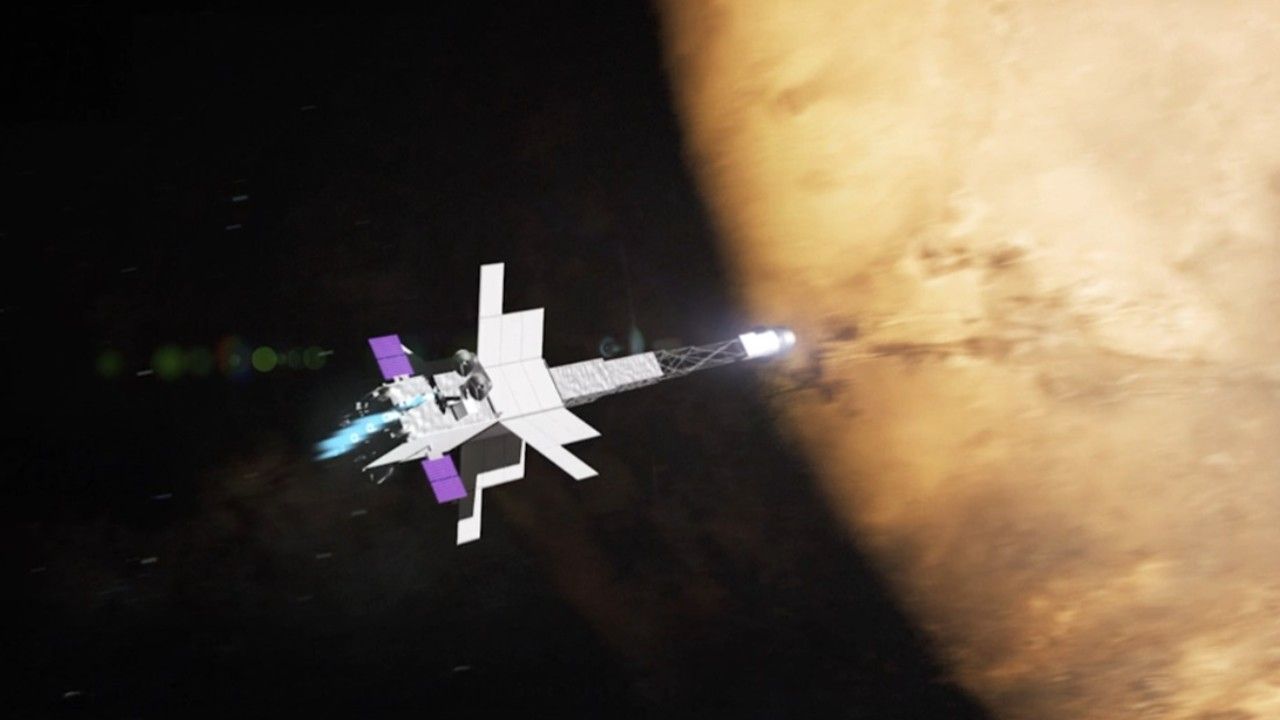
This week, NASA administrator Jared Isaacman announced the agency will be developing the “first nuclear powered interplanetary spacecraft” ahead of a planned 2028 launch to Mars.
The ambition of the mission, known as Space Reactor-1 (SR1) Freedom, goes far beyond its proposed mission of reaching Mars. If it is successful, it will be the culmination of over 60 years of experiments and failed projects in nuclear propulsion, and it could potentially transform interplanetary space travel.
Article continues below
The idea of nuclear-powered spacecraft brings to mind concepts such as Project Orion, developed in the 1950s and which would have seen a spacecraft being propelled by the shockwaves of a rapid series of nuclear explosions behind it. Another nuclear-powered design was Project Daedalus, a British Interplanetary Society design study from the 1970s that proposed using nuclear fusion-powered engines.
NASA’s SR-1 Freedom concept would use a nuclear fission reactor, like a scaled-down version of the type of nuclear stations that power cities on Earth, to generate electricity that can run an ion engine.
However, NASA missions have been utilizing another form of nuclear power in space for decades, in the form of radioisotope thermoelectric generators, or RTGs. What’s the difference between RTGs and the nuclear electric propulsion that will drive SR-1 Freedom?
Powered by nuclear decay
Radioisotope thermoelectric generators produce power by using the heat released by the radioactive decay of plutonium-238, which has a half life of nearly 88 years (meaning that, on average, half its quantity will have experienced radioactive decay in that time), allowing it to power spacecraft for decades if necessary.
NASA has been using nuclear power in space for almost as long as the Space Age itself. In the 1960s, the agency funded the Systems for Nuclear Auxiliary Power, or SNAP, project. As its name suggested, SNAP involved utilizing nuclear-derived energy on space missions. According to NASA, the first to fly was SNAP-3 in 1961, which carried on board an RTG.
The RTG on board SNAP-3 carried 96 grams of plutonium-238, which produced a measly 2.5 watts of electrical power. Things have come a long way since the early 1960s, however. Since then RTGs have flown on interplanetary missions including the Pioneer 10 and 11 and Voyager 1 and 2 spacecraft to the outer solar system, the New Horizons voyage to Pluto and beyond, the Viking 1 and 2 Mars landers, and the rovers Curiosity and Perseverance.
Indeed, the need for RTGs was laid bare by Curiosity and Perseverance’s predecessors, the Mars Exploration Rovers Spirit and Opportunity, which were purely solar powered but suffered from diminishing power as Martian dust covered their solar arrays.

Nuclear electric propulsion
Another advance that dates back to the 1960s is electric propulsion, perhaps better known as the ion engine. This works by ionizing atoms belonging to a gaseous propellant, such as xenon or krypton, and then accelerating those ions out through a nozzle to provide thrust. This acceleration can be achieved in two ways. One is the application of electromagnetic fields to produce something called the Hall effect that accelerates the ions.
The other way is a gridded ion thruster, in which the positively charged ions are injected into a ‘discharge chamber’ where they move towards a negatively charged grid and are accelerated through the holes in that grid by a voltage, expelling them once again out through a nozzle, the ion engine producing a soft blue glow.
On space missions within the inner solar system the ions can be ionized by electricity produced via solar arrays, hence we refer to such technology as solar electric propulsion (SEP). Yet you might be surprised to find that SEP typically produces less than one pound of thrust.

This pales in comparison to the 8.8 million pounds of thrust that the Space Launch System rocket will provide when it blasts the Artemis 2 mission towards the moon. SEP’s tiny amount of thrust is however additive, and builds up over time to push spacecraft to velocities of around 200,000 miles (320,000 kilometers ) per hour, or more, long after an equivalent chemical rocket would have exhausted its fuel.
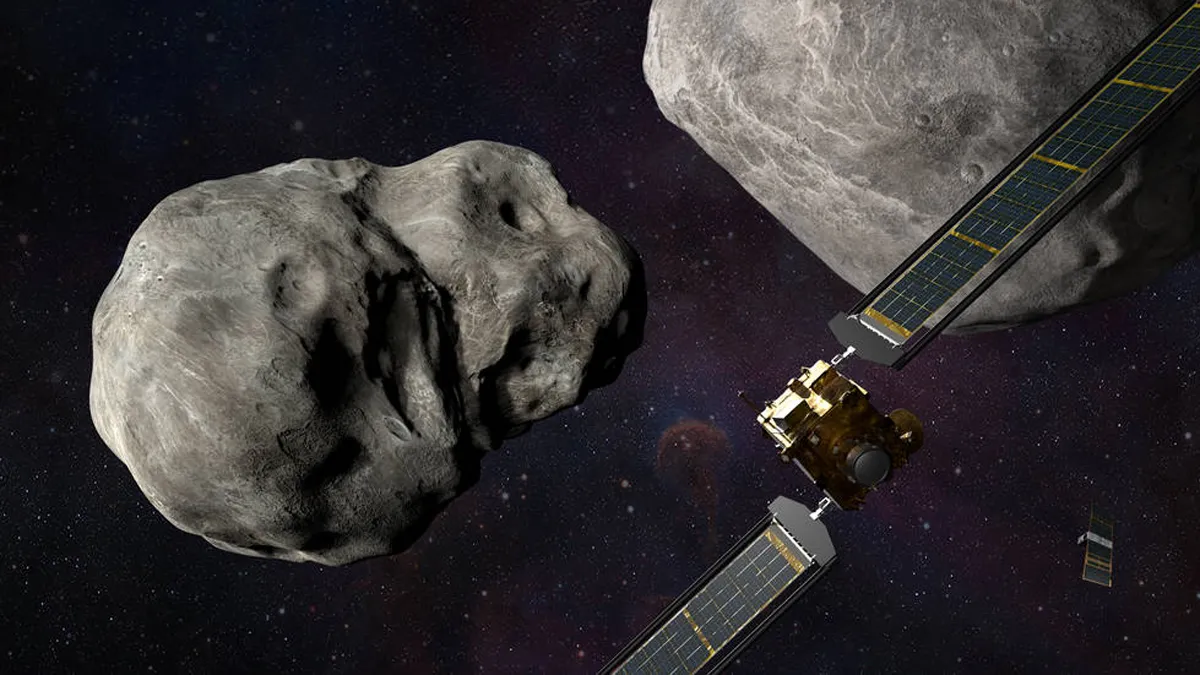
SEP has been used on missions in Earth orbit since the 1960s. The first interplanetary mission with SEP was NASA’s Deep Space 1 in 1998, and since then it has been used to great effect by missions such as the European Space Agency’s SMART-1 mission to the Moon, NASA’s Dawn spacecraft that visited Ceres and Vesta in the Asteroid Belt, and the DART mission that impacted the double asteroid Didymos and Dimorphos in 2022.
Replacing solar with nuclear has two advantages in deep space. One, it makes it easier for space missions to deploy ion engines in the distant outer solar system, far from the sun. And two, it produces between one and two orders of magnitude more power than SEP does, thereby increasing the thrust and the mass of the payload that it can carry.
RTGs are not enough for this kind of work, which is why nuclear electric propulsion (NEP) requires a fission reactor. The heat produced by the reactor is transformed into electricity and this is what ionizes (electrically charges) the propellant gases for use in the ion engine.
SR-1 Freedom’s 20-kilowatt fission reactor, containing low-enriched uranium and uranium dioxide, would be situated at the end of a long boom, ensuring distance between the radiation that it produces and the rest of the spacecraft.
In SEP, a large fraction of a spacecraft’s total area is devoted to solar arrays. With NEP those solar arrays are switched out for heat exchange fins to radiate away some of the excess heat from the reactor and prevent the spacecraft’s components from melting.
It’s worth noting that there is a third variation of the nuclear engine, which is nuclear thermal propulsion, in which the energy produced by a fission reactor heats a propellant, causing it to expand and burst through a nozzle, producing thrust like a more conventional rocket.
Nuclear hazards
Safety is, of course, of paramount importance when sending nuclear material into space, and people are very often scared of the word ‘nuclear’.
In 1997, controversy engulfed the launch of the joint NASA/European Space Agency Cassini–Huygens mission to Saturn. It carried on board three RTGs carrying 73 pounds (33 kilograms) of plutonium-238 between the two probes.
The mission’s environmental impact study suggested that there was a 1 in 1,400 chance of an accident during blast-off, and 1 in 476 chance during the flight through Earth’s atmosphere, which could spread radioactive material not just across Florida, from where Cassini–Huygens launched, but across the entire globe depending upon the altitude at which an accident happened. This led to serious concerns from some quarters, with science popularizer Michio Kaku among the leaders of the protests demanding the launch be scrubbed, but Cassini–Huygens’ went ahead without a hitch, as have all the subsequent RTG missions.

Care is of course taken in ensuring that should an accident occur, the radioactive material is protected as well as can be. The risk is minimized by packaging that radioactive material inside extremely durable graphite blocks bolstered by a layer of iridium and surrounded by an aeroshell to protect the RTG should it undergo an atmospheric re-entry.
Though this does not provide an absolute guarantee, one would imagine that any fission reactor launched into space would require similar safety protocols. Indeed, there are very stringent regulatory constraints, both in the United States and internationally, regarding sending nuclear material into space.
There’s also the issue that nuclear fission is a highly toxic process. It involves splitting the atom, producing radioactive waste as well as energy. By using fission reactors in space, we are essentially sending little packets of toxic waste across the solar system, which could in the future prove dangerous for any astronauts that encounter them, or any biospheres that may exist on other planets or moons, such as Mars or Europa, should one of these toxic parcels crash land there.
The history of nuclear electric propulsion
This isn’t the first time that NASA has toyed with using nuclear electric propulsion. In 1965 the agency launched the SNAP-10A mission, which was the first and so far only time that nuclear electric propulsion has been successfully deployed. It was also the first time that a nuclear reactor was launched into space. That reactor operated just fine for 43 three days before developing a fault and shutting down, according to the U.S. Department of Energy.
However, in the 61 years since SNAP-10A, there have been no further missions successfully demonstrating nuclear electric propulsion, but there have been many attempts to do so. NASA’s most recent project was DRACO, the Demonstration Rocket for Agile Cislunar Operations, in conjunction with DARPA, Lockheed Martin and BWX Technologies.
Alas, the DRACO program was paused in January 2025 because of technical and regulatory challenges, before being cancelled outright that summer when it was left off the proposed 2026 federal budget. DARPA claimed that the costs of the program no longer matched the benefits, given that ordinary launch costs were coming down.
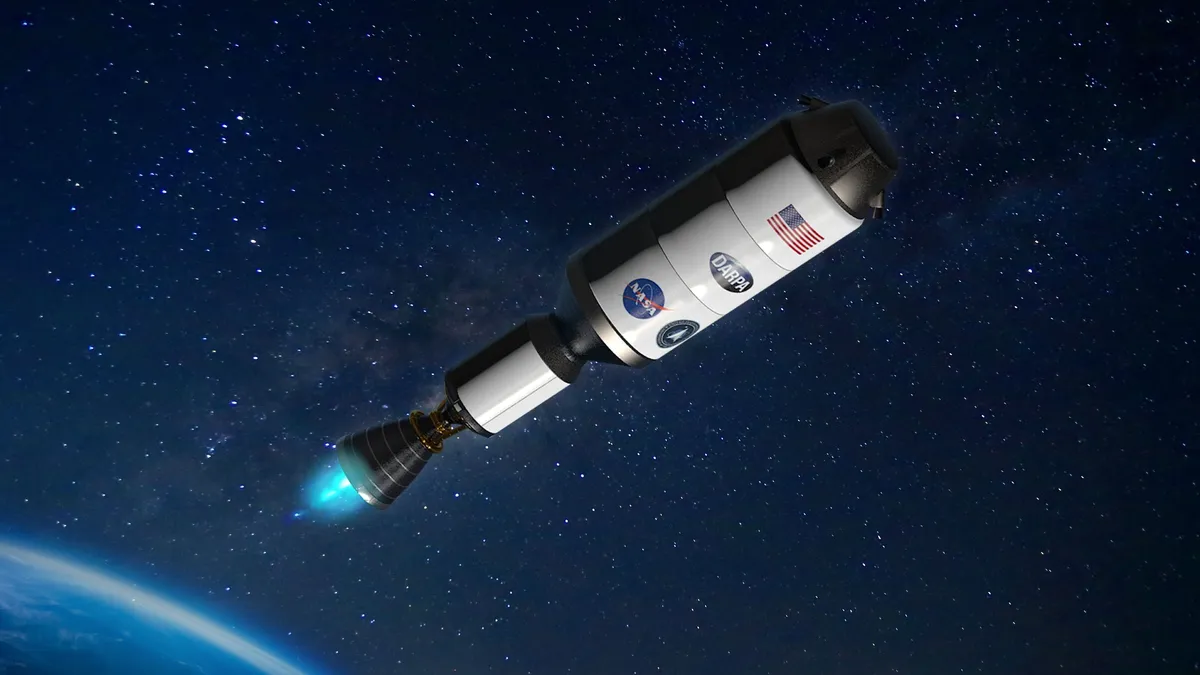
Now, however, NASA seems to have changed their tune with their renewed interest in nuclear electric propulsion. There is certainly a strong case that using nuclear power is vital if we are to launch more regular interplanetary missions and send astronauts and massive payloads to Mars or elsewhere.
Yet time is certainly against NASA launching the mission in 2028 as planned, and it remains to be seen whether, after more than sixty years of trying, NASA can finally get the technology to work. If they do, then the increased efficiency and power that it can bring to electric propulsion engines could transform space travel, whether it be taking astronauts to Mars or driving scientific missions to the outer solar system.