On the surface, the Individual Savings Account (Isa) is very simple.
It’s a savings product into which you can put cash and investments up to the value of £20,000 each tax year.
All money that you make within your Isa – whether that’s from savings interest, investment returns or dividends – is tax-free.
However, Isas have little-known features that offer far more flexibility and value than many savers realise.
Use them to their full potential and you could save thousands of pounds over the years that you hold them.
Here is our ultimate guide to making the most of your Isas – and the lesser-known features you can deploy so they work harder for you.

Boost your savings: Isas have little-known features that offer far more flexibility and value than many savers realise
You CAN have fixed and easy access Isa
Savers often face a dilemma with their choice of cash Isa. Do you go for a fixed-rate deal in the hope that you lock in a generous rate for a set time period, such as one, two or five years?
Or do you opt for an easy-access Isa, which allows you to dip into your savings whenever you need – but accept a slightly lower rate?
Often, the best option is to do both. You can open a combination of Isas, granting yourself both security and flexibility.
Lock away the money that you are confident you won’t need, and leave the rest in the best easy-access Isa you can find.
You can open as many Isas as you like in any tax year – the only restriction is that you mustn’t exceed your £20,000 allowance (£9,000 for children under 18).
If you prefer to keep things simple, you could go for something in between – an Isa that allows you a certain number of withdrawals every year.
That offers you the reassurance that you can access your cash in an emergency, but you can generally earn a higher rate than with an easy-access version with no restrictions at all.
And if you’re up for a bit of complexity to earn more interest, you could consider a range of Isas maturing at regular intervals.
For example, you could open a two-year Isa every year. That way, you benefit from the security of a fixed-rate deal, but have the
reassurance that you can access some of your savings each year as your deals mature.
Beware though – although Isa providers are legally allowed to offer you more than one Isa each tax year, some providers do not have the technology to do this and so don’t permit it. Those with such restrictions include HSBC, Santander and Lloyds Bank.
The best fixed-rate deals include 4.42 per cent from Hodge Bank for one year and 4.4 per cent from Hargreaves Lansdown, held with Chetwood Bank, fixed for two years.
Among the top easy-access rates are Atom Bank’s 4.25 per cent Isa and the 4.26 per cent deal from Hargreaves Lansdown, held with Vida Savings.
For an up-to-date round-up of the latest deals, go to our sister website thisismoney.co.uk/save.
Hold a few stocks and shares Isas
Similarly, you can hold as many stocks and shares Isas as you like – so long as you don’t exceed your annual allowance.
This flexibility can be very helpful if you have been with the same provider for a number of years and want to try some of the new competition.
The stocks and shares Isa landscape has completely
transformed in the past few years. There are now providers that offer no fees on share dealing, with impressive apps to allow you to manage your investments on your mobile phone, and competitive rates on money you hold in cash before you start investing.
There’s nothing to stop you trying out one of these without going to the trouble of transferring your existing investments from your current provider.
Later, if you find you prefer the new provider, you can always move over. If not – well, you can treat it as a lesson learned and move the balance of your new account back to your old one or to a third alternative.
To compare platforms, go to thisismoney.co.uk/platforms.
Take cash out… and put it back in
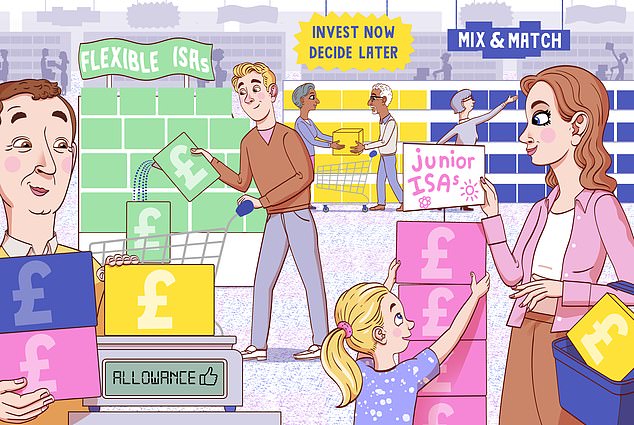
Some cash Isas are known as ‘flexible’, which means you can take money out and put it back in within the same tax year without it counting towards that year’s allowance.
Say you had used up your £20,000 allowance and then withdrew £10,000. With a flexible Isa, you could return the £10,000 within the same tax year without breaching your allowance.
If your Isa is not flexible, you would have to wait until the next tax year to use your new allowance to return it.
Flexible Isas are a great option if you want to use your Isa as a piggy bank – putting money in and taking it out whenever you need to, while earning tax-free interest.
Not all Isas are flexible, so if you think this feature may be valuable, check whether the one you are considering is flexible before opening it.
Top flexible options include the Vida Savings double access Isa at 4.16 per cent and the 4.11 per cent easy-access Isa from Aldermore.
You can wait to invest money
If you want to take advantage of this year’s allowance but have not yet decided what to invest in, you don’t have to rush.
You can usually put money into a stocks and shares Isa and hold it in cash until you work out what you want to do with it.
But it’s rarely a good idea to leave it for too long, because stocks and shares Isas don’t tend to pay as good a rate of interest on cash as you could earn in a cash Isa.
Plus, investing tends to produce better returns than holding cash over the long term. However, it can be a good short-term solution while you decide what to do next.
Pass on allowance to your spouse
Couples who are married or in a civil partnership can inherit Isa allowances from one another.
As well as your normal annual Isa allowance of £20,000, you can add a tax-free amount up to the value that your spouse held in their Isa when they died. This is often called an inherited Isa allowance or Additional Permitted Subscription.
However, this does not apply to unmarried couples who are living together. Cohabiting couples are treated differently by the taxman and do not enjoy the same tax breaks that married couples do.

If you want to take advantage of this year’s allowance but have not yet decided what to invest in, you don’t have to rush. But it’s rarely a good idea to leave it for too long
A family of four can shelter £58,000
Growing numbers of families are using Junior Isas (Jisas) and adult Isas to shield large sums from the taxman and save for future needs such as university fees, a deposit for a house or costs towards a future wedding.
Both parents have a £20,000 allowance, and you can put away £9,000 a year for each child you have under the age of 18. This means a family with two children can save a total £58,000 into Isas every tax year.
Stocks and shares Junior Isas for kids
Although many parents default to opening a cash version of the Jisa for their children, stocks and shares Isas are worth considering as they tend to produce a higher return in the long-run.
It may feel reckless to take on investment risk with the savings of a child but, if there are many years before they may need to access the money, there is plenty of time to ride out the ups and downs of the stock market and benefit from long-term growth.
A child can have one or both types of Jisa. They can take control of the account when they are 16, but they cannot withdraw the money until they turn 18.
It’s not only parents who can pay into a Jisa – grandparents and other relatives or friends can also add to the pot, as long as it doesn’t exceed the £9,000 annual allowance.
If you’re set on putting money aside for a specific goal, then a stocks and shares Jisa is a good option because you’re investing over a longer-term horizon.
It is important to note that money in a Jisa cannot be taken out by anyone, including parents, until the child turns 18.
And the funds legally belong to the child, not the parent who has opened and manages the account.
So even if you have grand ideas about saving for a first house deposit or university fees, it may not pan out if your child doesn’t agree.
New Isas can take old Isa transfers
Savers often focus on taking advantage of their current Isa allowance, but making the most of Isas opened in previous tax years can be even more important.
Don’t assume that Isas you opened more than a year ago are still earning the same rate of interest – providers have a sneaky habit of cutting your rate the moment your back is turned and they think you’ve forgotten about it.
You can transfer old Isas into new ones with better rates. Or, you can get in touch with your existing provider and see if it can offer you an improved deal.
It’s worth checking on all of your old Isas at least every year to see if you could earn more by transferring them to a better account.
Once you tot up your tax-free cash, you may decide that you have enough to invest a portion that you won’t need to access for a good five to ten years, as well.
Take fixed-rate cash out if needed
When you lock away your money in a fixed-rate Isa, you agree not to touch it for the full duration of the term.
However, unlike with other fixed-rate accounts, you can break that agreement if you absolutely have to.
You always have the option of closing an Isa and getting your money back earlier.
This isn’t ideal – it loses its tax-free status and you may be fined a sum of interest. But it can be reassuring to know that you can get access to your money if something unexpected happens.
Such knowledge may embolden you to fix for longer if the only thing holding you back is fear that you may need the money in a financial emergency.
‘Bed and Isa’ for tax free investments
If you’re holding investments outside of an Isa, you can ask your provider to perform a task for you known as ‘bed and Isa’.
This is where you sell investments and buy them back immediately in your Isa, making the most of your annual allowance and ensuring that any future growth and income is tax-free.
Your provider may be able to buy and sell instantaneously so that you pay only one lot of dealing charges and you don’t have to worry about missing out on any investment growth while you’re out of the market.
This will count towards your overall Isa allowance of £20,000 each tax year.
If bed and Isa may breach your allowance, be sure to tell your provider to limit transfers of investments below it.
For an up-to-date round-up of the latest deals, go to our sister website thisismoney.co.uk/save.