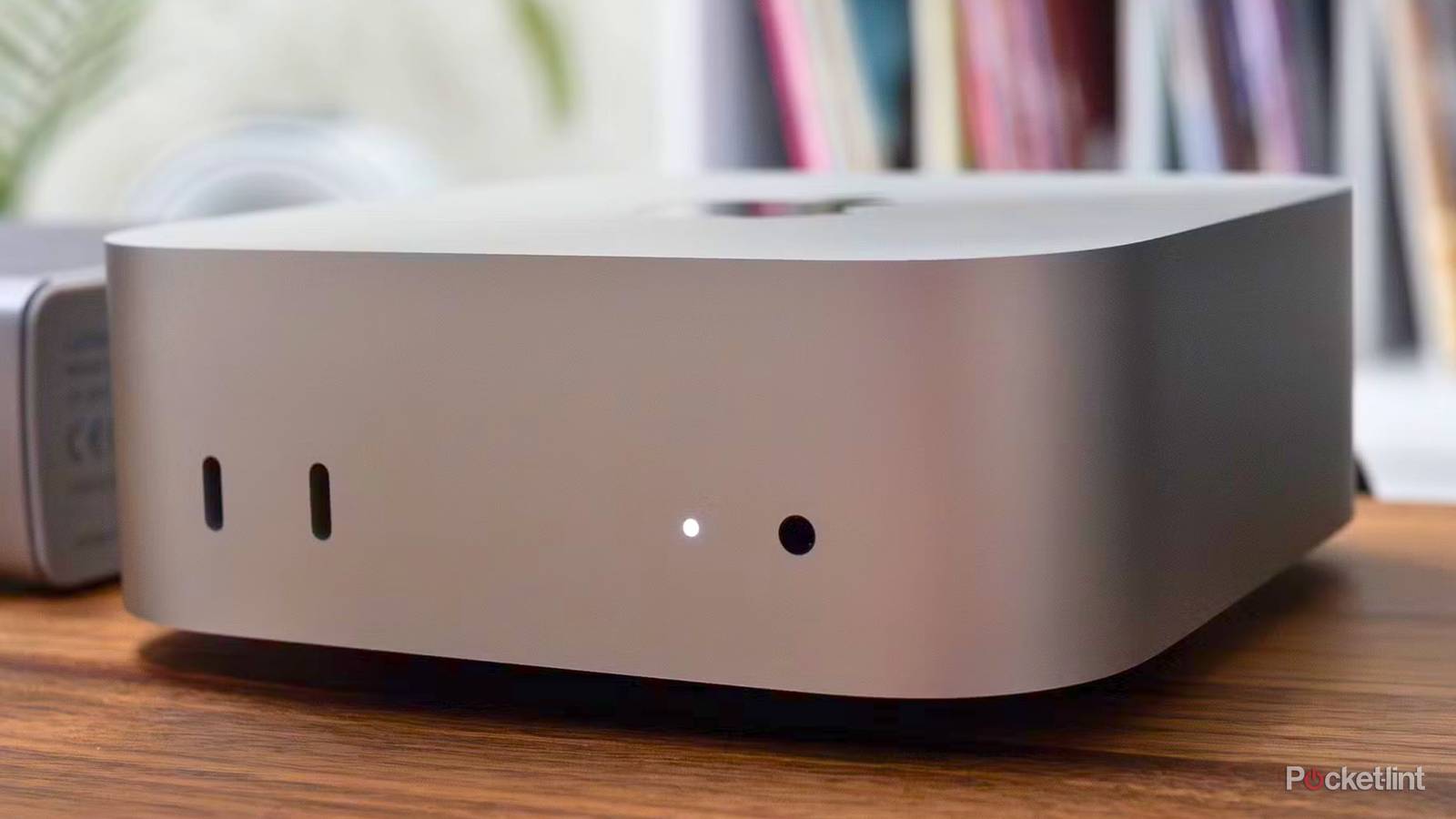
Ever since Apple redesigned its Mac mini series from the ground-up for the Apple Silicon era, I’ve been a big fan of the pint-sized computer line. While I’ve never personally owned one, that hasn’t stopped me from falling in love with its diminutive stature, its powerful computational performance, and its charming aesthetic.
Mini-style PCs in general are pretty compelling in my eyes. With modern ARM-based processors under the hood, they’re able to pack a real punch into a small chassis, while making yesteryear’s PC towers look like skyscrapers by comparison. They also allow for modular flexibility in a way that all-in-one PCs like the iMac simply don’t, allowing you to mix and match components to your heart’s content.
With it’s (relatively) competitive price tag in mind, I’ve long considered dropping cash on a Mac mini to call my own. However, there’s one missing hardware feature in specific that has always stopped me from whipping out my wallet, and it’s not USB Type-A, it’s not an SD card slot, and it’s not a top-mounted power button, either: it’s a built-in backup battery.
A backup battery just makes all the sense in the world
It would turn the Mac mini into a plug-and-play powerhouse

These days, just about every mobile tech gadget ships with an internal power pack to keep it up and running when disconnected from a power outlet. Of course, this doesn’t apply to traditional desktop computers, which remain stationary and often require large amounts of AC to stay powered on.
The Mac mini, of course, isn’t a traditional desktop PC. It’s compact and lightweight enough to rest in the palm of my hands, and its silicon is low-powered and produces minimal heat even under stress. The mini’s portable size makes me want to bring it with me from desk to desk, and to dock it from one monitor to the next in the same vein as docking a phone, a tablet, a laptop, or a handheld gaming console.
The problem here is that without a built-in backup battery — even a small one — Mac mini units can’t be plugged and unplugged in a hot-swappable manner. Pulling the cord cuts all power to the device, thus requiring a full shut down or reboot before it can be relocated to another living space or office environment.
Personally, I’d prefer for there to be a dedicated battery slot of sorts, or perhaps a larger battery bank housing that could connect to the bottom of the unit…
A backup battery would be a welcome inclusion for another reason beyond portability: in the event of a power outage, having a built-in power source would keep the device up-and-running, reducing the chance of data loss, corruption, or other workflow disruptions. With the growing popularity of battery-powered external monitors and laptop-shaped lapdocks, it wouldn’t be a stretch to work off of a battery-powered Mac mini during, say, a blackout.
Of course, if Apple were to implement a backup battery into its next-generation Mac mini, it could go about it in a number of ways. On the one hand, the company could simply stick a small lithium-ion power pack into the unit and call it a day, but this wouldn’t be ideal for accessibility in the long term. Personally, I’d prefer for there to be a dedicated battery slot of sorts, or perhaps a larger battery bank housing that could connect to the bottom of the unit in a similar fashion to many after-market I/O expansion peripherals.
Ultimately, I think it’s fairly unlikely that Apple will ship a battery alongside a refreshed Mac mini model anytime in the short-to-medium-term future, but I’ll continue to hold on to hope. After all, we’ve seen other mini PCs with backup batteries hit the market, and even keyboard-shaped all-in-one units that can be plugged, unplugged, and transported across contexts with ease.