


British Muslims are five times more likely to have a positive view of the Iranian regime than the general public, according to a new poll.
Muslims in the UK are far ‘more hostile’ towards the United States and Israel while they are ‘much warmer’ towards China and Russia, the survey found.
The findings come in a new report from Policy Exchange that reveals British Muslims have a ‘vastly different view on the Iran conflict and international relations than the general population’.
Almost two in five Muslims in the UK hold a favourable view of Iran compared to just eight per cent of the wider public, the representative survey of 2,223 adults and 1,031 Muslims in the UK found.
British Muslims have a +22 net favourability rating towards the hardline dictatorship in Tehran while for the general population this is -42, a difference of 64 points.
The poll, by JL Partners, was carried out between March 2 and 13, just weeks after Iran’s security forces brutally cracked down on protests with multiple estimates putting the death toll over 30,000.

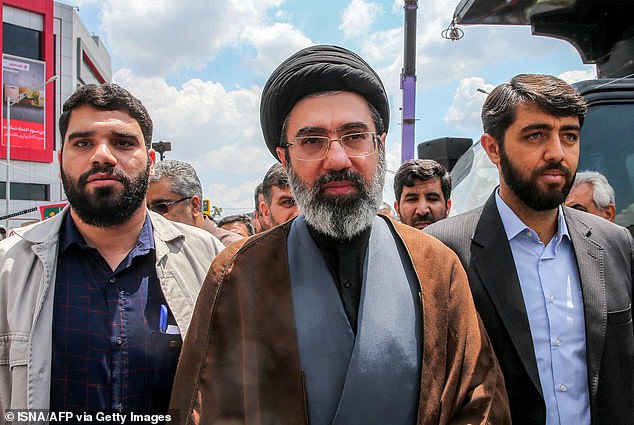
British Muslims have a +22 net favourability rating towards the hardline dictatorship in Tehran while for the general population this is -42. Pictured: Iran’s supreme leader Mojtaba Khamenei

British Muslims are ‘notably more hostile’ towards the US and Israel with net negative favourability ratings of -41 and -52. Pictured: US President Donald Trump
It found that 17 per cent of the public considered the US and Israeli strikes on Iran to be ‘definitely wrong’ compared to 50 per cent of British Muslims.
And while neither the US or Israel is popular with the public – with net negative favourability ratings of -16 and -22 respectively – British Muslims are ‘notably more hostile’ towards the two countries with favourability ratings of -41 and -52.
Beyond the conflict in the Middle East, Muslims in the UK are also generally ‘less hostile’ towards countries opposed to British values such as China and Russia, the poll found.
China has a favourability rating of -22 among the public while for Vladimir Putin’s Russia this is deep into negative territory at -52. By comparison British Muslims have a net positive +22 view of Beijing and a +2 view of Moscow.
Dr Rakib Ehsan, the author of Worlds Apart: British Muslim Attitudes on the Iran Conflict, said the data shows that modern Britain is ‘anything but on the same page’ with its views.
‘As well as being notably more hostile towards the United States and Israel, British Muslims hold much warmer feelings towards Iran than the wider public do,’ he said.
Join the debate
Do YOU think attitudes towards Iran, the US and Israel are becoming more polarised in Britain?

British Muslims have a net positive +22 view of Beijing and a +2 view of Moscow

Beyond the conflict in the Middle East, Muslims in the UK are also generally ‘less hostile’ towards countries opposed to British values such as China and Russia
‘Part of their overarching anti-Americanism is their dramatically less negative views on China and Russia, revealing a broader scepticism of Western geopolitics.’
There are also differences between the general public and the UK Muslim population in terms of where they are getting their information on the Iran conflict.
While the wider public largely relies on legacy broadcast news, almost a quarter of British Muslims are getting news on the conflict from Qatari-owned Al Jazeera.
Some 26 per cent of Muslims in the UK are getting their news on Iran from Instagram and 27 per cent from TikTok. This drops to just 10 per cent and 11 per cent for the wider public, the poll found.
Compared to the general population, Muslims in the UK are also more likely to obtain information on the Iran conflict from WhatsApp (by 14 per cent compared to 5 per cent), and from podcasts or YouTube commentators (by nine per cent compared to three per cent).
Dr Ehsan added: ‘The relatively youthful British Muslim population is also different to the wider public in how they get their news and information on the Iran conflict, relying more than the general population on “non-legacy” sources in the social-media sphere such as Instagram and TikTok.’