



Summary
- Sound is impressively clear and musical with flexible EQ and useful listening modes.
- Comfortable C-clip fit, long battery (~7.5-8h) and fast 3-min quick charge for 1h playback.
- Great tap controls and app extras; mic lacks warmth, no wireless charging, tragus tap gimmicky.
When I first began reviewing open-ear earbuds, I wrote an opinion piece on why I would choose transparency mode on a pair of ANC earbuds five days a week and twice on Sundays, over open-ears. The Sony LinkBuds Clip shows just how far open earbuds have come since that piece a couple of years ago.
The open-ear sound is very good, the device’s tap functions are solid, and the app has some great features! But you’re paying flagship prices here, so let’s take a closer look and see why you might want Sony’s implementation of C-shaped clip-ons to be your next open earbuds.


4.3/5
- Battery Life
-
9 hours
- Charging Case Included?
-
Yes
- Microphones
-
AI voice pickup unit (VPU)
- Brand
-
Sony
- Solid battery life
- Very comfortable, C-shape design
- Comes with sizers to customize fit
- 10-band EQ
- No wireless charging
- Tragus controls are finnicky
Price, availability, and specs
Available for purchase as of January 21st, 2026, the Sony LinkBuds Clip is priced at $230 USD / $300 CAN at Sony.com, Amazon, Best Buy, and other authorized retailers. You can pick up a pair in Black, Greige, Green, or Lavender.
- Battery Life
-
9 hours
- Charging Case Included?
-
Yes
- Microphones
-
AI voice pickup unit (VPU)
- Brand
-
Sony
- Supported codecs
-
SBC, AAC
- Bluetooth
-
5.3
- IP Rating
-
IPX4
- Solo bud mode?
-
Yes
- Driver Size
-
10mm
- Charging type
-
USB-C, no wireless
- Dimensions and weight (earbuds)
-
6.4g x2
- Dimensions and weight (case)
-
42g
- Colors
-
Black, Greige, Green, Lavender
- Compatibility
-
Android, iOS, Window, Mac
- Max talk time
-
4 hours
- Charging time
-
Earbuds ~1.5hrs, Case ~3hrs; 3-minute charge = 1 hour playback
- Multipoint support
-
yes
- Frequency range
-
20 Hz – 20,000 Hz (44.1 kHz sampling)
What I liked about the Sony LinkBuds Clip
Excellent comfort, solid battery life, smart features

Let’s kick this off with some housekeeping! I don’t want to spend the entirety of this review lamenting the differences between open-ear and ANC earbuds. In terms of audio quality, there’s no intellectually honest comparison. Comparing the two is like comparing a standard submarine to one with a built-in screen door. Part of what makes sound quality so good on earbuds that seat in your ears is exactly that: they’re in your ear canal and form a good seal so that sound doesn’t escape. Open earbuds, on the other hand, are designed to let other sounds into your ears, so their audio fidelity is intentionally compromised for that purpose.
With that out of the way, I have to say that the Sony LinkBuds Clip sound very good! I tested them against my favs, the Bose Ultra Open Earbuds, which I’ll get to in a bit. The LinkBuds Clip arrives in minimal packaging, with no charging brick or USB-C charging cable included. You’ll get just the earbuds, color-matched sizing inserts, and manuals. The sizing inserts, or Air Fitting Cushions, clip onto the earbuds’ bands to help provide a tighter fit for those with small ears. I have a huge melon and decent-sized ears, so I didn’t need them.
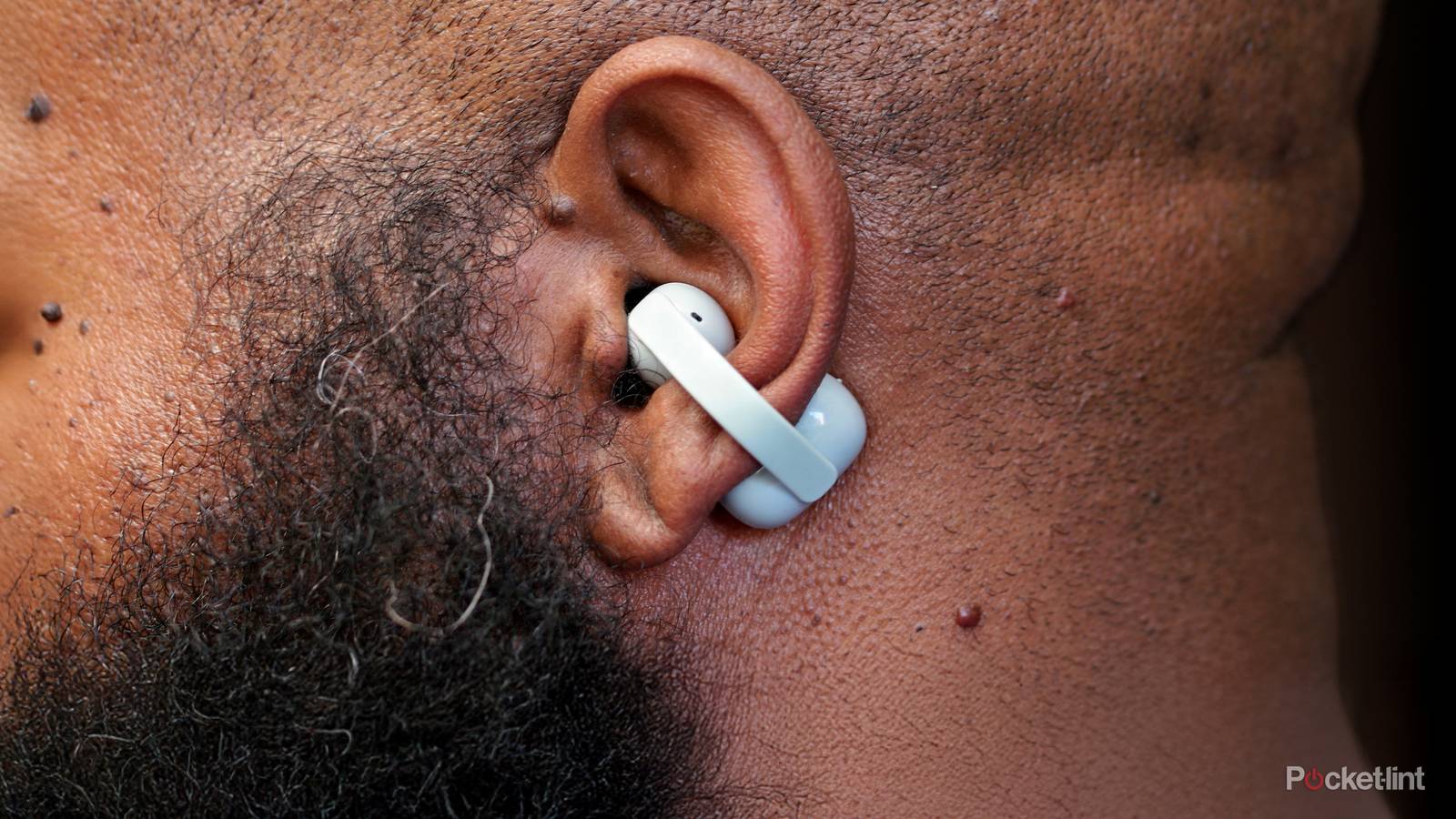
These are C-shaped clip-on earbuds with cylindrical portions connected by a band that wraps around the fleshy part of the ear, called the “Helix.” You can control playback and calling by tapping the wraparound band of the earbuds or the back of the larger cylinders that sit behind your ears. Repeatedly tapping that band lets you increase or decrease the volume, with the left side reducing it and the right side increasing it. This is an awesome feature because many earbuds still require you to touch your phone to adjust the volume.
Then, there’s the option to tap on the ear’s tragus, that fleshy part between your cheek and your ear canal. It’s a somewhat gimmicky interaction that works inconsistently, but when it does, it’s a great way to control certain functions!
Clipped in for comfort and sound
I’ve worn the LinkBuds Clip for hours without any discomfort, but you’ll need to dial in the fit properly to find the right position to achieve that. I noticed that having them sit certain ways does get fatiguing after a time, but finding the sweet spot makes for comfortable, long-wearing listening.
When you set up the LinkBuds Clip in the Sony Sound Connect app, you have access to a few sound customizations and optimizations. After I began my testing, Sony rolled out a firmware update that added even more options to that list. For your listening modes, you’ll get:
- Standard: use this mode with EQ off, or play with the seven preconfigured EQ settings, which include a 10-band Manual mode for on-the-fly adjustments and two Custom EQ settings that let you save two of your own custom configurations.
- Voice boost: bypasses any EQ settings and increases the gain of higher-frequency sounds in your music. Careful here, as some tracks with bright vocals, drum snares, etc., may get a bit fatiguing.
- Sound leakage reduction: ultimately softens the music to reduce leakage, so it may not be ideal in loud settings. Think of this one as a “library mode” for listening in quiet environments. It really makes the audio muddy, though, so it’s my least favorite setting here.
- Background music: This mode was added after the firmware update and makes your music sound as if it’s coming from behind you. It does exactly what its name implies, and I’ve found it quite enjoyable in quiet environments when I’m working and literally want some background focus music.
With those listening modes and the 10-band EQ covered, let’s talk about actual listening! The soundstage is pretty constricted, given the open-ear aspect, but the instrumentation and stereo imaging are quite compelling. Listening to my test track from Charles Mingus, “Moanin’,” there’s a surprising amount of discreet imaging with the instrument placement. I experienced similar listening enjoyment with Jamiroquai’s “Starchild” and Herbie Hancock’s “Watermelon Man.”
In loud, urban environments, listening to vocal-heavy songs like Joni Mitchell’s “River (With French Horns) [Blue Sessions],” the Voice Boost mode works wonders for pushing the vocal clarity forward, but that’s the upside. The downside is that there are sections of her song when she hits the high notes, and it definitely gets fatiguing. Listening to The Roots “Do You Want More?!!!??!”, there’s a wicked snare drum hit that also gets fatiguing.

Overall, the sound signature and customization options make for a delightful listening experience with the Sony LinkBuds Clip. These won’t be a bass-lover’s dream, but they’ll deliver open-ear sound that is clear, musical, and has admirable detail retrieval, despite using only the SBC and AAC codecs, with no access to a higher-resolution codec like Sony’s own LDAC.
In busy, noisy urban environments, I recommend using the 10-band EQ to customize your own “vocal boost” mode that won’t make high frequencies harsh.
A couple of Sony Sound Connect extras that I really enjoyed were the voice cues that tell you the time every hour on the hour, and when you use scene-based listening for the first time on a given day, the earbuds speak the date and weather conditions. You can also set voice cues to read out notifications from a list of apps on your phone.
The “Walking,” “Running,” and “Gym” scene detection features work too well. I had to turn off the “Walking” scene detection because it was so sensitive that it kept starting the chosen playlist when I walked from my apartment to my car in the parking lot. Every time. Since running is more intentional, that was never a bother, and the gym scene can be set up to be location-based, which means granting the app location permissions. If you’re comfortable with that, it works flawlessly.
Short note: The Adaptive volume control function that was added after I’d finished my review period, and as I began writing this, seems promising but will require further testing. It dynamically adjusts the volume of your sound to balance out background noise while keeping decibels within a healthy range for your hearing protection.
The battery life has been very good. Especially compared to the closest rival, the Bose Ultra Open Ear earbuds. And getting one hour of playback on three minutes of quick charging is great in a pinch! With the addition of Adaptive volume, I’ll have to see how that constant leveling affects the battery. So far, I’m getting around 7½ to 8 hours of continuous playback, while Sony claims up to 9 hours. The volume at which you listen and certain features like increasing the bass gain in the EQ, will affect the battery life.
What could use some improvement?
Not much, but there are some items

Part of the functionality on offer here is tapping your ear’s tragus to trigger certain features, but I’ve used that feature since the original LinkBuds came out, and it’s largely a gimmick for me because it’s unreliable.
I wasn’t too impressed with the microphone call quality. It wasn’t bad, but my voice lacks warmth and sounds a bit distant from the microphone. I’d like to see Sony improve this aspect of the earbuds in future updates, given that they say AI is enhancing call quality.
$230 earbuds should have a wireless charging case in 2026. Cheaper competitors have it, and at flagship prices, it should be included.
Should you buy the Sony LinkBuds Clip?
A tough call, frankly

There is a lot of great competition in the open-earbud, clip-style subcategory these days. Add in the on-ear variety of open earbuds, and that competition becomes steeper. There are less expensive open-ear options from Nothing and Soundcore that give Sony a run for its money, and the Bose Ultra Open Ear earbuds are more immersive, but with worse battery life for $70 more, so it’s really going to be a game of dollars and comfort.
I find that the clip-on style is more comfortable for extended wear and offers better open-ear sound than competing traditional open-ear products, which place the speakers over your ear canals. Those tend to block out more sound than the clips do in my experience. Before buying the Sony LinkBuds Clip, you should check out the clip competition and try each for yourself to see which style’s clip implementation feels best on your ears and for your wallet.
- Battery Life
-
9 hours
- Charging Case Included?
-
Yes
- Microphones
-
AI voice pickup unit (VPU)
- Brand
-
Sony
- Supported codecs
-
SBC, AAC
- Bluetooth
-
5.3