



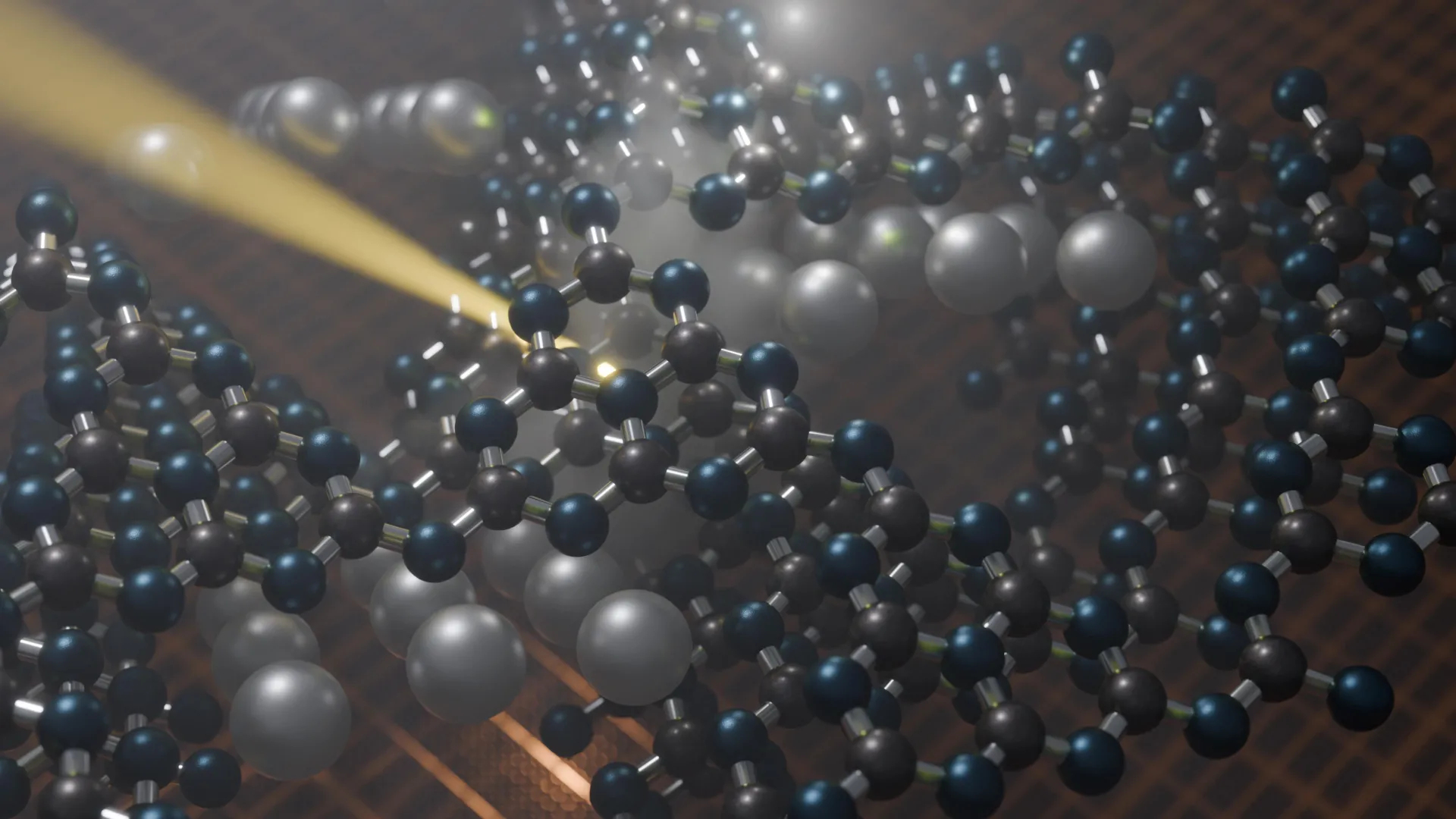
Photocatalysis offers a promising way to convert the vast supply of sunlight into useful chemical energy. Among the materials attracting growing attention are polyheptazine imides, which have structural and functional features that make them particularly effective for photocatalytic reactions. Until recently, scientists had only limited insight into how changes in their structure influence their electronic and optical behavior across the many possible materials in this family.
Researchers led by a team at the Center for Advanced Systems Understanding (CASUS) at Helmholtz-Zentrum Dresden-Rossendorf (HZDR) have now introduced a dependable and reproducible theoretical approach to tackle this problem. Their predictions were validated through measurements on real material samples. The team believes this advance could significantly accelerate research on polyheptazine imides and spark rapid growth in the field.
Carbon Nitride Materials and Visible Light Absorption
Polyheptazine imides belong to the broader class of carbon nitrides. These materials consist of layered structures that resemble graphene but are built from nitrogen rich ring shaped molecular units.
While graphene is known for exceptional electrical conductivity, it does not function well as a photocatalyst. Polyheptazine imides differ in a crucial way. Their electronic band gaps allow them to absorb visible light, which makes them suitable for sunlight driven chemical reactions.
Carbon nitride materials also offer several practical advantages. They are relatively inexpensive to produce, non toxic, and thermally stable. However, early versions of these materials did not perform well as photocatalysts because their internal properties limited effective charge separation.
When a photon strikes a material, it can excite an electron and move it away from its original position, leaving behind a positively charged hole. If the electron quickly recombines with the hole, the energy is released only as heat or light instead of driving chemical reactions.
“Polyheptazine imides containing positively charged metal ions exhibit markedly improved charge separation. This feature renders them highly suitable for practical applications,” says first author Dr. Zahra Hajiahmadi.
Computer Modeling Speeds the Search for Better Catalysts
Improved materials are needed to unlock the economic potential of several photocatalytic processes. These include water splitting (to produce hydrogen as a fuel), carbon dioxide reduction (to produce basic carbohydrates as fuels or industrial chemicals), and hydrogen peroxide production (as a basic industrial chemical).
Designing a polyheptazine imide catalyst that performs well for a specific reaction requires careful control over many aspects of its structure. Creating and testing every possible material candidate in the laboratory would be unrealistic. Computational methods therefore play an essential role in narrowing down the possibilities.
“The design space is enormous,” explains Prof. Thomas D. Kühne, Director of CASUS, head of the CASUS research team “Theory of Complex Systems” and senior author of the study. “One can for example add functional groups on the surface or substitute specific nitrogen or carbon atoms with oxygen or phosphorus atoms.”
Kühne’s research group is developing advanced numerical techniques designed to be both efficient and capable of accurately reproducing the chemical and physical behavior of complex materials.
Systematically Testing 53 Metal Ions
A defining feature of polyheptazine imides is the presence of negatively charged pores within the material. These pores can host positively charged metal ions, which can significantly enhance catalytic performance.
Hajiahmadi’s work represents the first comprehensive investigation of how different metal ions influence the optoelectronic properties of these materials. The study examined 53 metal ions in total, categorizing them according to where they sit within the structure (in plane or between layers) and how they alter the geometry of the material (resulting in a distortion or not).
“We used a reliable and reproducible computational framework that goes beyond conventional modeling approaches,” says Hajiahmadi. “Standard computational studies of photocatalysts typically focus on ground-state properties and neglect excited-state effects, despite the fact that photocatalysis is inherently driven by photoexcited charge carriers. Specifically, we employ many-body perturbation theory methods.”
These methods begin with a simplified model system that does not include particle interactions. Interactions are then added as small corrections, allowing researchers to approximate how large numbers of particles affect each other. Although such calculations require substantial computing power and are rarely applied in this field, the new study demonstrates their value. The framework provides an accurate description of how these materials absorb light and how their electronic structure behaves under illumination.
Experiments Confirm Theoretical Predictions
Using their computational approach, the researchers explored how different metal ions alter the structure of the polyheptazine imide network. Their analysis revealed that introducing ions can cause measurable structural changes, including shifts in the spacing between layers and modifications to local bonding environments. These structural variations directly influence the electronic band structure and optical properties of the materials, affecting how efficiently they capture light.
To test their predictions, the team synthesized eight polyheptazine imide materials, each incorporating a different metal ion. The materials were then evaluated for their ability to catalyze hydrogen peroxide production.
“The results clearly showed a high degree of agreement to our predictions and outperformed competing calculation methods,” Hajiahmadi concludes.
Kühne adds: “If there was some doubt about polyheptazine imides being one of the most promising platforms for next-generation photocatalytic technologies, I believe this work put them to rest. The path toward the targeted design of efficient polyheptazine imide photocatalysts for sustainable reactions is clearer now. I firmly believe that it will be taken often and successfully.”