



The latest Resolve poll highlights a deep breakdown in voter confidence towards the major parties, with both the Coalition’s and Labor’s primary votes falling below 30 per cent.
There is no sugarcoating this: the public are registering a strong protest vote against both major Australian political parties. Sick and tired of their spin, failures and inability to effectively lead.
One Nation is the chief beneficiary, as its support continues to rise, up two points to 24 per cent, according to the latest poll.
Nearly one in every four voters is registering support for Pauline Hanson’s minor party, doubling its support over the past 12 months and giving it the opportunity to vie for major party status, if it can maintain that support come election time.
It’s hard to escape the conclusion that Pauline Hanson’s frank talk is a major contributing factor to her party’s steady rise. Hanson is an anti-politics politician, who ironically has been in and around politics for three decades now.
That consistency makes her a known commodity, and therefore an easier place to park a protest vote against the major parties. It might also contribute to voter forgiveness for when she goes too far with some of her rhetoric and antics.
Resolve has Labor’s primary vote on just 29 per cent, dropping three points in the past month. The Coalition’s woes continue, with its support down one point to 22 per cent, now a smaller vote share than One Nation.
The fact One Nation is now level pegging with the major parties is extraordinary when you compare the extent of the party infrastructure that supports the Coalition and Labor parliamentary teams.

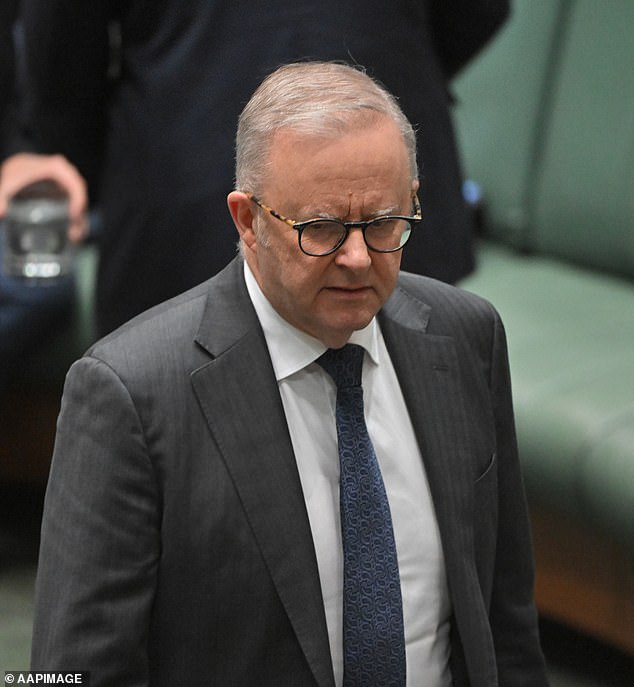
Australian voters are having small parties over Labor and the Coalition (pictured is Labor leader, Prime Minister Anthony Albanese)
Their party organisations, at state level as well as federally, dwarf the extra-parliamentary support One Nation has at its disposal. It’s too simple for the major parties, and parts of the media, to comfort themselves with the idea that this is simply a right wing flare up that will burn itself out.
The evidence of shifting voting patterns points to something broader: we may be witnessing the greatest threat to the dominance of the two party system in this country. That is, if the polling support for the minor party translates on election day.
This coming weekend will see South Australians head to the polls for their state election. Labor are overwhelming favourites, the real test will be whether One Nation can become the official opposition in the election’s aftermath. Remembering that One Nation is at its weakest in a state like SA.
Federally, One Nation is heavily drawing votes from the Coalition, but it’s also attracting support away from the Labor Party. And the numbers suggest that it is branching out from the regions and Queensland, where One Nation’s support has traditionally been at its strongest.
The minor party will be hoping to seriously contest outer metropolitan electorates as well as regional electorates and Senate seats at the next federal election. Where it doesn’t win representation, One Nation preferences will play an important role in which major party does win seats.
With cost of living pressures at the forefront of people’s minds, voters are penalising the incumbent Labor Party for the difficulties they face. However, that protest vote is landing with One Nation and other minor parties and independents (Greens and teals) rather than the Opposition, as traditionally occurs.
It’s a sure sign that the dysfunction within the Coalition since the 2025 election thumping is now threatening its electoral viability.
But polling well and winning seats at elections are not the same thing. One Nation can build a large primary vote nationally and still struggle to convert that into lower house victories if it can’t do preference deals to help it secure over 50 per cent support in individual seats.

One Nation has been the lead beneficiary of Aussies’ favour towards smaller parties (pictured is One Nation leader Pauline Hanson)
While One Nation’s support has surged into the mid-twenties, there is a sense that the overwhelming majority of the community wouldn’t countenance a vote for Hanson or her party.
That sentiment, if true, might prevent voters delivering the minor party preferences ahead of alternatives on ballots.
The Senate is easier terrain for One Nation, because a smaller statewide vote can translate into seats under proportional representation.
Minor parties only need 14 per cent support after preferences are distributed to win Senate seats. On its current numbers that’s well below the party’s primary support.
The House of Representatives is much harder for small parties, because after preferences a party needs more than 50 per cent support. This has always been a barrier to entry for minor parties seeking to expand their representation to lower houses, especially if they struggle to attract more centrist voters.
The Coalition has expressed a willingness to do preference deals with One Nation, however there is no guarantee that Labor will do the same. Equally, some voters might not be inclined to blindly follow party preference recommendations when it comes to One Nation, for reasons already canvassed.
To win lower house seats, Hanson’s party needs to win more primary votes than at least one of the major parties and then attract their second and third preference votes to leapfrog to more than 50 per cent support.
It may be more likely that One Nation struggles to win seats despite its large primary support, but the growth of its support prevents the Coalition from regaining seats it otherwise hoped to win. Preventing it seriously contesting for government against Labor.
While Labor needs to worry about losing support to One Nation, it would take comfort from the emerging fight between the Coalition and Hanson’s party. New Nationals leader Matt Canavan has signalled plans to target One Nation in a bid to revive his party’s fortunes.
While that might be necessary for the Nationals to survive, the warring between fellow right-wing parties makes it harder for the Coalition to compete for government.
Staving off threats from One Nation risks pushing the Coalition further to the right to narrow the space within which Hanson and her team can foment discontent. This makes it harder for Liberals to win back inner-city seats, whether that’s against teals or the Labor Party.
It’s possible that one day Liberals and One Nation work together to form government, possibly in the aftermath of the demise of the Nationals, for example.
But in the here and now, the more likely scenario at the next election will see these right-of-centre parties scrapping over the leftovers of opposition, leaving an unpopular government with a record low primary vote to dominate at the election anyway.