



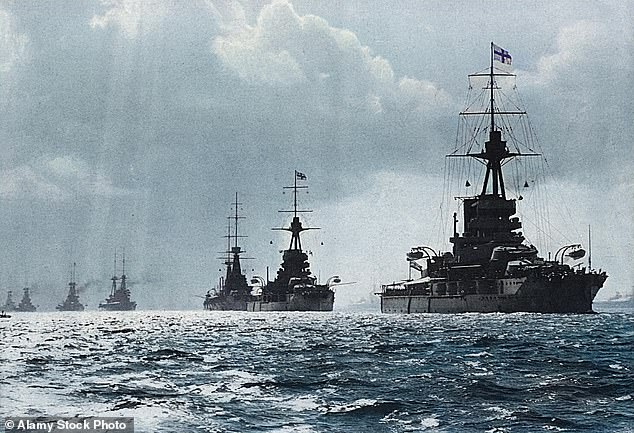
In July 1914, with the world on the brink of war, King George V reviewed just some of the ships standing ready to protect Britain in the maelstrom that was brewing. From the deck of the royal yacht, he watched as 59 battleships and dozens of cruisers and destroyers steamed through Spithead off the Isle of Wight in line astern at a steady 16 knots. Only half the active service strength of the Royal Navy was assembled. It still took six hours for the column to pass.
Once again the world is in a dangerous place. But if King Charles were to review those fighting ships of his Navy that are in a fit state to protect our interests today the same exercise would take 11 minutes.
No measure of how shrunken Britain has become is quite so poignant or so telling as the decline to virtual insignificance of our once mighty and prestigious Navy.
In 1914, Britain had by far the largest fleet the world had ever seen, capable of projecting power to every corner of the globe. Those were the days when the world map was awash with red ink and the sun never set on the Empire. Even 44 years ago, with Britain in palpable decline, Margaret Thatcher’s government could still summon up a fleet the sight of which would have had Rudyard Kipling reaching for his pen.
I saw it myself in the spring of 1982 as a young war correspondent in the anchorage of Ascension Island where the grey hulls of aircraft carriers, destroyers and frigates stretched to the horizon, loaded with the Paras and Marines who would go on to liberate the Falklands. That was the last time that the Navy could muster the strength for such a feat – an amphibious operation 8,000 miles away on the other side of the Atlantic Ocean. Nowadays, if the French were minded to seize Jersey, the challenge of finding the ships to carry a force to expel them would probably be beyond the Senior Service.

The Navy in 1914, when Britain had by far the largest fleet the world had ever seen, capable of projecting power to every corner of the globe, writes Patrick Bishop

The 44-year-old minesweeper HMS Middleton returns from the Gulf earlier this week for a major inspection after her safety certificates expired, just as Iran began lacing the Strait of Hormuz with mines
You do not have to be an Empire nostalgist to weep at the pitiful state of today’s Navy. There are currently 63 ships ostensibly on active service, fewer than half those available in 1982. The most potent surface units are the newish aircraft carriers Prince of Wales and Queen Elizabeth, six Type-45 guided missile destroyers and seven Type-23 frigates. Below the waves are ten nuclear powered submarines, four of which can launch ballistic missiles.
In addition are various mine countermeasures, patrol and survey vessels. Despite mounting threats from Russia, and Cyprus in Tehran’s sights, only half of those ships are combat ready.
The Queen Elizabeth has been plagued by technical problems since going into commission in 2017 and two years ago had to withdraw from a large Nato exercise because of a major fault in a propeller shaft. She is currently in dry dock in Rosyth, Scotland, undergoing six months of essential repairs.
All but three of the subs are also non-serviceable. Of the six destroyers, HMS Dragon is finally on its way to the Med. HMS Duncan and Dauntless are available. The other three are in ‘deep maintenance’. Of the seven frigates, three to five are operational.
Those that are in action seem often be in the wrong place at the wrong time. When the Greenland crisis broke earlier this year it transpired that the nuclear-powered attack submarine HMS Anson was heading in the wrong direction, en route to a deployment in Australia. This week came the bleakly comical news that the 44-year-old minesweeper HMS Middleton had returned to Blighty from the Gulf for a major inspection after her safety certificates expired, just as Iran began lacing the Strait of Hormuz with mines.
Who is responsible for this dismal underperformance? The top brass – of whom there are an abundance, with 40 admirals now compared with 53 in the glory days of 1982 – must take some share of culpability. Not least of the charges against them was their acquiescence in the Blair government’s decision to commission two enormous and vastly expensive carriers rather than a host of smaller and nimbler ships.
The choice was always controversial. ‘Instead of six Ferraris we could have had 100 BMWs,’ one retired naval officer has lamented. The Navy’s flat-footed reaction to the Iran crisis has done nothing to vindicate the gamble. No one can blame the 38,000 men and women of the Royal Navy who continue to do their duty cheerfully and efficiently despite all the difficulties.
The real villains are the politicians. Successive governments have all been guilty of reflexively slashing defence budgets when economies were needed, taking no heed of the threats that have been looming ever larger on the horizon since the turn of the century.
Communism had not long collapsed when it became clear that the end of the Cold War did not mean the dawn of eternal peace but the start of a different sort of conflict. Globalisation has only increased our vulnerability. Official complacency has been enabled by an indulgent America, which – until Donald Trump – was prepared to foot most of the bill for Europe’s defence. This has resulted in a continuous erosion of the military budget to the point where the Navy is now threatened with irrelevance.
Conservative and Labour governments have been allowed to get away with it by a self-deluding British public reluctant to regard defence spending as a pressing priority and still unwilling to acknowledge the dangers inherent in today’s fractious and unstable global environment.
European allies like France have faced the same budgetary pressures and succumbed to the same wishful thinking. However they have reacted much more convincingly to the new realities. President Emmanuel Macron has put Keir Starmer to shame with his swift decision to despatch the French fleet’s sole carrier Charles de Gaulle to the eastern Mediterranean while the Prime Minister dithered about sending the Prince of Wales – and then decided not to.
Depressing though the decay of the Royal Navy may be, this is not just a story about numbers in a Ministry of Defence inventory. It also tells us much about the transformation of national attitudes and how Britain sees itself in the world.

I saw in 1982 how the grey hulls of aircraft carriers, destroyers and frigates stretched to the horizon, loaded with the Paras and Marines who would go on to liberate the Falklands
For centuries, the Royal Navy was a central pillar of our island nation. Sea power was at the heart of the country’s wealth and the instrument that gave it enormous influence way beyond its size and population. The Navy was what made Britain great.
Naval officers were an exalted caste and the most successful commanders household names, revered by the population. There have been more pubs named after Horatio Nelson, the hero of Trafalgar than any other historical figure.
The respect in which the Navy was held was underpinned by a recognition of geographical fundamentals. Britain’s safety depended on command of the surrounding seas. And Britain’s prosperity rested on control of the ocean trade routes that fed our wealth.
There was also widespread acceptance of a harsh historical truth. It was famously stated by the 19th-century statesman Lord Palmerston that ‘we have no eternal allies, and we have no perpetual enemies. Our interests are eternal and perpetual, and those interests it is our duty to follow’.
These realities have been denied by recent generations of politicians. They have forgotten the crucial link between sea power and security. And they have allowed the illusion of human progress to blind them to the atavistic impulses that lurk under the surface of apparently civilized nations.
Britain’s pathetic belief that its relationship with America is ‘special’ was always a fantasy. Each week Donald Trump provides stinging reminders of the truth of Palmerston’s words.
It was not a mistake that the French president Charles de Gaulle ever made. It was thanks to his suspicion of America’s good intentions that he insisted that France have its own wholly independent ‘Force de Frappe’ nuclear deterrent. Sixty-six years on, his misgivings have proved fully justified. Poland and Germany are now scrambling for a place under the French nuclear umbrella in the belief that if it comes to a showdown with Russia, America cannot be assumed to have their backs.
We do not have that luxury. Piggybacking on American might has led to a crippling reliance on their technology. A British prime minister can theoretically launch a nuke without Washington’s permission. But the Trident missiles with which our submarines are equipped are supplied by the US.
A misguided strategy in recent years of siding with America, right or wrong, in a bid to big ourselves up on the world stage has made us look like stooges, and scarcely won much respect from Washington.
Any fundamental rethink of our security strategy must be built on the principles that underpinned the policies that made Britain an unlikely world power in the first place. Recent events prove again that you cannot be taken seriously if you lack a strong Navy.
China understands this very well. It can command up to 400 warships, making it the most numerous fleet in the world, against the 290 to 300 operated by the US Navy (although the larger ships of the American fleet mean it has almost double the tonnage). At the same time, we must jettison for ever the nonsense of the ‘special relationship’ and accept we can never henceforth take American goodwill for granted, regardless of whoever follows Trump into the White House.
A new strategy based on old principles is pointless without the vast amounts of money needed to back it up. That will require a conversion in the Government’s credo on a par with St Paul’s on the road to Damascus. Vacillating, historically ignorant and incapable of coherent strategic vision, Starmer and his crew are patently lacking the purpose, will and moral muscle for such an enterprise.
It is not entirely their fault. The society that brought them to power bears its share of guilt. Brits still admire the military and are endlessly nostalgic about the Second World War.
There is little enthusiasm though for paying for a proper Army, Air Force and Navy, let alone for joining up.
Recruitment and retention in all services have been a struggle for decades and particularly in the Navy, which in 2023-2024 achieved only 60 per cent of its recruitment target compared with 65 per cent for the Army and 70 per cent for the RAF. A life on the ocean wave has lost its appeal if it means long absences from partners, family and friends.
There is a bigger problem. Social research suggests that young Brits are generally resistant to the idea of military service.
In this, the country is out of step with our neighbours in Europe. In polls last year nearly 50 per cent of French men and women under the age of 30 said they were ready to sign up and serve if war broke out compared with only 11 per cent of Britons.
The heady days of the Spithead review are gone forever and given our status as a medium-sized power it would be foolish to wish them back. But we are in sore need of a small but properly functional Royal Navy. Without a sea change in government policy and public attitudes, we are not going to get one.
Patrick Bishop’s North Cape: The Navy’s Last Great Sea Battle will be published next year.