



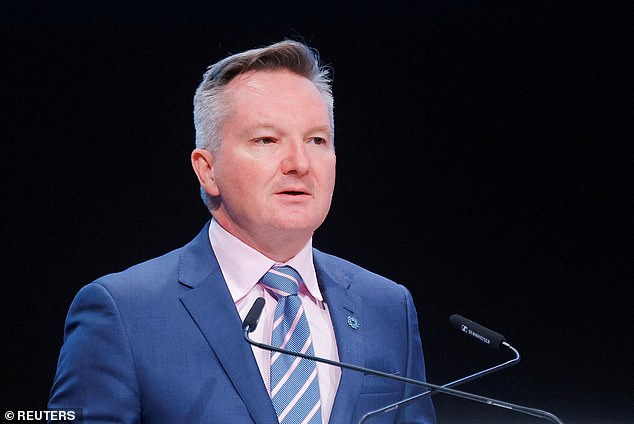
Energy Minister Chris Bowen has lowered national fuel stockpile requirements for Australian petrol companies to make it easier for them to release supply to regional areas.
Under the new rules, the required stock of diesel will drop from 2.7 billion litres to 2.2 billion litres, while petrol stock requirements will fall from 1 billion litres to 700 million litres.
‘The minimum stock obligation, which was introduced by the Albanese government in 2023 for this purpose, for, if you like, the rainy day, is now necessary,’ Bowen said.
‘This will enable the fuel companies to more flexibly manage their supply chain. This fuel will not be released immediately.
‘I will be having conversations, and have had conversations over the last 24 hours, and we’ll have more with the fuel companies about ensuring that this flows to regional Australia.’
The price of Brent crude, the US oil benchmark, surged to more than $100 a barrel on Friday (AEDT) amid reports Iran had been laying mines in the Strait of Hormuz – a key trade route for oil from the region.
The conflict in the Middle East effectively closed the Strait of Hormuz, the gateway for about 20 per cent of global gas and oil shipping, leaving tankers idle for over a week and forcing producers to halt pumping while storage facilities were cleared.

Energy Minister Chris Bowen has lowered national fuel stockpile requirements for Australian petrol companies to make it easier for them to release supply to regional areas

An oil tanker burns after being hit by an Iranian strike in the ship-to-ship transfer zone at Khor al-Zubair port near Basra, Iraq, late Wednesday, March 11, 2026. (AP Photo)
Images verified by Reuters emerged overnight of ships engulfed in orange fireballs in Iraqi waters after an apparent escalation in Iranian attacks.
Iran’s new Supreme Leader Mojtaba Khamenei, who took over from his father Ayatollah Ali Khamenei, has said the Strait will stay closed to maintain pressure.
‘The lever of blocking the Strait of Hormuz must continue to be used,’ he said on Thursday.
The federal government has relaxed quality standards for the next 60 days to boost the domestic market with an extra 100 million litres of fuel per month, allowing fuel with higher levels of sulphur to be used.
Bowen’s announcement came after he refused to guarantee that Australia would not experience fuel shortages amid the conflict in Iran.
‘A national crisis is a time for leadership on both sides of the House,’ Bowen told parliament on Thursday.
‘Do I think if a fishing company can’t get access to diesel for that fishing, do I think it’s a crisis? Yes, I do.’
His comments follow reports that fishing trawlers are struggling to secure diesel.
Pavo Walker, the CEO of Australia’s largest wild‑caught tuna and swordfish company, said many vessels in his fleet are finding it increasingly difficult to obtain fuel.
‘The eastern seaboard of Australia is running out of fuel, no one can guarantee us any fuel for our fishing vessels,’ he said.
‘We’ve got no fuel, so we can’t go to sea and we can’t catch fish.’
Bowen said regional areas were experiencing shortages in fuel due to rising demand, rather than supply issues.
He said panic buying was contributing to the issue.
‘We recognise fully that in regional areas in particular, there are shortages in particular areas, and that the supply chain is under huge pressure, as we have seen a massive increase in demand,’ he told parliament.
‘The rush to buy fuel is unprecedented, outstripping the surge at the outbreak of the Russia-Ukraine war in 2022.’
The minister said in some cases bulk customers were buying four times the amount of fuel they normally purchased.
Meanwhile, the International Energy Agency has warned that the Middle East war has plunged the world into an even bigger oil crisis than in the 1970s.
The 1970s saw the West punished by Arab nations, furious with America’s support for Israel, with a crippling oil embargo.
‘The war in the Middle East is creating the largest supply disruption in the history of the global oil market,’ the IEA said in its monthly report.
It comes as analysts at US bank Goldman Sachs predicted that oil prices could hit $150 a barrel in the event of prolonged disruption.