




Image source: Getty Images
Rolls-Royce (LSE:RR) shares motored to a new record at the end of last month, reaching an intraday high of 1,420p. This followed the FTSE 100 engine maker’s full-year 2025 results, which were excellent.
Two days later however, the US and Israel began bombing Iran, sending the FTSE 100 down sharply. The Rolls-Royce share price has now pulled back to 1,292p, as I type, a fall of around 9% from its high.
I’ve been waiting for a dip to consider buying more shares. Is this the opportunity I’ve been waiting for?
The platform’s burning no more
It’s no secret that Rolls-Royce stock has been a mind-bogglingly good investment in recent years. In fact, nothing comes remotely close to matching its return since March 2021.
| Five-year return (excluding dividends) | |
| Rolls-Royce | 1,040% |
| Babcock International | 448% |
| BAE Systems | 362% |
| Airtel Africa | 324% |
| Fresnillo | 285% |
Of course, these other firms listed weren’t on the brink during Covid, so this explains some of the outperformance. Yet there’s no denying that CEO Tufan Erginbilgiç has done an amazing job extinguishing the flames on what he called the “burning platform” (ie the old Rolls-Royce).
Last year, the company’s underlying operating margin reached 17.3%, up from 10.3% in 2023. Bear in mind the original target back in 2023 was for an operating margin 13%-15% by 2027. So it has obliterated that goal two years early!
Meanwhile, free cash flow came in at £3.27bn, up from £1.26bn in 2023. And the balance sheet is far less of a concern these days, with gross debt reduced from £3.6bn to £2.8bn last year.
In a show of confidence in its financial future, Rolls-Royce announced a massive multi-year share buyback programme, totalling £7bn-£9bn from 2026 to 2028.
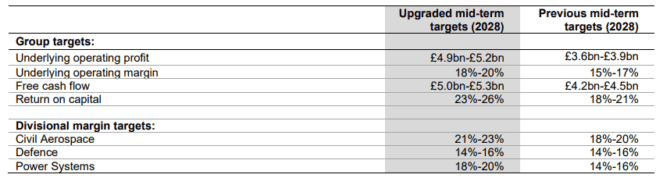
Finally, the mid-term targets were upgraded (yet again).
Optionality
I first bought Rolls-Royce shares in mid-2023 at 149p, then added again in 2024 at 475p and last year at 624p. The thing that attracted me was that the engineering firm appeared to have multiple avenues of growth. Often called optionality, this is something I look for in investments.
At its core, Rolls’ Civil Aerospace division should benefit from the rise of long-haul travel. Plane maker Airbus projects a need for 9,170 new widebody aircraft over the next 20 years, including both passenger planes and freighters.
Meanwhile, massive military budget hikes across Europe should bolster the Defence unit. Last year, Rolls-Royce secured lucrative aftermarket contracts worth more than £1.5bn with the Ministry of Defence and the US Department of War.
Then further out there are small modular reactors (SMRs), which will be necessary for nations aiming to reach net zero targets. The company’s unique nuclear capabilities makes it well-placed to become a global leader in this massive emerging market.
One area I underestimated was the Power Systems division, which is growing strongly due to soaring power generation demand driven by AI data centres.
Buy more shares?
So I’m more than happy with what I see financially and operationally here. But what about the valuation?
Unfortunately, the forward price-to-earnings ratio is 36. Here, I think the stock is priced for perfection. But with war raging in the Middle East, flights being diverted, and global supply chains already strained, we’re sadly not living in a perfect world.
For me then, I see better opportunities in the FTSE 100. But if Rolls-Royce keeps dipping, I’ll reassess.