

Last January, in a rousing speech delivered at University College London, Sir Keir Starmer heralded the beginning of an artificial intelligence (AI) revolution.
If ‘fully embraced’, he claimed, the new technology would pump an extra £47 billion into the British economy every year – more than 80 per cent of the Ministry of Defence’s annual budget, or almost 25 per cent of a year’s NHS spending.
‘In a world of fierce competition, we cannot stand by,’ said the PM. Paraphrasing Facebook’s now-abandoned motto – ‘move fast and break things’ – he concluded: ‘We must move fast and take action to win the global race.’
An accompanying press release contained the rather odd sentence: ‘Today’s plan mainlines AI into the veins of this enterprising nation.’
Central to this new injection were two huge investments promised by private companies pledging to spend billions building critical new ‘data centres’ to host the powerful computers used by AI models.
Rather than merely writing students’ essays for them, putting people out of work or creating ‘deepfake’ pornography, AI – thanks to these new data centres – finally looked set to deliver tangible economic benefits to Britain.
A year on from Sir Keir’s speech, however, a bombshell new investigation has exposed these private company pledges so far to be a sham: ‘phantom investments’ that aren’t worth the paper they were written on.
The two AI firms at the centre of the scandal are London-based start-up Nscale and American outfit CoreWeave. Both, incidentally, have close business ties to the monolithic, $4.5trillion AI chip-manufacturer Nvidia – currently the most valuable company in the world.

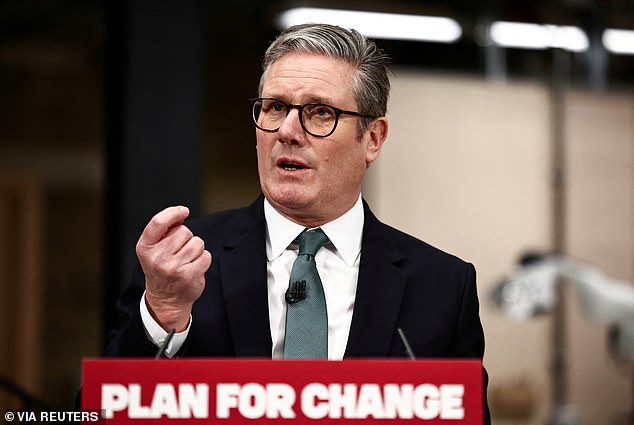
Keir Starmer delivering a speech during a visit to the Manufacturing Futures Lab at UCL last year
To coincide with the PM’s speech, Nscale promised a £2.5 billion investment to build a single new data centre in Loughton, Essex, while CoreWeave had previously pledged £1 billion to build two new data centres – one near Gatwick Airport in West Sussex and another in the Docklands area of east London – during the tenure of ex-Tory PM Rishi Sunak.
But let’s begin with Nscale, which announced on Monday that it had signed ex-deputy PM Nick Clegg to its board (Clegg parted company with Meta, the company that owns Facebook, in 2024, having pocketed at least £24 million from his six years there).
Clegg’s new job – where he’ll be joined by his fellow ex-Meta executive Sheryl Sandberg – was announced to coincide with a fresh £2 billion cash injection into the firm, valuing it at a hefty £14.6 billion and making it, on paper at least, one of Europe’s AI success stories.
And yet an investigation by the Guardian newspaper has found that Nscale’s flagship data centre project in Loughton, Essex, hasn’t even begun construction. Last January, as part of its £2.5 billion investment, it was announced Nscale would build ‘the largest UK sovereign AI data centre’ on the site. A press release ‘confirmed’ the purchase of the Loughton premises, claiming the site would be ‘live’ by the fourth quarter of 2026.
Data centres are the backbone of AI, with their immensely powerful computers connecting to form a ‘supercomputer’ capable of processing vast amounts of data. Imagine an A-level student picking up their iPhone to ask ChatGPT – one of the world’s most popular AI models – a question such as: ‘Why did the First World War start?’
Enormous quantities of data need to be crunched not only to answer that question, but also to engage in what could be a lengthy follow-up discussion between the student and the AI. That crunching happens in data centres all over the world.
Unless Britain builds its own hubs, we will never be a major player in AI. (We are already at a huge intrinsic disadvantage thanks to the Net Zero crusade, which has left us with some of the most expensive electricity in the developed world.)
The Nscale facility was considered particularly significant because – as a ‘sovereign’ operation – it was intended to service British institutions, businesses and government operations rather than overseas clients.

Plans for the AI data centre in Loughton, Essex. It was set to be ‘the UK’s largest sovereign AI data centre’
According to Nscale’s own timetable, construction should therefore be well under way on the enormous climate-controlled warehouse in Loughton to house the servers destined to power Britain’s AI ambitions. Instead, a year on, a local scaffolding firm is currently using the site for storage. Less tech-hub, more scrapyard.
More intriguingly still, Land Registry records appear to suggest that Nscale is not in fact the registered owner of the premises, raising doubts over whether the promised data centre will ever be built at all.
A year on from celebrating that alleged £2.5 billion investment, the Government appears increasingly sheepish on the subject. In a statement to the Guardian, it weakly described Nscale’s previous commitment as ‘not a formal contract, rather an intention to commit capital’ insisting that the figure was published by the company.
For its part, Nscale denies scaling back its plans. A spokesman says: ‘As a UK-headquartered company, we remain committed to the UK investment we announced.’ They add that the Loughton project is ‘progressing as we envisaged. We’re investing not only in the site itself but also in offsite power infrastructure, local contractors and local suppliers.’
And then there’s CoreWeave, founded in New Jersey in 2017 and which started life as ‘Atlantic Crypto’, an operation ‘mining’ the cryptocurrency bitcoin.
In May 2024, then-PM Rishi Sunak described CoreWeave as ‘the future of AI innovation’, claiming the firm’s new £1 billion investment in British data centres would ‘further cement the UK’s position as an AI and tech superpower’ (Sunak now works as an ‘adviser’ to AI firm Anthropic).
Then-culture secretary Michelle Donelan said in perfectly clear terms the supercomputers at Gatwick and the Docklands would bring ‘two new data centres to our shores’ – and, at the end of 2024, CoreWeave duly announced the new data centres were operational.
However, planning records suggest that precisely zero new datacentres have been built at either of those locations. It emerges instead that the facilities were not ‘new’ at all: they were in fact built in 2002 and 2015 respectively, had long been operational and had been leased by tech giants including Google and Fujitsu.

A year on from the announcement, a local scaffolding firm is currently using the site for storage
Rather than building its own data centres, then, CoreWeave had instead merely rented existing space. To describe this sleight of hand as a communications fudge would be to put it lightly.
According to Cecilia Rikap, professor of economics at University College London: ‘The rules [on companies announcing investment] are very flexible and help [AI firms] to make these big claims and investments that a government such as Sir Keir’s, which is desperate for good news, can use for their favour.’
For its part, CoreWeave says its method of using existing sites reflects the ‘industry-standard’ approach. In a platitude that could have been written by an AI model itself, the company added: ‘We are delivering advanced, purpose-built AI infrastructure to support the development of AI at scale.’
Next month, the Government is set to deliver yet another bombastic AI announcement: a new £500 million ‘sovereign fund’ for investing in the technology across the country.
It isn’t clear at this stage whether that money, if it ever appears, will go towards building data centres, developing software or funding some other technological purpose.
What we do know is that the Government continues to bang the AI drum at every possible opportunity.
And yet, with private companies seemingly failing to hold up their side of the bargain, the ministers appear to be the only ones marching to its beat.