

The Kremlin has warned that ‘the end of the world is upon us.’
Vladimir Putin’s spokesperson Dmitry Peskov hit out at a breakdown in ‘international law.’
The doom-laden warning for the planet came amid massive US and Israeli strikes on Iran, which the Kremlin labelled a ‘perfect storm.’
Russia appears helpless to assist Tehran except possibly in providing intelligence on American and Israeli military positions.
Putin’s mouthpiece said: ‘There have been worse things in human history… but we weren’t alive then, so it seems to us that the end of the world is upon us.’
Amid the war in the Middle East, Putin, who illegally invaded Ukraine four years ago, believes ‘we have all lost what we call international law’, said Peskov.
‘To be honest, I don’t even understand how anyone can call on others to follow the norms and principles of international law. It no longer exists.’

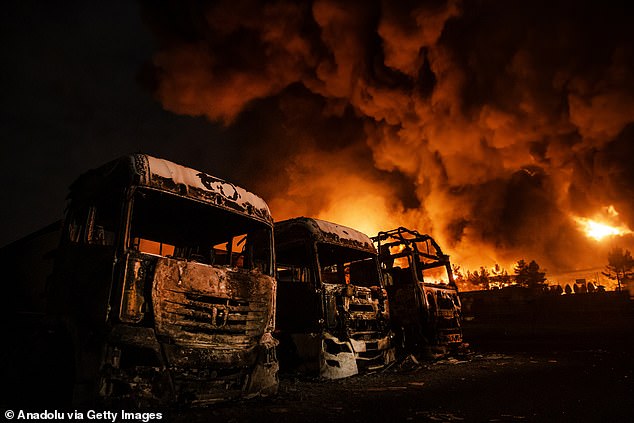
Fire breaks out at the Shahran oil depot after US and Israeli attacks, leaving numerous fuel tankers and vehicles in the area unusable in Tehran, Iran on March 8, 2026

The Kremlin has warned that ‘the end of the world is upon us’.

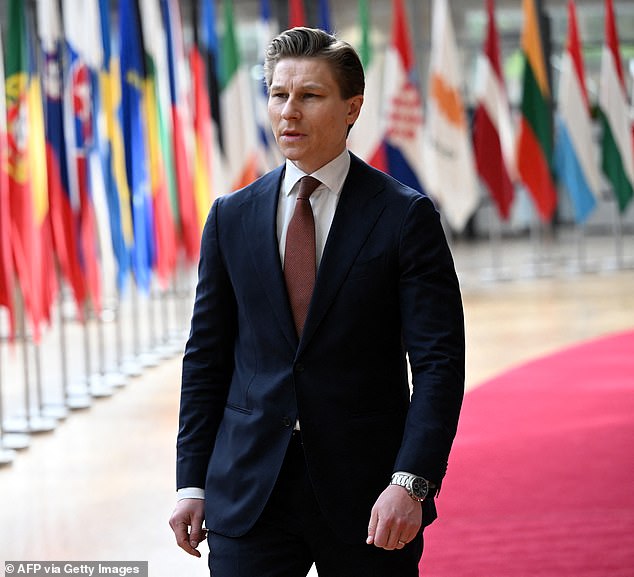
Vladimir Putin’s spokesperson Dmitry Peskov (pictured) hit out at a breakdown in ‘international law’
‘It is unlikely that anyone can now formulate what law has replaced international law….No one can provide a clear definition,’ said the Russian dictator’s spokesperson.
‘Therefore, Putin is correct. Against the backdrop of this perfect storm that has now begun, we need to focus on ourselves, our interests, and our potential.
‘Where it is lacking, we need to build it up, think carefully, and remain focused.’
Today, Putin pledged ‘unwavering support’ to Iran’s new supreme leader, Ayatollah Mojtaba Khamenei, appointed after his father and predecessor was killed in US-Israeli strikes.
‘I would like to reaffirm our unwavering support for Tehran and solidarity with our Iranian friends,’ Putin said in a message to Khamenei, adding that ‘Russia has been and will remain a reliable partner’ to Iran.
‘At a time when Iran is confronting armed aggression, your tenure in this high position will undoubtedly require great courage and dedication,’ the Russian leader said.
It comes as the war in the Middle East caused an enormous spike in the price of oil, as the cost of a barrel rocketed to above $100 for the first time in years.
An emergency meeting of the G7 has been called for today, where firefighting options including the release of oil reserves – held back for crises such as this – will be discussed.
The main issue is the near-total closure of the Straight of Hormuz, through which around a fifth of the world’s oil travels, which means major uncertainty hangs over short-term supply.
Iran’s Revolutionary Guard has threatened to ‘set ablaze’ any Western tanker that attempts to navigate the strait, and hundreds of ships laden with oil, as well as liquefied natural gas, have amassed either end of it.

A thick plume of dark black smoke lingered in Tehran on Sunday after heavy Israeli airstrikes on an oil depot
For the first time since war broke out, the effect of this disruption was felt reflected acutely in the markets, when the price of a barrel of Brent crude shot up almost 24 percent.
It took just a minute for the price to rise by 10 percent, and 15 minutes for another 10 percent, seeing it surge beyond the $100 mark for the first time since the early days of Russia’s invasion of Ukraine in 2022.
Petrol prices at the pump are also likely to spike as the higher cost filters through to consumers.
UK Chancellor Rachel Reeves will attend an emergency meeting of G7 finance ministers at 1:30pm GMT, chaired by France, to address the economic fallout of the war.
The ripples from war in the Middle East are already being felt in Europe, with rising energy prices and NATO allies targeted, EU chief Ursula von der Leyen said today.
‘We are now seeing a regional conflict with unintended consequences. And the spillover is already a reality today,’ the European Commission president told EU ambassadors, ahead of a midday call with Middle Eastern leaders.
‘Our citizens are caught in the crossfire. Our partners are being attacked,’ she said, citing an Iranian-made drone hitting a British base on EU-member Cyprus, trade disruptions and the ‘displacement of people’.
While Iran has not officially shut off the Strait of Hormuz – through which a fifth of the world’s crude supplies and a substantial amount of gas run – shipping through the critical waterway has all but dried up.
European gas prices also jumped as much as 30 percent Monday, albeit remaining well below the peaks reached in the aftermath of Russia’s 2022 invasion of Ukraine.
Von der Leyen stressed that ‘there should be no tears shed for the Iranian regime’.
‘The people of Iran deserve freedom, dignity, and the right to decide their own future – even if we know this will be fraught with danger and instability during and after the war’.

A ‘river of fire’ engulfed Tehran following heavy Israeli shelling on the city overnight on Sunday
The ‘longer-term impact’ of the war posed ‘existential questions’ on the future of an international rules-based system and the 27-nation’s bloc place in the world, she told the annual gathering of European Union diplomats in Brussels.
‘The idea that we can simply retrench and withdraw from this chaotic world is simply a fallacy,’ she said.
Von der Leyen also addressed the Ukraine conflict and assured the gathering that Brussels will see through a vital 90 billion euro ($104 billion) loan to Kyiv that is being blocked by Hungary.
‘We will deliver on our commitments, because our credibility – and more importantly, our security – is at stake,’ she said.