



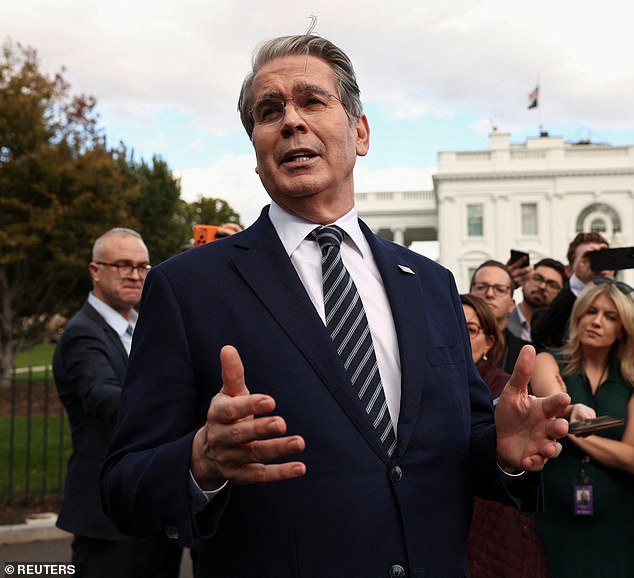
The US is preparing to unleash its ‘biggest bombing campaign yet’ against Iran tonight, Treasury Secretary Scott Bessent warned, with strikes expected to hammer the regime’s missile factories.
In just one week, tensions in the Middle East have spiraled, beginning with a deadly joint US-Israel military operation against Iran.
The strikes killed Supreme Leader Ayatollah Ali Khamenei, prompting Tehran to launch relentless retaliatory missile and drone attacks on US military bases across the Gulf region.
On Friday, Bessent told Fox Business that America is gearing up for its most intense wave of strikes so far in the war against the regime.
‘Tonight will be our biggest bombing campaign, and we’ll do the most damage to the Iranian missile launchers, the factories that build the missiles, and we are substantially degrading them,’ the secretary revealed.
He said Iran has failed to make headway on the military front against what he called the US’s ‘overwhelming’ strikes, forcing the regime to pivot to the economic battlefield.
‘Having not been able to succeed there militarily, they’re trying to create economic chaos, and I don’t think they’re going to be able to do it,’ he told Fox.
Bessent suggested Iran could escalate by targeting the world’s energy lifeline, the Strait of Hormuz, to disrupt global oil and gas flows.

Treasury Secretary Scott Bessent (pictured) said its on Friday that the US will launch its ‘biggest bombing campaign yet’ against Iran

Tensions in the Middle East have spiraled since the deadly joint US-Israel military operation against Iran (pictured: strikes hit Tehran on March 6)

Bessent said America is gearing up to target Iranian missile launchers and the factories that build the missiles (pictured: US Air Force B-1 Lancer bomber is worked on by military personnel)
He cautioned that closing the critical waterway, which carries roughly 20 percent of the world’s oil and gas, could wreak havoc and send energy prices soaring.
‘When the conflict began, insurers dropped all the insurance for any vessels going in and out of the Strait of Hormuz or generally around the Gulf,’ Bessent explained.
The rising tensions have made sailing through the strait increasingly dangerous, with private insurers initially refusing to cover ships or dramatically hiking premiums due to war-related risks.
President Donald Trump has since ordered war-risk insurance for American ships in the Strait of Hormuz, so US vessels and their cargoes remain protected in the case of destruction.
On Tuesday, Trump assured the US Navy that it could begin escorting oil tankers through the strait if necessary, according to Reuters.
The war in West Asia has only continued to drive oil prices higher, with Brent crude reaching $93.32 a barrel as of March 7, 2026.
In response, the president pledged that the US would guarantee the free flow of energy worldwide, asserting the country’s military and economic power is the greatest on Earth.
In a move to reassure shipping companies, the International Development Finance Corporation (DFC) said Wednesday it will offer up to $20 billion in insurance.

Bessent warned that Iran could escalate the war by targeting the Strait of Hormuz (pictured in 2025) to disrupt global oil and gas flows

Bessent said Iran is failing to make headway on the military front against what he described as the US’s ‘overwhelming’ strikes (pictured: aftermath of strikes in Tehran, March 4)

Trump ordered war-risk insurance for American ships in the Strait of Hormuz so US vessels remain protected from destruction
‘What this program will do is give shippers insurance, whether they are hauling oil, products, fertilizer,’ Bessent explained, according to Fox Business.
He said Iran claims the Strait of Hormuz is open, but is blocking ships linked to US or Israeli interests from passing through.
Since the strikes began, nearly ten vessels have been hit in Gulf waters, and Iran’s Guard has ordered ships not to cross the vital strait.
But Iranian Revolutionary Guard Corps spokesperson Ali Mohammad Naini challenged Trump’s plan to deploy naval vessels in the strait on Friday, warning they are ‘awaiting their presence.’
‘Iran strongly welcomes the escort of oil tankers and the presence of US forces for the crossing of the Strait of Hormuz. And we are, by the way, awaiting their presence,’ Naini said, according to state media.
‘We recommend that, before making any decision, the Americans remember the fire on the American supertanker Bridgeton in 1987 and the oil tankers that were recently targeted,’ he added.
Bessent said that US vessels will now have to be safeguarded while navigating the Iranian-controlled waterway.
‘There is a willingness to go through the strait if we also provide a naval escort if needed,’ he told Fox Business.

An intelligence report concluded a large‑scale US assault on Iran would be ‘unlikely’ to topple the Islamic Republic’s leadership, WSJ reported (pictured: aftermath of strike on girls school in Iran)

Bessent (pictured with Trump) said that Iran claims the Strait of Hormuz is open, but won’t allow ships linked to US or Israeli interests through

Findings found Iran would likely respond to the Supreme Leader’s death by following protocols to preserve the regime (pictured: March 6 Iranian protest against US and Israel)
He vowed to address the issue, stressing that vessels from Iran and China have continued to navigate the strait safely.
‘We will await to hear from CENTCOM in terms of when they think safe passage is possible,’ Bessent told the outlet.
‘I don’t know whether it’s a week or two weeks, but we are on track to get this solved,’ he added.
Meanwhile, a classified report by the National Intelligence Council found that even a large‑scale US assault on Iran would be unlikely to topple the Islamic Republic’s entrenched military and clerical leadership, according to The Washington Post.
Three people familiar with the findings told the outlet that Iran would likely respond to Khamenei’s death by following protocols aimed at preserving the regime instead of allowing it to collapse.
While Trump has stood firm on the attack, the report raised doubts about the US’s ability to ‘clean out’ Iran’s leadership structure.
His administration initially said the strikes were intended to take out Iran’s nuclear capabilities, but in recent days has demanded ‘unconditional surrender.’
The president has made it clear that he wants a say in Iran’s leadership, telling NBC News: ‘We want them to have a good leader. We have some people who I think would do a good job.’

Pictured above is the site of an Israeli airstrike that targeted an area in the southern costal city of Tyre on March 7

The White House told the Washington Post that the Iranian regime is ‘being absolutely crushed’ (pictured: smoke from explosion in Tehran, March 6)

Iran has the largest and most varied missile arsenal in the Middle East, with thousands of ballistic and cruise missiles (pictured: debris of missile fired from Iran toward Israel)
But experts told the outlet that the NIC report coincides with how the Islamic Republic of Iran operates.
Holly Dagres, a senior fellow at the Washington Institute for Near East Policy, told the publication that bending the knee to Trump would go against ‘everything they stand for.’
Suzanne Maloney, an Iran scholar and vice president at the Brookings Institution, agreed with the assessment: ‘There’s no other force within Iran that can confront the remaining power that the regime has.’
Meanwhile, the White House maintained Trump’s position in a statement to the Washington Post, claiming that the Iranian regime is ‘being absolutely crushed.’
Iran, the 17th largest nation in the world, has continued advancing longer-range missile technologies, often building on its space-launch program.
It has the largest and most varied missile arsenal in the Middle East, with thousands of ballistic and cruise missiles, some capable of striking as far as Israel and into eastern Europe, according to the Center for Strategic and International Studies.
To date, the country has not tested or fired a missile with the range to strike the US.
Still, Iran has spent years advancing missile accuracy and lethality, turning its growing arsenal into a potent means of projecting power and threatening American military positions in the region.