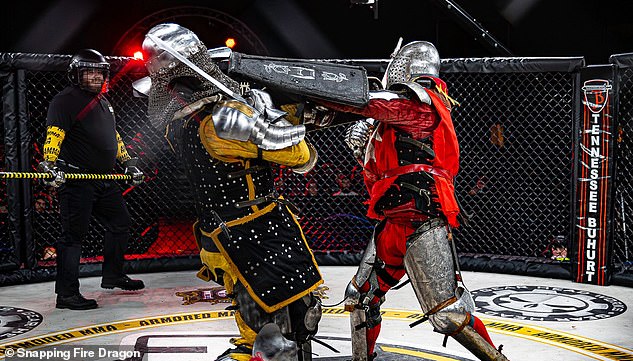
Growing up, plenty of us played the role of knight battling our friends, with sticks often used as swords and, if you were fortunate enough, an old bin lid as a shield.
As adults, life takes over. However, Armored MMA allows those who are not done with their childhood fantasies to live out the dream in a safe environment.
A version of the sport of Buhurt, whereby participants fight whilst wearing armour accurate of medieval times and with blunt weapons, Armored MMA is beginning to get traction around the world with combatants inside a cage, similar to those used in the UFC and the like.
Mickey Guida launched the AMMA league in Nashville, Tennessee just a few years ago as restrictions put in place during the Covid Pandemic began to relax.
The sport has come a long way from its modest origins in Europe with Buhurt.. The weapons may be blunt, but the risk is still very real.
‘On a day-to-day basis, we can hit really hard and it’s not gonna hurt as much as a light sparring day in MMA, judo or Muay Thai,’ says Guida. ‘I’m less likely to get a broken nose, cauliflower ear, anything like that.

Competitors use their weapons to battle and almost anything goes

Founder Guida believes Armored MMA is less dangerous than MMA
‘You can train harder, with more safety. But is it more or less dangerous? Probably less. But the risk of something going terribly wrong is there. If my helmet comes off at the wrong time, you do a backhand hammer fist to my face, I might be dead. That’s a pretty high risk.
‘In the cage, if you follow the rules, if you have the right regulations, it’s all good. My armour came off my knee and before the referee saw that, I was hit in the knee twice and it took me out for a year. The tragic failures can happen but they’re low percentage compared to the daily damage you get in MMA.
‘The biggest different between this and regular MMA is there are no submissions with us. We’re working towards maybe armlocks, leg locks but there’s no way we would allow choking. With the metal around your arm, you could crush a windpipe pretty quickly. We punch, kick, throw knees, we allow some striking zones such as the back of the head, knees to the face while you’re on the ground, but the other difference is the weapons, of course.’
With celebrity interest from the likes of Arnold Schwarzenegger and Tom Hardy, it is no surprise to see that participation in the combat sport has rocketed in the last few years, with Guida taking his team of fighters on tour around the USA this year to put on shows in arenas.
With scoring systems in place to encourage striking rather than holds, which is overseen by four referees, as well as one inside the ring with the fighters, Guida is delighted to see how much his own organisation has grown since the days of training fighters in his back yard – literally.
‘I think more people are more interested in medieval stuff now. Fantasy has always been around, but there’s tonnes and tonnes of people using medieval for their marketing, brands and stuff like that.

Competitors wear a suit of armour that weighs 50lbs plus
‘It’s picking up, especially at renaissance fairs,’ he says. ‘After the pandemic, we saw a big uptake in renaissance fair attendance in the United States anyway.
‘I gave it a shot, realised there’s a lot of athleticism, martial arts and things you should need to be good at it. Then I travelled around the country training, brought the information back and started to teach people on my back porch.
‘Once I had enough students, we were sick of fighting in the rain, so put together some money, got a gym, but it’s big and expensive to own and operate, so we started doing events with $5-10 tickets.
‘We got 200 people showing up every week for 43 shows in the first year on Wednesdays. We moved to a bigger venue down the street, just one show each month for a year and then took a chance with the arenas.
‘I was competing towards the end of the pandemic, and once the restrictions lifted, we started looking for a gym then moved into it.
‘A lot of people took breaks during the pandemic so that gave me a chance to access more people that way as beginners. I didn’t have an MMA or martial arts background, so it was good to get in at that time.’
With a range of fight types – solo as well as a number of team options – and weight classes going from featherweight to titanweight (300lbs+), everyone really is welcome.
Unlike their MMA counterparts, Guida believes that having ‘a little bit of fat on you’ is of benefit to any fighter as it helps absorb some of the blows. However, being encased in a 50lb+ suit of metal quickly depletes the energy stores.
With Guida training fighters out of his own gym in Nashville, there are six registered armoured combat gyms in the United Kingdom.
The American admits that no background in MMA is required to be successful in the sport, with his own preference in teaching complete novices.
‘The athleticism, training, mentality from an MMA background would be beneficial but the skillset? No,’ he admits.
‘I can teach someone to fight in armour who has never done anything outside of it a little bit faster because, in MMA, there are a lot of bad habits that those fighters have to get over.

Armoured combat is banned in some states but Guida insists it can be safe
‘They’ve seen millions of reps about being an arm’s length away from your opponent, but now it’s an arm’s length and three feet away, where a jab to the face doesn’t hurt. The gas tank is different, your grappling is different, visibility is different… it’s so different I’d rather someone didn’t have that background.’
The next thing for Guida is making the sport legitimate and recognised by the governing bodies, among those Buhurt International and the International Medieval Combat Federation, while also turning it into a spectacle where those involved can make enough money from the sport.
Although armoured combat has been banned in some states, Guida is still campaigning to show that it can be a safe, legitimate business.
By compiling his own evidence of what other organisations are doing and where improvements can be made, he hopes that one day he and his fighters can earn a living doing what they love.
‘There’s a couple of leagues – Buhurt International, IMCF – that have regulations in place for all their different styles,’ he says.
‘I’ll be going to Hungary at the Buhurt International World Championships because my team did well in the US so my team is going to fight there and represent the USA.
‘They’ve done 20 years of this, they know the helmet needs to be 2.5mm thick, we can’t do this, we can’t do that.
‘They have the authenticity committee, which forces you to wear historically accurate armour and whatnot. So we abide by that but we allow for safety modifications.

Fighters clash in the arena with blunt swords and shields
‘But we are starting to tip away from the thickness protocols as, historically, the helmets were 1.8mm-2.2mm thick.
‘We’re reaching out to some universities about doing concussion protocol studies to see if we’ve made a mistake.
‘The organisations do a poor job of regulating the armour. They tell you to wear it but they’re not checking it.
‘You’ll buy a helmet from a blacksmith, wear it in a tournament and it could get punched because of poor tempering or something like that. So we’re trying to regulate it so we can make it as a sport where we can give certifications to armour manufacturers or weaponsmiths so that you can’t bring random things to fights.
‘The sport has been banned in a few states already. We don’t want to just put on shows. If we can go legalised, we can put on shows anywhere. We can have gambling, sponsors love it.
‘But the other regulation needs put in place where people can lose their jobs for calling fights the wrong way.
‘There have been times where I’ve told my teams if they’re fighting somewhere that they can’t let it go to the judges because the team hosting has allowed cheating for their team.
‘So I am collecting videos, reports and all sorts of evidence from these different leagues that have been popping up since our success, to go to BI and IMCF, to show what they consider safe for themselves and their audience compared to what we do because we want to stop this type of thing.’