



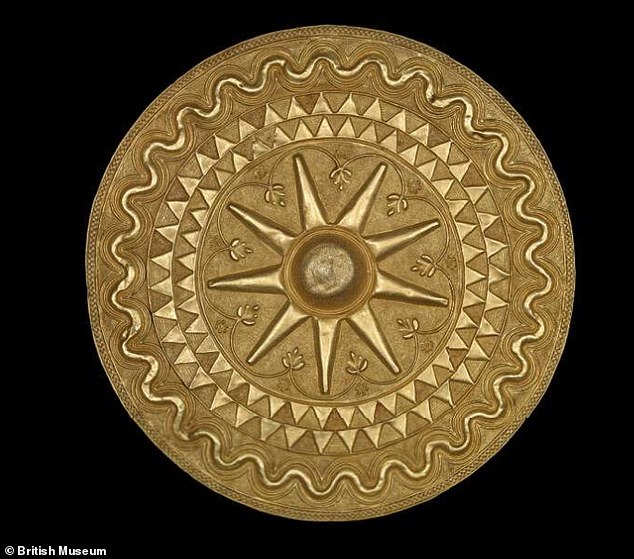
When a striking Asante gold disc in the British Museum was stolen from its wooden display case in 1991, it had apparently disappeared without trace. But, over the next few years, it was in fact exhibited by leading museums and sold by a famous auction-house – with none of their respective experts realising that this was the same stolen object, it has now been revealed.
The scandal has been exposed by historian Barnaby Phillips who says that, although the British Museum reported the 1991 theft to the police, they had no idea that the disc was ‘being hawked around’ the museums of Europe and the United States and had been auctioned by Sotheby’s. He had been tipped off about the case by an informed source.
The theft took place in October 1991 from the then Museum of Mankind, which housed the British Museum’s Department of Ethnography between 1970 and 1997. A warder doing his rounds one lunchtime was shocked to find that a wooden display case had been prised open, apparently with a screwdriver discarded at the crime scene.
Mr Phillips has discovered that, by 1994, the disc was in the hands of Karl-Ferdinand Schaedler, a leading German collector of traditional African art, who died in 2024. He had proudly featured it in his glossy publications and loaned it to at least two museums, including Vienna’s renowned Museum für Völkerkunde.
The collector then decided to sell it through Sotheby’s in 1999, when it was bought for a few thousand pounds by the Indianapolis Museum of Art. The prized acquisition inspired the logo for the museum’s 2002 festival of African art and even appeared on specially-printed T-shirts.
That was when Doran Ross, a respected scholar of Ghanaian art at the Fowler Museum in California, spotted its similarity to the stolen object and alerted London colleagues.
Decorated with a distinctive sun pattern, this is the largest of the British Museum’s Asante soul discs, or akrafokonmu, with a diameter of 21.5 centimetres. Thought to have been created in the early 20th century, and possibly presented by Europeans to an unknown Gold Coast chief, it was donated in 1925 by Sir Bignell Elliott, a timber merchant from Kentish Town in north London.
Mr Phillips, a former BBC correspondent, reveals the case in his new book, titled The African Kingdom of Gold: Britain and the Asante Treasure, which is published on Thursday.

Decorated with a distinctive sun pattern, this is the largest of the British Museum’s Asante soul discs, or akrafokonmu, with a diameter of 21.5 centimetres

When a striking Asante gold disc in the British Museum (pictured) was stolen from its wooden display case in 1991, it had apparently disappeared without trace
He told the Mail: ‘What has never been reported is what happened to the Asante gold or the fact that it had gone missing for over a decade. Nobody has reported that it was hawked around museums in Europe and the United States and was auctioned.’
Instead, he adds, this ‘awkward business was settled as quietly and diplomatically as possible’. As the Indianapolis Museum had purchased the disc in good faith, the British Museum trustees agreed to loan it for the duration of their exhibition.
Mr Phillips says: ‘The British Museum quietly dressed it up as a loan to the Indianapolis Museum.’
In 2002, the disc was returned to the British Museum, whose webpage ‘was disingenuously updated in 2025 to include the Indianapolis and European museum ‘loans’ but makes no mention of the theft’, Mr Phillips notes. ‘The British Museum got it back through sheer good fortune.’
He asks: ‘What diligence did Sotheby’s do on the collection it sold in 1999?

Mr Phillips, a former BBC correspondent, reveals the case in his new book, titled The African Kingdom of Gold: Britain and the Asante Treasure, which is published on Thursday
‘It is difficult to say who comes out of this story the worst: Karl-Ferdinand Schaedler, Sotheby’s or the British Museum. Did Schaedler investigate the provenance of the disc he mysteriously acquired in the early 1990s? He died in 2024 and I was not able to ask him. ‘He was a lovely person, completely honest and would have been horrified if he’d known it was stolen,’ according to… a friend.’
Mr Phillips’s book also reveals that hundreds of 18th-century prints were stolen in broad daylight from the British Museum by a former member of its staff.
These revelations follow the Bloomsbury institution’s 2023 admission that it had sacked a curator over the theft of hundreds of antiquities.
Sotheby’s declined to comment.
The British Museum said: ‘These events occurred decades ago and the object was safely returned to the collection where it remains.
‘Thefts will unfortunately always be a risk for every museum and for this reason we take safeguarding the collection incredibly seriously. Alongside security measures, making the collection more widely known is another way we feel makes it safer and in 2023 we committed to have it fully digitised within five years.’
The Daily Mail asked the American and Austrian museums for comment.